35,000+ smart investors are already getting financial news, market signals, and macro shifts in the economy that could impact their money next with our FREE weekly newsletter. Get ahead of what the crowd finds out too late. Click Here to Subscribe for FREE.
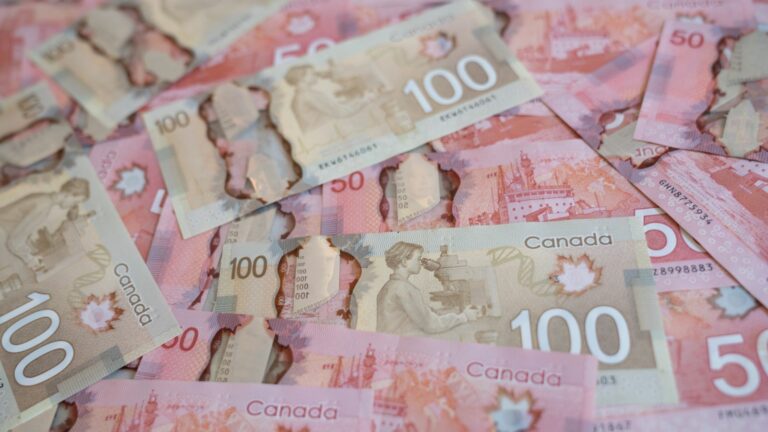
The Canadian dollar has slipped to one of its weakest levels in more than a year and a half, adding another concern for households, businesses, and policymakers already navigating economic uncertainty. On November 23, the loonie traded near 69.5 U.S. cents as falling oil prices, widening interest-rate differences, and unresolved trade tensions with Washington weighed on Canada’s currency. Although the dollar recovered slightly the next day, it remained below 70 U.S. cents. The decline comes as President Donald Trump’s trade policies continue to complicate Canada’s economic outlook, raising questions about investment, manufacturing competitiveness, and cross-border commerce. For Canadians, the consequences extend well beyond currency markets, potentially affecting everything from grocery prices and winter vacations to business expenses and future economic growth.
Canadian Dollar Falls to Its Weakest Level in 19 Months
Canadian Dollar Trades Near 69.5 U.S. Cents as Trump Trade Uncertainty Adds to Economic Pressure
- Canadian Dollar Falls to Its Weakest Level in 19 Months
- Falling Oil Prices Add Another Burden to the Loonie
- Higher U.S. Interest Rates Are Making the American Dollar More Attractive
- Trump’s Trade Negotiations Are Creating More Economic Uncertainty
- Canadian Manufacturers Face Difficult Decisions as Trade Pressures Continue
- A Weaker Dollar Makes U.S. Travel and Imported Goods More Expensive
- Inflation Concerns Complicate the Bank of Canada’s Next Moves
- Some Exporters Could Benefit From the Weaker Canadian Dollar
- Slower Economic Growth Raises Questions About Canada’s Resilience
- The Canadian Dollar’s Next Direction Depends on Trade, Oil, and Interest Rates
The Canadian dollar’s recent decline has brought it to levels not seen since the spring of 2025. On November 23, the currency traded around 69.54 U.S. cents, equivalent to approximately C$1.4380 for one American dollar. It also touched a 19-month low during the session. The weakness came after an extended losing streak, with the loonie heading toward its tenth consecutive daily decline, its longest such stretch since January 2016. Bank of Canada figures showed an indicative daily exchange rate of 69.59 U.S. cents, confirming the broader downward movement.
The currency recovered modestly on November 24, reaching approximately 69.8 U.S. cents during morning trading, but remained significantly weaker than it had been earlier in November. On October 30, the Bank of Canada’s daily reference rate had been 71.63 U.S. cents. That difference may appear small, but currency movements become meaningful when applied to international purchases, corporate contracts, and cross-border investments. The extended decline also reflects a combination of domestic economic concerns and changing expectations about the strength of the American economy.
Falling Oil Prices Add Another Burden to the Loonie
Canada’s currency has historically been sensitive to oil prices because petroleum remains one of the country’s most important exports. When global crude prices decline, the value of Canadian energy exports can weaken, reducing an important source of foreign revenue. This relationship was visible on November 23, when oil prices fell sharply alongside the Canadian dollar. U.S. West Texas Intermediate crude settled at approximately US$80.17 per barrel, down 3.88%, while Brent crude dropped 3.46% to US$89.37. Both benchmarks reached their lowest closing levels in roughly three months.
The latest decline was driven partly by increasing oil supplies from the Middle East and the reopening of a major Libyan pipeline. For Canadian energy producers, especially those operating in Alberta, lower crude prices can reduce revenue even when production remains steady. The U.S. Energy Information Administration reported that crude oil represented 69% of the value of energy trade between Canada and the United States in 2025. However, oil is only one influence on the exchange rate. Global investor sentiment, interest-rate expectations, and trade policy also help determine the loonie’s direction.
Higher U.S. Interest Rates Are Making the American Dollar More Attractive
Another major challenge for the Canadian dollar comes from differences between American and Canadian interest rates. On October 28, the Bank of Canada increased its overnight policy rate by 25 basis points to 2.50%, its first increase since July 2023. Meanwhile, the U.S. Federal Reserve maintained its benchmark target range at 3.75% to 4.00%. This leaves American short-term policy rates substantially higher than Canada’s, creating an incentive for some international investors to favour U.S.-dollar assets.
Scotiabank chief foreign exchange strategist Shaun Osborne identified the widening interest-rate differential as a major factor behind the loonie’s recent weakness. Higher U.S. yields can attract capital seeking stronger returns, increasing demand for American dollars relative to Canadian dollars. The relationship is not automatic, because investors must also consider inflation, currency risk, and future policy changes. Nevertheless, the gap helps explain why the Canadian dollar has struggled even after the Bank of Canada increased borrowing costs. As long as investors expect American interest rates to remain comparatively elevated, the loonie could face continued pressure regardless of short-term improvements in Canadian economic indicators.
Trump’s Trade Negotiations Are Creating More Economic Uncertainty
The unresolved trade dispute between Ottawa and Washington has become another important concern for Canada’s currency. On November 20, U.S. President Donald Trump said his administration was working toward a trade agreement with Canada but acknowledged that additional negotiations were necessary. His comments came after bilateral talks broke down in August, leading to additional tariffs and renewed uncertainty around Canada’s access to its largest export market. Canadian officials have continued pursuing an interim arrangement that could provide relief to industries facing substantial American duties.
The uncertainty is particularly significant for automotive manufacturing, steel, aluminum, and lumber businesses whose operations depend on cross-border trade. Although most trade between Canada and the United States remains tariff-free under qualifying CUSMA provisions, several economically important sectors face additional restrictions. The Bank of Canada’s October monetary policy report estimated that the average American tariff rate on Canadian goods had increased to 7.5%, compared with 5.0% in July. For businesses making investment decisions, the difficulty is not simply the current tariff level. Companies must also consider whether future negotiations will reduce trade barriers or introduce additional costs that weaken their competitiveness.
Canadian Manufacturers Face Difficult Decisions as Trade Pressures Continue
Canada’s manufacturing sector illustrates how currency movements and trade uncertainty can affect businesses differently. A weaker Canadian dollar can make domestically produced goods more affordable for American purchasers, potentially helping exporters compete. However, manufacturers that rely on imported machinery, specialized equipment, or American-made components may face higher expenses. These conflicting effects are especially important in industries with deeply integrated North American supply chains, where parts and finished products regularly move across the border during production.
Recent economic figures show that manufacturing activity remains uneven. Statistics Canada’s preliminary estimate released November 23 suggested manufacturing sales increased 2.3% in October, largely because of higher sales of petroleum and coal products and primary metals. The estimate remains subject to revision and does not eliminate the challenges facing tariff-exposed businesses. The Parliamentary Budget Officer has estimated that trade measures introduced since early 2025 could reduce Canada’s real economic output by approximately 1.4% after five years compared with a scenario without those barriers. Such projections demonstrate why manufacturers must weigh short-term currency advantages against the longer-term consequences of weaker market access and investment uncertainty.
A Weaker Dollar Makes U.S. Travel and Imported Goods More Expensive
For Canadian households, one of the clearest consequences of a weaker dollar is the higher cost of spending money in the United States. At an exchange rate of approximately 69.5 U.S. cents, a US$100 purchase costs about C$144 before currency conversion fees. That matters for families planning vacations, retirees spending winters in warmer states, and Canadians purchasing American products online. Even relatively modest currency movements can add significant costs to hotel reservations, entertainment expenses, and other purchases when spending reaches several thousand dollars.
The effects also extend into Canadian stores. Businesses importing electronics, household appliances, machinery, or consumer products priced in American dollars may face higher purchasing costs. Some companies absorb those increases temporarily, while others eventually adjust their prices. Research published by the Bank of Canada has demonstrated that exchange-rate changes can influence retail prices, although the size and timing of those effects vary considerably. This means a weaker loonie does not automatically translate into an immediate price increase for every imported product. Nevertheless, persistent currency weakness can create additional pressure on consumers whose household budgets are already stretched.
Inflation Concerns Complicate the Bank of Canada’s Next Moves
The Canadian dollar’s decline is occurring while inflation remains above the Bank of Canada’s 2% target. Statistics Canada reported that consumer prices increased 3.1% year over year in October 2026, unchanged from September. Transportation prices rose 8.9%, while food purchased from stores increased 2.0%. Higher prices for gasoline, natural gas, groceries, and clothing contributed to the overall increase. A weaker currency could add to these pressures by raising the Canadian-dollar cost of imported products and materials used by domestic businesses.
The situation presents a difficult balancing act for the Bank of Canada. Higher interest rates can help restrain inflation and potentially provide support for the currency, but they also increase borrowing costs for households and businesses. In October, the central bank projected that inflation could reach approximately 3.5% by the end of 2026 and remain above 3% through much of 2027. Its outlook identified energy prices, imported goods, and tariff-related costs as important sources of inflationary pressure. Policymakers must therefore consider whether additional tightening is necessary without creating unnecessary weakness in an economy already facing trade disruptions and uneven employment growth.
Some Exporters Could Benefit From the Weaker Canadian Dollar
Although a declining currency creates challenges for consumers and import-dependent companies, it can provide advantages for certain Canadian exporters. Businesses earning revenue in U.S. dollars may receive more Canadian dollars when converting those earnings, potentially improving their financial results. Canadian-made products can also become more competitively priced for foreign purchasers when exchange-rate changes are reflected in export prices. These benefits can be particularly relevant to manufacturers, agricultural producers, technology companies, and tourism businesses serving international customers.
However, the advantage depends heavily on individual circumstances. Exporters purchasing imported materials may see their additional revenue offset by higher production costs, while tariffs can eliminate some of the competitiveness gained through currency depreciation. Statistics Canada reported that merchandise exports reached $78.6 billion in September, increasing just 0.2% from August. Meanwhile, a November 23 release showed that visits to Canada by U.S. residents increased 16.7% year over year in September. A weaker loonie can make Canadian destinations more affordable for American visitors, although travel patterns are also influenced by economic conditions, consumer preferences, and other factors. Currency depreciation can help certain businesses without guaranteeing a broader export-led recovery.
Slower Economic Growth Raises Questions About Canada’s Resilience
Canada’s recent economic indicators provide additional context for the currency’s weakness. Statistics Canada reported that real gross domestic product was essentially unchanged in both July and August 2026, while its preliminary estimate suggested a 0.1% contraction in September. The labour market has also shown signs of pressure. Employment changed little in October, declining by approximately 4,700 positions, while the unemployment rate increased to 6.7%. For households already managing higher living costs, limited employment growth can make financial decisions more difficult and reduce confidence in future spending.
Consumer spending presents a similarly mixed picture. Retail sales increased 0.8% in September, but much of the increase came from gasoline stations and fuel vendors. After adjusting for prices, overall retail sales volumes increased just 0.1%. Statistics Canada’s early estimate also suggested that October retail sales declined 1.5%, although that figure remains subject to revision. These results do not establish that Canada is entering a recession, particularly after stronger economic growth earlier in 2026. However, they illustrate why investors are closely monitoring domestic conditions. If Canadian economic activity weakens while the United States remains comparatively strong, expectations about future interest rates could continue weighing on the loonie.
The Canadian Dollar’s Next Direction Depends on Trade, Oil, and Interest Rates
The Canadian dollar’s outlook will depend on several developments rather than a single announcement from Washington. Progress toward a Canada–U.S. trade agreement could help restore confidence among exporters and investors, particularly if it reduces uncertainty surrounding automotive manufacturing and other heavily affected industries. Stabilizing oil prices could also support the currency, while a narrowing gap between American and Canadian interest rates might reduce the financial incentive to hold U.S. dollars. Conversely, additional tariffs, weaker Canadian economic figures, or another surge in American dollar strength could create renewed downward pressure.
Several upcoming events could help clarify the situation. Statistics Canada is scheduled to release third-quarter economic growth figures on November 30, providing a more complete picture of Canada’s recent performance. The Bank of Canada’s next interest-rate announcement is scheduled for December 9, coinciding with the conclusion of the Federal Reserve’s December 8–9 policy meeting. Investors will also monitor global energy developments and the direction of negotiations between Ottawa and Washington. While the loonie’s move toward 69.5 U.S. cents reflects substantial economic uncertainty, its future direction remains far from predetermined. For Canadian households and businesses, the larger concern is whether currency weakness becomes another persistent cost in an already challenging economic environment.
This Options Discord Chat is The Real Deal
While the internet is scoured with trading chat rooms, many of which even charge upwards of thousands of dollars to join, this smaller options trading discord chatroom is the real deal and actually providing valuable trade setups, education, and community without the noise and spam of the larger more expensive rooms. With a incredibly low-cost monthly fee, Options Trading Club (click here to see their reviews) requires an application to join ensuring that every member is dedicated and serious about taking their trading to the next level. If you are looking for a change in your trading strategies, then click here to apply for a membership.