35,000+ smart investors are already getting financial news, market signals, and macro shifts in the economy that could impact their money next with our FREE weekly newsletter. Get ahead of what the crowd finds out too late. Click Here to Subscribe for FREE.
Canada and Mexico are strengthening their economic partnership as U.S. President Donald Trump’s trade policies create growing uncertainty across North America.
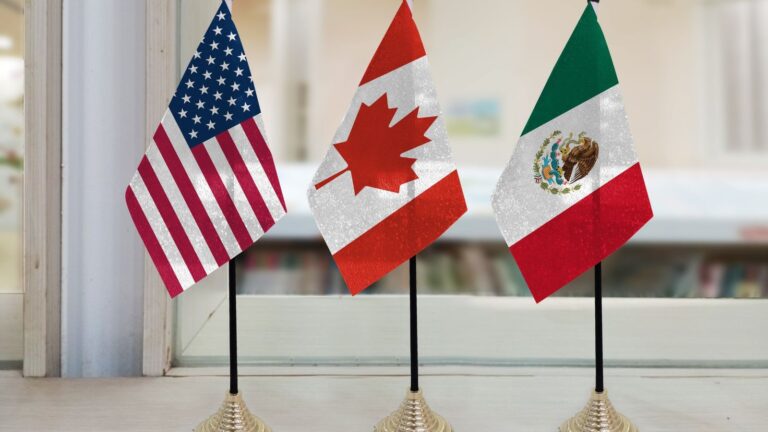
Prime Minister Mark Carney and Mexican President Claudia Sheinbaum reaffirmed their commitment to renewing the Canada-United States-Mexico Agreement (CUSMA) during a November 17 meeting in Shenzhen, China. Their united position comes months after Washington refused to extend the agreement in its current form, leaving the continent’s economic future facing years of potential uncertainty.
The meeting also highlighted a significant shift in Canada-Mexico relations. Bilateral merchandise trade increased 19% during the first nine months of 2026, while investment and cooperation have expanded across several industries.
With both countries facing American tariffs and difficult negotiations, their growing partnership could become increasingly important in determining the future of North American trade.
A Meeting in China Sends a Message to Washington
Carney and Mexico’s President Unite Behind CUSMA Renewal as Trump’s Trade Pressure Pushes Both Countries Together
- A Meeting in China Sends a Message to Washington
- Trump Refuses to Extend the Trade Agreement He Helped Create
- CUSMA Remains in Force, but the Clock Is Running
- Canada-Mexico Trade Surges as Economic Ties Strengthen
- A Strategic Partnership Is Producing Concrete Results
- Trump’s Tariffs Are Creating Pressure on Both Countries
- The Auto Industry Could Become the Biggest Battleground
- Canada and Mexico Are Taking Different Approaches to Trump
- Both Countries Are Building Stronger Supply Chains Beyond the U.S.
- The Next Phase of CUSMA Could Shape North America for Years
The November 17 meeting between Carney and Sheinbaum took place on the sidelines of the Asia-Pacific Economic Cooperation summit in Shenzhen, China. Although the gathering focused on Asia-Pacific economic cooperation, the two North American leaders used their encounter to discuss continental trade and the future of CUSMA. Both emphasized the importance of maintaining a strong three-country trading framework, despite mounting disagreements with Washington. Their meeting demonstrated that Canada and Mexico intend to remain active participants in shaping North America’s economic future rather than allowing the United States to determine its direction alone.
Carney highlighted opportunities for deeper cooperation between Canada and Mexico, including partnerships involving other countries and the United States. Sheinbaum similarly stressed the importance of maintaining what she described as an extraordinary relationship between the two nations. The leaders’ public statements were diplomatic rather than confrontational, and no new trilateral trade agreement was announced. Nevertheless, their renewed commitment to CUSMA sent a meaningful political signal: Canada and Mexico continue to favour a shared economic framework even as Trump’s administration demands substantial changes.
Trump Refuses to Extend the Trade Agreement He Helped Create
The current confrontation has an unusual historical dimension. CUSMA was negotiated during Trump’s first presidency and entered into force on July 1, 2020, replacing the North American Free Trade Agreement. At the time, the new agreement represented a central achievement of Trump’s trade agenda. Six years later, however, his administration declined to extend the same agreement during its first mandatory joint review on July 1, 2026. Canada and Mexico supported renewal, but Washington insisted that unresolved trade disputes and perceived shortcomings needed to be addressed before any extension could proceed.
U.S. Trade Representative Jamieson Greer confirmed that Washington would continue negotiating with both neighbouring countries rather than approve the agreement in its existing form. American officials have raised concerns involving trade deficits, market access, industrial competitiveness and rules governing where products are manufactured. From Washington’s perspective, the review creates an opportunity to secure better terms for American producers. For Ottawa and Mexico City, the refusal introduces uncertainty into a system that businesses have relied upon for years. The disagreement is therefore not simply about whether CUSMA should survive, but about whose priorities will shape its future.
CUSMA Remains in Force, but the Clock Is Running
Despite the increasingly tense political rhetoric, CUSMA has not expired. The agreement continues to operate and is scheduled to remain in effect until July 1, 2036, unless the countries agree to extend it or a member withdraws under its separate withdrawal provisions. Under Article 34.7, all three governments must agree to an extension for the agreement’s 16-year term to be renewed. Because Washington refused to approve that extension in July 2026, the countries now face annual joint reviews until they reach an agreement or the existing term ends.
This distinction matters enormously for businesses. A Canadian manufacturer can still use CUSMA’s preferential trade provisions when its products meet the applicable requirements, although separate U.S. tariffs may still apply to certain goods. The immediate concern is less about the agreement disappearing overnight and more about uncertainty surrounding future investments. Companies planning new factories, warehouses or production lines often make commitments stretching decades into the future. A trade agreement facing repeated political disputes can complicate those decisions even while its legal protections remain in place. Renewal could restore longer-term confidence without requiring businesses to wait until 2036.
Canada-Mexico Trade Surges as Economic Ties Strengthen
The growing relationship between Canada and Mexico is supported by more than diplomatic statements. According to the Canadian prime minister’s office, bilateral merchandise trade increased 19% during the first nine months of 2026 compared with the same period in 2025. That growth builds on an already substantial economic connection. Canadian government figures show the two countries exchanged nearly $62 billion in merchandise during 2025, making Mexico an increasingly important commercial partner for Canadian businesses seeking opportunities beyond their traditional markets.
The longer-term trend is equally revealing. Global Affairs Canada reports that trade in goods and services between Canada and Mexico increased 56.6%, equivalent to $19.7 billion, between 2019 and 2025. The relationship encompasses manufacturing, agriculture, transportation, energy and other industries. For exporters, stronger bilateral connections can create additional customers and supply options when American trade restrictions disrupt established business relationships. However, rising Canada-Mexico trade does not mean the United States has become replaceable. The American market remains far larger for Canadian exporters, and the three countries’ manufacturing networks are deeply interconnected. The significance of Mexico’s growing role lies in giving Canada additional economic options rather than eliminating its dependence on American demand.
A Strategic Partnership Is Producing Concrete Results
The renewed push for CUSMA builds on a broader Canada-Mexico partnership established during Carney’s visit to Mexico City in September 2025. That visit produced a Comprehensive Strategic Partnership and a three-year action plan covering economic prosperity, mobility and inclusion, security, and environmental sustainability. By November 2026, the two governments reported launching more than 130 initiatives across those priorities. The November 17 meeting marked the partnership’s first anniversary and provided an opportunity to evaluate its progress. Both leaders agreed to accelerate implementation during the second year, particularly in areas that could make their economies more resilient.
The economic relationship is also attracting new investment. According to the prime minister’s office, the countries welcomed nearly $1 billion in Mexican investments in Canadian mining and food production, alongside more than $3.7 billion in Canadian investments in Mexican manufacturing, renewable energy and mining. These figures suggest that companies are looking beyond their established North American operations when evaluating opportunities. The partnership is not a substitute for CUSMA, but it provides additional ways for businesses to cooperate even when negotiations involving Washington become difficult.
Trump’s Tariffs Are Creating Pressure on Both Countries
Trump’s tariff policies have become a common source of concern for Canadian and Mexican businesses, although the countries face different restrictions. In 2026, Washington imposed additional 50% tariffs on certain Canadian products under Section 338 of the Tariff Act of 1930, alongside other existing sector-specific duties. Some restrictions affect products even when they meet CUSMA’s rules of origin. Canada has responded with retaliatory measures, creating additional friction in a trading relationship that historically depended on relatively predictable cross-border access. Industries involving vehicles, steel, aluminum and other manufactured products have been particularly exposed.
Mexico has faced its own challenges. On November 12, Trump threatened to double tariffs on Mexican goods unless the country stopped a migrant caravan from approaching the American border. Sheinbaum challenged the circumstances surrounding the threat, with Mexico stating that the caravan was not approaching the northern border at that time. The episode illustrated how disputes outside conventional trade negotiations can suddenly become tariff issues. For businesses, the uncertainty complicates pricing, procurement and investment decisions. For Carney and Sheinbaum, it reinforces the value of maintaining economic partnerships that are not entirely dependent on the stability of negotiations with Washington.
The Auto Industry Could Become the Biggest Battleground
Few industries demonstrate the stakes of CUSMA renewal as clearly as automotive manufacturing. Canada, Mexico and the United States operate highly integrated vehicle-production networks, with components frequently crossing borders before finished vehicles reach dealerships. Under CUSMA, passenger vehicles and light trucks generally must satisfy a 75% regional value-content requirement to qualify under the agreement’s automotive rules. The agreement also includes labour requirements intended to ensure that a significant share of vehicle production occurs at facilities paying at least US$16 per hour. Washington has indicated interest in strengthening automotive rules further, creating concern about how new requirements might affect existing production networks.
For Canada, the consequences could be substantial. Federal government figures indicate that the automotive industry supports approximately 125,000 direct jobs and that more than 90% of Canadian-made vehicles are exported to the United States. On November 14, Carney emphasized that Ottawa would not accept a trade arrangement that undermined the viability of Canada’s automotive sector. The risks are already visible in Brampton, Ontario, where Stellantis abandoned plans to produce the Jeep Compass and shifted planned production to Illinois, leaving more than 2,000 Canadian workers without jobs. Such developments explain why automotive manufacturing remains central to Canada’s trade strategy and why preserving competitive North American supply chains matters to both Ottawa and Mexico City.
Canada and Mexico Are Taking Different Approaches to Trump
Although Carney and Sheinbaum agree on preserving CUSMA, they have not adopted identical strategies toward Washington. Canada has responded to American trade restrictions with retaliatory tariffs and has emphasized protecting its economic sovereignty. Mexico, meanwhile, has generally avoided imposing a comparable round of retaliatory duties, concentrating instead on negotiations aimed at securing tariff relief. During July, U.S. Trade Representative Jamieson Greer met with Sheinbaum as American and Mexican officials discussed automobiles, agriculture, labour, economic security, electronic payment services, steel and aluminum. These bilateral discussions continued even as Canada’s negotiations with Washington encountered serious setbacks.
That difference creates both an opportunity and a complication for Canada-Mexico cooperation. Mexico has incentives to reach arrangements that reduce costs for its own manufacturers, while Ottawa must ensure that any broader agreement protects Canadian employment and industrial capacity. Reuters reported that Mexico’s planned fourth round of bilateral negotiations was postponed in September, with disagreements over tariffs and trade requirements continuing into the autumn. The two governments’ support for CUSMA therefore should not be interpreted as a promise to negotiate every issue together. Their shared position is more specific: both want the trilateral framework preserved, even if separate negotiations are needed to address individual disputes with the United States.
Both Countries Are Building Stronger Supply Chains Beyond the U.S.
While CUSMA remains the centrepiece of North American economic integration, Canada and Mexico are working to create additional commercial connections. Their bilateral action plan identifies opportunities involving ports, rail infrastructure, energy corridors, agriculture, critical minerals and advanced manufacturing. The countries are also exploring stronger maritime links and improvements to cargo transportation. These initiatives could help businesses diversify their distribution networks and reduce vulnerabilities associated with relying too heavily on a single market or transportation route. The emphasis is on reinforcing North American competitiveness while giving both economies greater flexibility.
The commercial activity is already measurable. During their November meeting, Carney and Sheinbaum highlighted trade missions that collectively generated more than 3,700 business-to-business meetings and over 100 commercial agreements and new partnerships. Cooperation is expanding beyond conventional trade as well, including nearly 30 security-related stakeholder engagements and training exercises, alongside more than $10 million dedicated to security capacity and cooperation initiatives. Health security, biomanufacturing and environmental stewardship are also part of the agenda. These initiatives illustrate how the Canada-Mexico relationship is evolving from a primarily trade-focused connection into a wider strategic partnership with implications for business investment, public safety and economic resilience.
The Next Phase of CUSMA Could Shape North America for Years
The November 17 meeting strengthened the political case for preserving CUSMA, but the path toward renewal remains uncertain. All three governments must ultimately agree to extend the agreement, and Washington has not yet accepted the existing terms. American officials have already begun preparing for the next stage of the review process. A notice published in the U.S. Federal Register on October 5 established a public consultation process ahead of the 2027 annual review, with written comments due January 12, 2027. The consultation covers issues ranging from trade compliance and investment conditions to economic security and North American competitiveness.
There are signs that negotiations could still advance. On November 14, Carney said discussions with Trump had become substantive and that progress was being made, although no agreement had been reached. Mexico has also continued pursuing its own negotiations with Washington. For Canadian and Mexican manufacturers, farmers and investors, the most important outcome would be a durable agreement that provides predictable market access and supports long-term investment. Carney and Sheinbaum’s growing cooperation may strengthen their ability to influence that outcome, but it does not eliminate their dependence on American participation. Their November meeting demonstrated a clear preference for continued three-country economic integration, leaving the next decisive move in the hands of negotiators across all three capitals.
This Options Discord Chat is The Real Deal
While the internet is scoured with trading chat rooms, many of which even charge upwards of thousands of dollars to join, this smaller options trading discord chatroom is the real deal and actually providing valuable trade setups, education, and community without the noise and spam of the larger more expensive rooms. With a incredibly low-cost monthly fee, Options Trading Club (click here to see their reviews) requires an application to join ensuring that every member is dedicated and serious about taking their trading to the next level. If you are looking for a change in your trading strategies, then click here to apply for a membership.