35,000+ smart investors are already getting financial news, market signals, and macro shifts in the economy that could impact their money next with our FREE weekly newsletter. Get ahead of what the crowd finds out too late. Click Here to Subscribe for FREE.
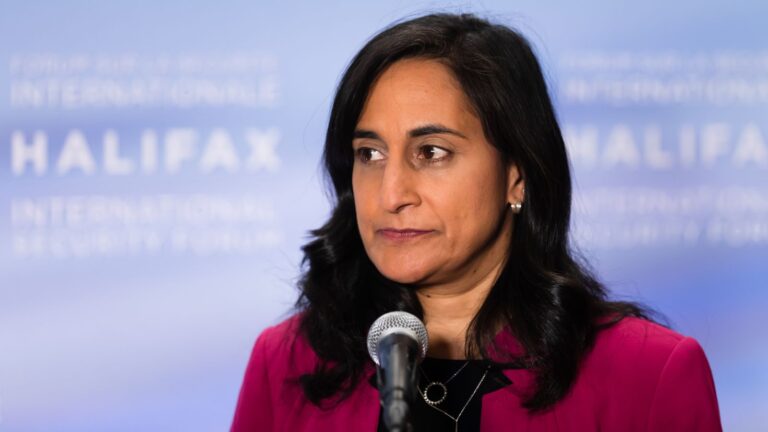
An election in the United States has created a new diplomatic puzzle for Canada: how much can Washington change when the president and Congress are moving in different political directions? At a G7 foreign ministers’ gathering in Paris on November 9, Canadian Foreign Minister Anita Anand questioned what comes next after Democrats won both chambers of Congress. U.S. Secretary of State Marco Rubio offered a clear response: President Donald Trump intends to keep directing American foreign policy.
The disagreement is about more than political messaging. From strained Canada–U.S. trade relations to wars in Ukraine and Iran, governments must decide whether the election will produce meaningful changes or merely more confrontation. For Ottawa, the stakes include economic certainty, national sovereignty and the ability to work with Washington without depending on a shift that may never arrive.
Anand Raises a Question Washington Has Yet to Answer
Canada’s Foreign Minister Questions Washington’s Next Move as Rubio Says Trump’s Policies Won’t Change After Midterms
- Anand Raises a Question Washington Has Yet to Answer
- Rubio Insists the White House Will Remain in Charge
- Democratic Victories Change the Balance of Power
- Ottawa Plans to Keep Talking, Regardless of the Vote
- The G7 Meeting Reveals How Far Allies Have Drifted
- Ukraine Shows Why Ottawa Cannot Wait for Washington
- The Iran War Turns Diplomacy Into an Economic Concern
- An International Court Becomes a Diplomatic Fault Line
- Artificial Intelligence Opens Another Front Between Allies
- Canada’s Next Move Depends on Decisions, Not Predictions
Canada’s Foreign Minister Anita Anand did not claim the American election would automatically transform relations with Ottawa. Speaking to reporters at the G7 meeting in Paris, she pointed instead to a tension: Trump retains executive authority, but Democrats have won control of the House of Representatives and Senate. What that divided arrangement will mean for American policy, she suggested, remains to be seen. Her comments reflected the uncertainty confronting allies that must plan around decisions made in Washington.
Anand’s distinction matters because an election result is not itself a diplomatic agreement or a reversal of tariffs. Canada has experienced criticism from Trump, and its officials cannot assume that new congressional leadership will bring immediate relief. A foreign minister negotiating amid such conditions must prepare for possibilities at once: continued White House pressure, tougher congressional questioning of the administration and occasional opportunities for cooperation. Anand’s message was therefore cautious, not celebratory.
Rubio Insists the White House Will Remain in Charge
Rubio answered the uncertainty with a direct defence of presidential authority. After meeting G7 ministers on November 9, he said Congress can influence foreign policy through funding and oversight, but the president remains the primary decision-maker. He also reaffirmed the administration’s “America First” approach and said Trump would keep pursuing diplomatic outcomes in the conflicts involving Iran and Ukraine. The message to allies was straightforward: the election should not be mistaken for a change in the White House’s priorities.
Rubio had made the same argument before the vote. At an October 31 press availability in Atlanta, the former senator explained that he had served through different combinations of congressional and presidential control. Divided government, he argued, was familiar rather than extraordinary. His experience gives that claim institutional weight, but it does not remove Congress from the equation. Presidential direction and the ability to implement policy are related, not identical, questions.
Democratic Victories Change the Balance of Power
The November 3 midterms handed Democrats control of both congressional chambers, according to election calls by the Associated Press. Their majorities will begin serving in January 2027, not immediately after the ballots were counted. Until then, Trump remains in office and the existing Congress continues its work. That distinction helps explain why foreign governments are watching the political transition rather than treating the election as an instant policy reversal.
Once seated, the new Congress will have tools that affect international affairs even without directing day-to-day diplomacy. Legislators determine appropriations, conduct hearings, scrutinize executive decisions and debate trade legislation. Congressional Research Service analysis also emphasizes that constitutional authority over tariffs and foreign commerce belongs to Congress, although lawmakers have delegated powers to presidents. Those checks can complicate an administration’s plans. They cannot, on their own, guarantee that Trump will abandon a preferred negotiating position or alter his relationships with foreign leaders.
Ottawa Plans to Keep Talking, Regardless of the Vote
On November 4, trade minister Dominic LeBlanc said Ottawa would not change its U.S. trade strategy after the midterms. He expected talks with U.S. Commerce Secretary Howard Lutnick and Trade Representative Jamieson Greer. Prime Minister Mark Carney emphasized affordability, opportunity and sovereignty despite political changes in Washington. Those statements suggest continuity in Ottawa’s negotiating objectives even as the balance of power in Washington shifts.
The economic reason for that discipline is substantial. Statistics Canada reported that exports to the United States represented 71.7 percent of Canadian merchandise exports in 2025. September 2026 data showed Canadian goods shipments to the U.S. rising 0.7 percent during the month, while exports to other countries declined 1.1 percent. For exporters, factories and their employees, even a small change in border policy can have consequences. Canada needs workable channels with both parties, not just hopes of a friendlier Congress.
The G7 Meeting Reveals How Far Allies Have Drifted
The Paris gathering brought together ministers from Canada, the United States, France, Germany, Italy, Japan and Britain, alongside the European Union. France organized the November 9–10 talks to address wars, instability, energy security and emerging technology. It sought closer coordination among partners. Yet the discussions exposed how much harder coordination becomes when Washington and several of its closest allies disagree over the means, even when they share an interest in ending conflicts.
European Union foreign policy chief Kaja Kallas said election results could influence the United States’ approach, and expressed willingness to work with whichever American institutions hold power. Rubio emphasized continuity instead. The contrast demonstrated that allies were drawing different lessons from the same vote. Diplomacy at the G7 is rarely limited to declarations: officials also test whether partners are prepared to compromise. In Paris, uncertainty over U.S. priorities was itself a consequential part of the negotiations.
Ukraine Shows Why Ottawa Cannot Wait for Washington
Russia’s war against Ukraine was one of the tests of whether G7 partners could maintain a common position. On November 9, Anand announced new Canadian sanctions targeting 38 entities and 24 individuals linked to Russia’s defence industry, missile development, cyber activity and financial support networks. The announcement placed measures beside diplomatic statements, reinforcing Canada’s commitment to pressure Moscow. It also showed that Ottawa was prepared to act regardless of the congressional transition.
Rubio said Washington would continue trying to broker an end to the war, while declining to predict the outcome of planned talks involving Russian, Ukrainian and American representatives in Abu Dhabi. European ministers, meanwhile, stressed that Europe must participate in decisions affecting its security. For families in Ukrainian cities facing attacks on civilian infrastructure, differences over negotiating formats are not abstract. The concerns are air defence, electricity and the conditions under which any durable settlement could be reached.
The Iran War Turns Diplomacy Into an Economic Concern
The conflict involving Iran has become a point of friction between Washington and its partners. Rubio said Trump preferred a diplomatic solution, but acknowledged before the G7 meeting that negotiations were not near a breakthrough. The war has disrupted shipping routes and energy markets, raising the stakes of decisions about how to end the fighting. French organizers placed Middle East stability and energy supplies high on the agenda in Paris.
The economic consequences extend well beyond the region. In its October 2026 oil report, the International Energy Agency forecast a sharp annual decline in global oil demand amid constrained supply, soaring fuel prices and worsening economic conditions linked to the war. Canada is a major energy exporter, but its households and businesses are exposed to fuel and transportation costs. That makes Washington’s strategy relevant to Canadian inflation and household budgets, even when the disagreement appears to concern distant military operations.
An International Court Becomes a Diplomatic Fault Line
The International Criminal Court has emerged as a sharp dispute between Washington and other G7 capitals. The United States is not a party to the Rome Statute that established the court. Canada and the other G7 countries are. Rubio objected to the prospect of Americans facing the court’s jurisdiction, while European officials defended its role in prosecuting serious crimes. The argument highlights a divide over international institutions and national sovereignty.
Canada’s position predates the Paris meeting. On October 9, Canadian officials joined other foreign ministers in reaffirming support for the ICC and criticizing proposed U.S. sanctions against the institution. Their statement warned that such restrictions could hinder the court’s staff and operations. A shared commitment to accountability does not automatically resolve every legal dispute over jurisdiction. Still, the disagreement puts Ottawa in a difficult position: maintaining relations with Washington while defending an institution it considers important to international justice.
Artificial Intelligence Opens Another Front Between Allies
Artificial intelligence was a topic on the G7 agenda. France identified AI safety as a priority, describing the development of advanced systems as both an opportunity and a security challenge. Canada’s foreign affairs department said Anand would lead conversations on AI and hybrid threats, including risks relevant to North America and Europe. Those concerns place technology alongside questions about borders, defence and public safety.
Rubio told reporters in Paris that Washington was wary of international attempts to regulate AI in ways that could stifle innovation. The distinction is important: countries can agree that unsafe uses are dangerous while disagreeing about which institutions should write rules or enforce them. For Canadian businesses building AI tools, incompatible regulations could complicate market access and investment. For governments, the challenge is balancing competitiveness and safeguards. The debate offers an indication of how the administration’s preference for national discretion may shape cooperation beyond military affairs.
Canada’s Next Move Depends on Decisions, Not Predictions
For Ottawa, the test is whether Washington’s actions begin to diverge from its rhetoric. The United States Trade Representative has launched a consultation ahead of a 2027 review of the Canada–United States–Mexico Agreement, with comments due January 12, 2027. That gives businesses and policymakers a deadline, unlike speculation about how Democrats might influence Trump. The coming months will be shaped by trade procedures and political negotiations.
Carney’s government has emphasized greater Canadian sovereignty and economic resilience, including through a national security strategy unveiled in October. Those goals do not require Canada to turn away from its largest trading partner. They require Ottawa to strengthen alternatives while protecting cooperation that remains essential. Anand’s question in Paris may therefore be the most practical one: what will Washington actually do? Rubio has stated the president’s intention. The answer for Canada will emerge through decisions on trade, security, diplomacy and international institutions.
This Options Discord Chat is The Real Deal
While the internet is scoured with trading chat rooms, many of which even charge upwards of thousands of dollars to join, this smaller options trading discord chatroom is the real deal and actually providing valuable trade setups, education, and community without the noise and spam of the larger more expensive rooms. With a incredibly low-cost monthly fee, Options Trading Club (click here to see their reviews) requires an application to join ensuring that every member is dedicated and serious about taking their trading to the next level. If you are looking for a change in your trading strategies, then click here to apply for a membership.