35,000+ smart investors are already getting financial news, market signals, and macro shifts in the economy that could impact their money next with our FREE weekly newsletter. Get ahead of what the crowd finds out too late. Click Here to Subscribe for FREE.
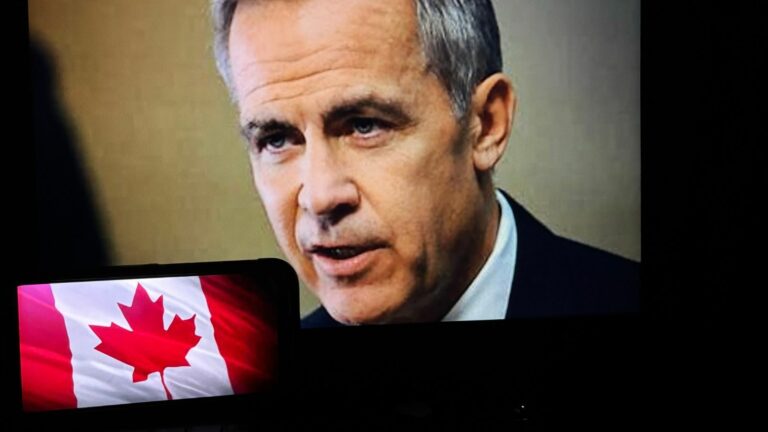
A colourful remark about chess has resurfaced at a consequential moment for Canada–U.S. relations. President Donald Trump has promoted Stephen Miller, one of his closest and most combative advisers, to White House chief of staff just as Ottawa and Washington try to overcome another impasse in their trade dispute.
The connection dates to May 2025, when Miller attended Trump’s first White House meeting with Prime Minister Mark Carney. Describing what he witnessed, Miller compared Trump’s performance to that of a chess grandmaster. His comment was praise for the president, not a claim that Miller personally led the negotiations.
Now, with Miller occupying a far more powerful White House position and Democrats poised to control Congress, the question for Canada is whether the personnel change will affect the direction—or the tone—of talks over tariffs and economic sovereignty.
Trump Elevates One of His Most Trusted Advisers
Trump Appoints White House Chief Who Once Compared His Negotiations With Carney to ‘Grandmaster Chess’
- Trump Elevates One of His Most Trusted Advisers
- The ‘Grandmaster Chess’ Comment Came After Carney’s First Visit
- Carney’s Response in the Oval Office Told a Different Story
- Miller Brings a Hardline Reputation, Not a New Trade Mandate
- The Trade Talks Have Already Broken Down Once—and Restarted
- Canadian Businesses Have More at Stake Than a Diplomatic Victory
- Democratic Victories in Congress Add Another Complication
- The Real Test Will Be What Changes at the Negotiating Table
Trump announced on November 6 that Stephen Miller would replace Susie Wiles as White House chief of staff, with the change taking effect Monday, November 9. The official White House announcement identified Miller as the administration’s 33rd chief of staff and emphasized his long association with Trump. Miller previously held the position of deputy chief of staff for policy in the current administration. His promotion puts someone already deeply involved in White House decision-making into the job of coordinating the president’s staff, schedule and dealings across government.
The transition followed a turbulent week in Washington. Republicans had just lost control of both chambers of Congress in the November 3 midterm elections, while Wiles, the first woman to hold the chief-of-staff post, was stepping aside after overseeing much of Trump’s second-term operation. Reuters reported that Wiles was expected to move into the president’s political operation. Miller’s appointment does not itself change any tariff or trade agreement, but it matters because the chief of staff can influence which issues reach the president, which officials participate in discussions and how firmly the administration pursues its priorities.
The ‘Grandmaster Chess’ Comment Came After Carney’s First Visit
The remark attracting renewed attention came from Miller’s appearance on Fox News’ Hannity following the May 6, 2025, Oval Office meeting between Trump and Carney. Miller, who attended the meeting, described watching Trump and said the encounter was like watching a grandmaster perform at chess. He presented the conversation as evidence that Trump’s negotiating style was changing Canada’s relationship with the United States. Miller pointed to discussions involving trade, border enforcement and Canadian defence spending as reasons he considered the meeting a success for the American president.
There is an important distinction between that commentary and the outcome of the meeting. Miller was describing his interpretation of Trump’s performance; he was not announcing a completed trade deal, nor was he identified as the principal American trade negotiator. The metaphor is revealing because it shows how one of Trump’s most influential aides publicly framed negotiations with Canada—as a strategic contest in which the president was the dominant player. Yet the same meeting was viewed in Ottawa as the beginning of difficult discussions between two sovereign governments. That difference in perspective remains relevant as Miller takes on greater responsibility.
Carney’s Response in the Oval Office Told a Different Story
The May 2025 meeting produced a memorable exchange that went well beyond trade figures. When Trump again raised the possibility of Canada becoming an American state, Carney pushed back by invoking the idea that certain places are simply not for sale. The prime minister made clear that Canada’s sovereignty was not negotiable, while also presenting economic and security cooperation as a shared opportunity. Trump responded without abandoning his familiar language about the relationship. The moment illustrated the challenge facing Carney: maintaining a working relationship with Washington without allowing diplomacy to be interpreted as consent to U.S. political demands.
Canada’s official account of the meeting focused on mutual respect, common interests and the need for more talks. Carney said afterward that the discussion had been constructive and wide-ranging, and the two leaders planned to meet again at the G7 summit in Kananaskis. Those were early steps rather than a settlement of the tariff dispute. Miller’s chess comparison sounded triumphant from the White House’s perspective, but the actual diplomatic process remained open-ended. More than a year later, the unresolved questions about market access, national independence and industrial protection show why the meeting cannot be judged by a single flattering metaphor.
Miller Brings a Hardline Reputation, Not a New Trade Mandate
Miller, 41, has been associated with Trump since the 2016 presidential campaign and has become particularly prominent for his role in immigration and border policy. During Trump’s second term, he helped drive an aggressive enforcement agenda and supported an expansive view of presidential authority. His reputation for confrontation has made him popular among many Trump allies and a target of sharp criticism from Democrats. Reuters reported that White House officials saw the promotion as a sign that Trump was not preparing to substantially revise his political agenda after the midterm losses.
That background helps explain why the appointment may draw attention in Ottawa, but it should not be overstated. A White House chief of staff is a powerful political and managerial adviser, not automatically the official responsible for setting tariff rates or negotiating the text of a bilateral trade agreement. U.S. Commerce Secretary Howard Lutnick and Trade Representative Jamieson Greer have been central American counterparts in the Canada talks. Miller’s new job could give him greater influence over the president’s approach and the administration’s internal priorities; it does not establish that he will personally take over the negotiating table. For Canadian businesses, that distinction matters more than the symbolism of the promotion.
The Trade Talks Have Already Broken Down Once—and Restarted
Canada and the United States entered November with a complicated negotiating history. On August 21, 2026, Carney suspended talks after saying last-minute American demands would have undermined Canadian interests and sovereignty. Ottawa identified stable market access, lower tariffs on strategic industries and freedom to make independent decisions as essential objectives. The breakdown coincided with another round of heavy U.S. tariffs and Canadian retaliation. For businesses making long-term decisions about factory investment or export contracts, the collapse reinforced the difficulty of planning around a rapidly changing trade relationship.
The atmosphere improved somewhat in early November. Trump said the two countries were approaching a deal, and Carney confirmed that renewed discussions had become more intensive. On November 3, the prime minister indicated Washington had withdrawn some previously unacceptable demands, including a proposed restriction on Canada’s ability to negotiate trade agreements with other countries. But he also said major issues remained unresolved. As Miller begins his new job, the available public statements still point to ongoing negotiations, not a fully concluded agreement. The immediate task for both governments is to turn expressions of optimism into detailed, enforceable terms that businesses can use with confidence.
Canadian Businesses Have More at Stake Than a Diplomatic Victory
The tariff dispute reaches directly into Canadian factories, suppliers and export businesses. U.S. measures include a 25% duty on covered vehicles and trucks, with exemptions for qualifying U.S. content, as well as tariffs of up to 50% on certain steel, aluminum and copper products. Separate Section 338 duties have also placed 50% tariffs on a range of Canadian goods, including selected machinery, plastics and other manufactured products, without the usual protection for goods meeting Canada–United States–Mexico Agreement origin rules. These overlapping measures create different pressures across industries and can make production decisions harder to predict.
The scale of Canada’s exposure explains the concern. Statistics Canada reported that 71.7% of Canadian merchandise exports went to the United States in 2025, down from 75.9% in 2024 but still representing the overwhelming share. In practical terms, a policy decision made in Washington can affect a parts maker in southwestern Ontario, a steel operation in the north or a smaller business supplying equipment to an American customer. Miller’s promotion does not alter those figures. What it changes is the political environment in which Canada is seeking relief, with Ottawa watching for any sign that the White House will favour compromise or continue using tariffs as negotiating leverage.
Democratic Victories in Congress Add Another Complication
Miller is assuming the chief-of-staff role after Democrats won both the House of Representatives and the Senate in the November 3 midterms. Their electoral gains do not immediately transfer congressional control, since the new lawmakers take their seats in January 2027. Still, the result has already introduced a new factor into Canada–U.S. relations. Some Democratic politicians have indicated that undoing tariffs on Canadian goods will be a priority. Carney said on November 6 that Canada would welcome efforts to restore freer trade, while acknowledging he had not yet spoken with those lawmakers about their plans.
Ottawa has also signalled that it will not put direct negotiations with the Trump administration on hold while waiting for the new Congress. Canada–U.S. Trade Minister Dominic LeBlanc said the election outcome would not substantially change the government’s immediate approach, and he expected further contact with American trade officials. For Miller, the congressional shift means managing a White House that may face more scrutiny and opposition at home. For Canada, it creates two diplomatic realities at once: a president who retains significant executive influence over trade policy and a newly elected Congress that could challenge parts of that policy. Neither development guarantees tariff relief.
The Real Test Will Be What Changes at the Negotiating Table
Canada’s formal trade team includes LeBlanc and chief trade negotiator Janice Charette, while senior American discussions have involved Lutnick and Greer. That structure is important as attention turns to Miller. His influence may be exercised privately through advice to Trump, coordination of officials or decisions about which proposals deserve the president’s attention. Those possibilities are reasonable to watch, but there is no confirmed announcement that Miller has replaced the existing trade negotiators or assumed direct responsibility for a Canada deal. The test will be how U.S. demands evolve, not whether one adviser uses combative language on television.
For Carney, the balancing act remains familiar: seek lower tariffs and dependable access to the American market while resisting conditions that compromise Canada’s independence. For manufacturers, the stakes are even more immediate. A negotiated reduction in duties could improve the outlook for investment and jobs; prolonged uncertainty could push companies to delay decisions or reconsider where production belongs. The grandmaster comparison captures the theatrical side of Trump-era diplomacy, but the outcome will be measured far from the television studio—in signed trade terms, factory schedules, cross-border orders and the ability of Canadian workers to plan their futures.
This Options Discord Chat is The Real Deal
While the internet is scoured with trading chat rooms, many of which even charge upwards of thousands of dollars to join, this smaller options trading discord chatroom is the real deal and actually providing valuable trade setups, education, and community without the noise and spam of the larger more expensive rooms. With a incredibly low-cost monthly fee, Options Trading Club (click here to see their reviews) requires an application to join ensuring that every member is dedicated and serious about taking their trading to the next level. If you are looking for a change in your trading strategies, then click here to apply for a membership.