35,000+ smart investors are already getting financial news, market signals, and macro shifts in the economy that could impact their money next with our FREE weekly newsletter. Get ahead of what the crowd finds out too late. Click Here to Subscribe for FREE.
A pipeline project abandoned five years ago has unexpectedly returned to the centre of Canada-U.S. trade negotiations, with President Donald Trump declaring that Canada will pay to revive Keystone XL as part of a potential new agreement.
Speaking on November 1, 2026, Trump suggested that Washington and Ottawa were approaching a trade breakthrough, with the long-disputed oil pipeline forming part of the negotiations. However, Prime Minister Mark Carney has not publicly confirmed any agreement requiring Canada to finance the project.
The renewed discussion comes as both countries struggle to resolve a damaging tariff dispute affecting major industries and cross-border commerce. While Keystone XL could offer Canadian oil producers additional access to American markets, its revival raises difficult questions about financing, environmental opposition, political commitments, and the future of North American energy relations.
Trump Puts Keystone XL Back on the Negotiating Table
Trump Says Canada Will Pay to Revive Keystone XL as Part of New Trade Deal Talks
- Trump Puts Keystone XL Back on the Negotiating Table
- What Keystone XL Was Originally Supposed to Accomplish
- Canada’s Previous Investment Makes Trump’s Demand More Complicated
- A Different Pipeline Project Is Already Moving Forward
- Keystone XL Becomes a Bargaining Chip in the Broader Tariff Dispute
- Economic Opportunities Come With Environmental and Community Concerns
- What Happens Next Will Determine Whether Keystone XL Returns
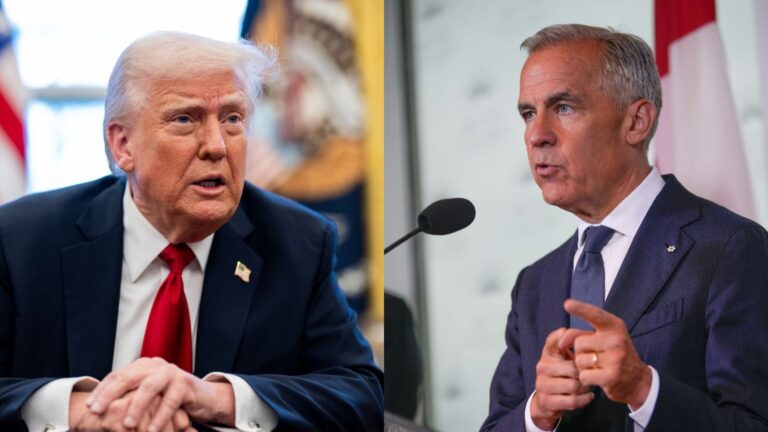
President Donald Trump brought Keystone XL back into the spotlight on Sunday, November 1, while speaking to reporters in Dubuque, Iowa. The president said the United States and Canada had developed the framework of a potentially beneficial trade agreement following discussions with Prime Minister Mark Carney. Trump described the proposed arrangement as particularly favourable for American farmers and suggested the countries were moving closer to resolving months of commercial tensions. However, his most significant comments involved the controversial pipeline, which has remained politically sensitive since its cancellation under former President Joe Biden. Trump claimed Canada would take responsibility for building the pipeline and paying for the project, while Washington would provide a route that he described as largely determined. His statements offered a clear indication of what he wants included in a potential agreement.
The announcement immediately raised questions about whether Ottawa had actually accepted the financial responsibility Trump described. Neither government had released a finalized agreement outlining the pipeline’s ownership, construction costs, financing arrangements, or expected completion date. Canadian officials also had not confirmed that the federal government would directly fund the project. Carney acknowledged that the two leaders had discussed the future of bilateral trade, characterizing their conversation as constructive and emphasizing the importance of protecting Canadian interests. He said negotiating teams would continue working toward an agreement over the coming weeks. The difference between the leaders’ statements is important. Trump presented Keystone XL as a component of an emerging deal, while Carney’s public comments focused on broader economic objectives without confirming the specific pipeline commitment. For Canadian taxpayers and the energy industry, that distinction leaves some of the most consequential questions unanswered.
What Keystone XL Was Originally Supposed to Accomplish
Keystone XL was designed to provide Canadian oil producers with a major additional route into the United States, particularly the refineries and transportation networks serving the American Midwest and Gulf Coast. First proposed in 2008, the approximately 1,947-kilometre pipeline would have connected Hardisty, Alberta, to Steele City, Nebraska, where it could connect with existing infrastructure. The proposed system was designed to carry up to 830,000 barrels of crude oil daily, primarily from Western Canada’s oil-producing regions. For Alberta’s energy industry, the attraction was straightforward: additional pipeline capacity could reduce transportation constraints and improve access to major customers. American refiners equipped to process heavier crude would also benefit from another supply option. The proposal therefore carried economic implications extending well beyond the communities directly along its planned route.
Despite that potential, Keystone XL became one of North America’s most politically controversial energy projects. Environmental organizations, Indigenous communities, and some affected landowners challenged its development over concerns about greenhouse gas emissions, water protection, and land rights. The project received Canadian regulatory approval in 2010, but American political decisions and legal challenges repeatedly delayed construction. Trump supported Keystone XL during his first presidency, and construction activity advanced in 2020. However, Biden revoked its cross-border presidential permit on January 20, 2021, prompting developer TC Energy to suspend construction. On June 9, 2021, the company officially terminated the project. Importantly, the existing Keystone Pipeline System continued operating. Keystone XL was a proposed expansion, not the entirety of the existing transportation network. Reviving the cancelled project would therefore involve rebuilding a development plan rather than simply restarting an operating pipeline.
Canada’s Previous Investment Makes Trump’s Demand More Complicated
Trump’s declaration that Canada would finance Keystone XL carries particular significance because Canadian public money was already committed to the project before its cancellation. In March 2020, Alberta’s government announced a financial arrangement with TC Energy that included a commitment of C$1.5 billion in equity investment and a C$6 billion loan guarantee. The provincial government argued that additional pipeline capacity was necessary to support Alberta’s energy producers and protect economic opportunities. However, those commitments should not be confused with the amount eventually spent. After the project’s termination, Alberta estimated its final financial exposure would remain materially within approximately C$1.3 billion. The experience became an expensive reminder that even a heavily supported energy project can face considerable political and regulatory uncertainty, particularly when critical infrastructure crosses an international border.
That history creates a difficult question for any renewed financing arrangement: who would actually be responsible for paying? Trump’s comments did not distinguish between the Canadian federal government, Alberta’s provincial government, private pipeline operators, or energy companies purchasing transportation capacity. These are fundamentally different possibilities, each carrying separate financial and political consequences. Canada’s earlier involvement was primarily through Alberta’s partnership with a private-sector developer, not a federal commitment to pay the full construction bill. The corporate landscape has also changed since 2021. TC Energy separated its liquids pipeline operations into South Bow Corporation in October 2024, creating a different business structure for future projects. Any new proposal would require clarity about ownership, investment commitments, operating revenues, and financial risks. Without those details, Trump’s financing claim remains an assertion about a potential agreement rather than evidence of an approved Canadian expenditure.
A Different Pipeline Project Is Already Moving Forward
Although Trump continues to refer to Keystone XL, the most advanced current proposal is a related project that would use portions of the original infrastructure rather than recreate the cancelled pipeline exactly as planned. South Bow Corporation has been developing the Prairie Connector project, which would transport Canadian crude from Hardisty to the U.S. border before connecting with infrastructure proposed by American partner Bridger Pipeline. In April 2026, Trump granted a presidential cross-border permit for Bridger’s proposed pipeline through Montana and Wyoming. Unlike the original Keystone XL alignment, the new American route would initially run toward Guernsey, Wyoming. On the Canadian side, South Bow’s plan includes approximately 380 kilometres of new pipeline and the reuse of around 150 kilometres of pipe installed before Keystone XL was abandoned. This distinction is significant because Trump’s comments may concern infrastructure that has already undergone substantial redevelopment and planning.
The project has also made measurable commercial progress. In May 2026, South Bow announced that nine customers had signed binding 20-year transportation commitments representing 465,000 barrels per day of service. Those agreements provide an important indication that oil producers and shippers see value in additional cross-border capacity. Nevertheless, the company has targeted mid-2027 for its final investment decision, meaning construction is not yet a certainty. Outstanding requirements include regulatory approvals, financing arrangements, government assurances about permit durability, and consultations with affected communities, landowners, and Indigenous and Tribal Nations. The Canadian Energy Regulator has also indicated that further regulatory approvals remain necessary despite the existing authorization of the Canadian Keystone XL corridor. Trump’s claim that much of the route has already been determined may reflect this earlier planning, but it should not be interpreted as confirmation that every approval has been granted.
Keystone XL Becomes a Bargaining Chip in the Broader Tariff Dispute
The renewed pipeline discussion comes against the backdrop of one of the most serious Canada-U.S. trade disputes in recent years. Negotiations deteriorated in August 2026 after the two governments failed to agree on conditions for a broader trade arrangement. Washington subsequently imposed tariffs of 50 per cent on C$27.6 billion worth of Canadian goods, according to Canada’s Department of Finance. Ottawa responded with countermeasures covering an equivalent value of American imports, including products from industries such as steel, aluminum, agricultural equipment, and dairy. The consequences extend beyond large corporations. Manufacturers operating across the border face higher costs and uncertainty, while agricultural producers must contend with changing market-access conditions. Trump has suggested that a new agreement would eliminate tariffs affecting American farmers, adding another potentially contentious issue to negotiations already involving energy infrastructure and industrial protection.
The discussions also take place alongside unresolved questions surrounding the Canada-United States-Mexico Agreement, commonly known as CUSMA. During the agreement’s mandatory joint review on July 1, 2026, Washington declined to extend the existing framework for another 16-year term. That decision did not terminate the agreement, which remains in force under its current provisions. Instead, it created additional uncertainty about the future of continental trade rules. Keystone XL could offer Washington a visible energy-policy victory while providing Ottawa with another issue to negotiate alongside tariffs affecting Canadian manufacturers and exporters. However, the potential trade-off remains speculative because neither government has disclosed a finalized package of concessions. For Canada, the central calculation will involve determining whether any benefits from lower tariffs and improved market access justify the financial and political commitments that Washington may demand in return.
Economic Opportunities Come With Environmental and Community Concerns
The economic importance of Canadian oil to the United States helps explain why Keystone XL continues to attract political attention. According to the Canada Energy Regulator, Canada exported approximately 3.9 million barrels of crude oil per day to the United States in 2025, representing about 90 per cent of its crude exports. Canadian supplies also accounted for more than 63 per cent of American crude oil imports that year. Additional pipeline capacity could strengthen this relationship by providing producers with more transportation options while supporting American refineries that depend on heavier Canadian crude. However, expanding oil exports southward also presents a strategic question. Canada has been working to diversify its energy customers, and the expansion of the Trans Mountain Pipeline has already helped increase crude exports to markets outside the United States. Another American-bound pipeline could improve transportation flexibility while reinforcing Canada’s reliance on its largest customer.
The environmental and community implications remain equally important. Keystone XL encountered years of opposition from Indigenous organizations, environmental groups, and landowners concerned about potential spills, greenhouse gas emissions, and the protection of land and water resources. Those concerns have not disappeared with the development of the related Prairie Connector and Bridger projects. Recent reporting from eastern Montana describes communities weighing potential construction employment and landowner compensation against questions about pipeline safety and property rights. Representatives of the Fort Peck Tribes have raised concerns about the potential consequences of a spill near important water systems. Meanwhile, federal and state regulators are continuing environmental reviews of the Bridger proposal. The contrast illustrates why reviving a pipeline involves more than political approval. Supporters see jobs, investment, and energy security, while opponents and affected communities continue to demand accountability over environmental risks and long-term consequences.
What Happens Next Will Determine Whether Keystone XL Returns
Despite Trump’s confident language, several major developments would be necessary before Canada could be considered financially committed to reviving Keystone XL. First, Ottawa and Washington would need to establish whether the proposed arrangement concerns the original pipeline, the newer Prairie Connector and Bridger developments, or some modified combination of existing and proposed infrastructure. Any agreement involving Canadian financial support would also need to clarify which government or private entities would provide funding and under what conditions. Commercial considerations would remain critical, including construction costs, financing, transportation contracts, and expected investment returns. Regulatory reviews and engagement with affected communities would also have to proceed. South Bow’s targeted mid-2027 investment decision demonstrates that the related development remains subject to substantial work before construction can be treated as certain. A trade agreement might improve its prospects, but it would not independently settle every commercial and regulatory requirement.
For now, the immediate focus remains on negotiations between Trump and Carney, particularly whether progress on tariffs can produce a broader agreement acceptable to both countries. Carney has emphasized that any arrangement must support Canadian workers, improve affordability, and respect Canada’s sovereignty. Trump, meanwhile, has presented the potential agreement as a victory for American farmers and the broader U.S. economy, with Keystone XL forming part of his vision for renewed energy cooperation. The coming weeks should provide a clearer indication of whether these objectives can be reconciled. As of November 2, 2026, no finalized agreement publicly establishes that the Canadian government has committed to paying for the pipeline’s revival. The central distinction remains straightforward: Trump has said Canada will pay, but Ottawa has not publicly confirmed that obligation. Until those details emerge, Keystone XL remains a potentially powerful bargaining chip rather than a guaranteed construction project.
This Options Discord Chat is The Real Deal
While the internet is scoured with trading chat rooms, many of which even charge upwards of thousands of dollars to join, this smaller options trading discord chatroom is the real deal and actually providing valuable trade setups, education, and community without the noise and spam of the larger more expensive rooms. With a incredibly low-cost monthly fee, Options Trading Club (click here to see their reviews) requires an application to join ensuring that every member is dedicated and serious about taking their trading to the next level. If you are looking for a change in your trading strategies, then click here to apply for a membership.