35,000+ smart investors are already getting financial news, market signals, and macro shifts in the economy that could impact their money next with our FREE weekly newsletter. Get ahead of what the crowd finds out too late. Click Here to Subscribe for FREE.
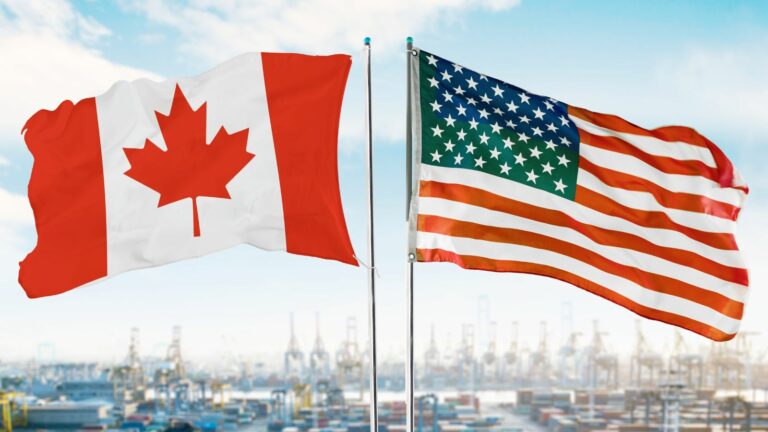
The already strained Canada-U.S. relationship has opened another front, this time over American elections. The U.S. Embassy in Ottawa is accusing Canadian political figures of attempting to influence American politics ahead of the November 3 midterms, pointing to retaliatory tariffs, cross-border political outreach and Ontario’s high-profile campaign against U.S. tariffs.
Prime Minister Mark Carney and Ontario Premier Doug Ford are pushing back, arguing that Canada is defending its workers and economy rather than trying to determine how Americans vote. The clash is unusually sensitive because it comes as control of Congress hangs in the balance and a bitter trade dispute is already reshaping one of the world’s largest economic relationships. At the centre of the disagreement is an increasingly important question: when does legitimate pressure on another government become interference in its elections?
The Embassy Turns a Trade Fight Into an Election Dispute
US. Embassy Accuses Canadian Politicians of Trying to Influence the Midterms as Carney and Ford Push Back
- The Embassy Turns a Trade Fight Into an Election Dispute
- Why Mélanie Joly Became Washington’s Main Target
- Doug Ford’s Reagan Ad Is Back at the Centre of the Fight
- Carney and Ford Say Defending Canada Is Not Election Meddling
- An $8.7-Billion Industrial Plan Shows What Ottawa Says It Is Fighting For
- Political Influence and Election Interference Are Not Automatically the Same Thing
- The Timing Is Explosive Because Control of Congress Is Up for Grabs
- The Economic Relationship Is Too Large to Separate Trade From Politics
- The Next Test Is Whether Politics Makes a Trade Settlement Even Harder
The U.S. Embassy escalated the disagreement on October 21 by publishing a fact sheet titled “Monitoring Canadian Activities in U.S. Politics.” It argued that Canadian ministers and premiers have openly discussed efforts to influence American political calculations while dismissing concerns about election interference. Industry Minister Mélanie Joly featured prominently, appearing repeatedly in the embassy’s examples, while Ontario Premier Doug Ford and other Canadian political and diplomatic figures were also mentioned.
The document went beyond tariff policy. It highlighted Liberal MP Anthony Housefather’s involvement in campaigning for Democratic Rep. Debbie Wasserman Schultz in Florida and pointed to a roundtable involving Canadian Consul General Bernadette Jordan and Democratic members of Congress. It also cited cases involving Canadians accused of illegally voting in U.S. elections. What it did not establish was a connection between those individual voting cases and an organized Canadian government operation. The embassy closed with an unmistakable warning that Americans, rather than outsiders, should decide American elections.
Why Mélanie Joly Became Washington’s Main Target
Joly gave U.S. officials unusually direct language to cite. When Canada announced retaliatory tariffs in August, she said Ottawa was selecting American products partly to create political pressure in particular states. The countermeasures covered about US$20 billion worth of annual U.S. imports, with tariff rates of 15%, 25% and 50%. They followed a new round of 50% American tariffs on roughly the same value of Canadian goods after trade negotiations broke down.
Strategically targeted retaliation is hardly new in international trade disputes. Governments frequently select politically sensitive exports because concentrated economic pain can persuade legislators, governors or industries to lobby their own government. The complication in 2026 is timing: Canada imposed the measures just weeks before competitive congressional elections. The embassy has also cited Joly’s meetings with American political leaders as evidence of political activity. Joly rejects that interpretation, saying her U.S. travel has involved officials from both parties and has focused on investment, jobs and Canadian economic interests.
Doug Ford’s Reagan Ad Is Back at the Centre of the Fight
Ford’s confrontation with Washington has a longer history. In October 2025, Ontario committed about C$75 million to an American advertising campaign featuring Ronald Reagan warning about the long-term economic damage caused by protectionism. The commercial used excerpts from a 1987 presidential radio address and eventually aired during the World Series, giving Ontario’s message a huge American audience at a particularly sensitive moment in bilateral trade negotiations.
President Donald Trump reacted furiously and terminated trade talks with Canada. The Reagan Foundation complained that the material had been selectively edited and lacked the full context of Reagan’s remarks, which included his justification for duties on certain Japanese goods. Independent fact-checkers reached a more nuanced conclusion: the Ontario commercial rearranged and omitted portions of the speech, but Reagan genuinely did warn that broad protectionism could trigger retaliation, shrinking markets and job losses. Washington’s new fact sheet now treats the campaign as part of its broader interference case. Ford says he has “no interest at all” in interfering in U.S. elections.
Carney and Ford Say Defending Canada Is Not Election Meddling
Carney’s response has been to place Canadian actions inside the larger trade confrontation. Asked about the embassy’s accusations, he emphasized that Washington initiated the measures Canada is responding to and said his government’s actions are intended to protect Canadian workers, families and the country’s economic future. Ford offered an even more direct rejection, stressing that Americans will decide the midterm results and that Ontario’s priority is protecting jobs and communities at home.
That distinction matters because both leaders have openly criticized U.S. tariff policy while stopping short of endorsing American candidates. Ford has previously predicted that Trump could lose congressional control, but his public position on the embassy controversy was that he was not attempting to produce that outcome. Carney, meanwhile, said he spoke with Trump for “quite some time” on October 21, including about trade. The juxtaposition was striking: Canada’s prime minister was speaking directly with the U.S. president on the same day Washington’s embassy was publicly portraying Canadian political activity as a potential electoral concern.
An $8.7-Billion Industrial Plan Shows What Ottawa Says It Is Fighting For
Carney and Ford were together in Ottawa when the latest controversy erupted because they were unveiling C$8.7 billion in measures aimed at industries battered by tariffs and economic uncertainty. The package includes a joint steel fund with C$3.55 billion from Ottawa and C$1.67 billion from Ontario. Another C$2.5 billion is earmarked for automotive capital projects, while the federal government is committing up to C$1 billion toward infrastructure supporting northern Ontario’s mineral-rich Ring of Fire.
Those figures help explain why Canadian leaders reject the idea that the dispute is mainly about U.S. electoral politics. Canada’s automotive sector supports more than 120,000 direct jobs and contributes more than C$16 billion annually to national GDP. The domestic steel industry supports more than 23,000 direct jobs and feeds a fabricated-metals sector employing roughly 172,000 people. For a worker in Hamilton, Windsor or an auto-parts community elsewhere in southern Ontario, retaliatory policy is therefore less abstract than the diplomatic language suggests. Factory investment, shifts and household incomes can turn on decisions made in Washington.
Political Influence and Election Interference Are Not Automatically the Same Thing
U.S. law does impose strict limits on foreign participation in elections, but the legal framework is more specific than simply banning foreigners from affecting American political debate. Federal Election Commission rules prohibit foreign nationals from making election-related contributions, donations and expenditures, or participating in campaign decision-making. Foreign governments are likewise subject to extensive restrictions. At the same time, the FEC recognizes that some political activity by non-citizens is lawful, including narrowly defined uncompensated volunteer activity that does not involve campaign management.
That distinction is important when evaluating the embassy’s claims. Trying to persuade a governor to oppose tariffs, lobbying Congress, criticizing U.S. policy or designing trade retaliation to create political pressure can influence American politics without necessarily proving an election-law violation. Whether a particular government-funded advertisement or activity crosses a legal boundary depends on its purpose, content, financing and connection to an election. When questioned about its fact sheet, the embassy did not identify specific criminal investigations or state that every cited Canadian action violated American election law.
The Timing Is Explosive Because Control of Congress Is Up for Grabs
Americans vote on November 3, and the margins in Congress are unusually narrow. All 435 House seats are being contested, along with 35 Senate seats. Republicans currently hold a 218-214 edge in the House, with vacancies and an independent also shaping the arithmetic, while the Senate stands at 53 Republicans to 47 senators aligned with the Democratic caucus. Democrats need a net gain of four seats in each chamber to secure outright control.
That gives almost any cross-border economic dispute a political dimension. Competitive Senate races in states such as Maine, Ohio and Michigan are unfolding while tariffs, manufacturing jobs and consumer prices remain prominent issues. More than 13 million Americans had already cast early or mail ballots by October 21, compared with roughly nine million at the equivalent stage of the 2022 midterms. Canadian measures targeting politically sensitive industries therefore arrive in a country already deep into voting. From Washington’s perspective, that makes Ottawa’s choice of targets unusually consequential. From Canada’s perspective, political leverage is precisely what makes targeted retaliation more useful than indiscriminate tariffs.
The Economic Relationship Is Too Large to Separate Trade From Politics
The dispute is unfolding across one of the largest bilateral economic relationships on Earth. U.S. goods and services trade with Canada totalled approximately US$872 billion in 2025. Canada remained America’s second-largest overall trading partner, while roughly 72% of Canadian merchandise exports went to the United States. Energy, automotive manufacturing, metals, agriculture and countless smaller supply chains remain tightly integrated across the border.
Those links produce unusual effects when tariffs change quickly. Statistics Canada reported that exports to the United States jumped 8.1% in August 2026 while imports from the U.S. fell 2.5%, pushing Canada’s monthly merchandise trade surplus with its neighbour from C$6.1 billion to C$11.2 billion. Statistics Canada cautioned that looming tariff deadlines can distort normal trade patterns as companies accelerate shipments before new duties take effect. For businesses, that can mean warehouses filling early, orders being delayed or production schedules changing almost overnight. Political pressure and economic pressure consequently become difficult to separate because the affected factories, farms and ports are also located in congressional districts and states.
The Next Test Is Whether Politics Makes a Trade Settlement Even Harder
Formal negotiations have been largely stalled since August, when Carney suspended talks after saying last-minute American demands were unfair and economically unacceptable. Washington then imposed 50% tariffs on roughly US$20 billion of additional Canadian imports, and Canada responded with matching countermeasures. No new high-level negotiating round has been announced, although officials on both sides have remained in contact and Carney continues to say Canada is prepared to negotiate a stable, mutually beneficial agreement.
The embassy’s election accusations add another layer of mistrust precisely when both countries have reasons to find an off-ramp. Canada cannot easily replace the U.S. market, while American manufacturers remain dependent on Canadian energy, metals, parts and other inputs. Ottawa is simultaneously accelerating efforts to diversify its exports so future disputes carry less economic risk. The November 3 midterms will not automatically settle any of those questions. Whatever voters decide, the larger challenge will remain: determining whether Canada and the United States can once again treat their disagreements as negotiations between deeply integrated partners rather than extensions of domestic political combat.
This Options Discord Chat is The Real Deal
While the internet is scoured with trading chat rooms, many of which even charge upwards of thousands of dollars to join, this smaller options trading discord chatroom is the real deal and actually providing valuable trade setups, education, and community without the noise and spam of the larger more expensive rooms. With a incredibly low-cost monthly fee, Options Trading Club (click here to see their reviews) requires an application to join ensuring that every member is dedicated and serious about taking their trading to the next level. If you are looking for a change in your trading strategies, then click here to apply for a membership.