35,000+ smart investors are already getting financial news, market signals, and macro shifts in the economy that could impact their money next with our FREE weekly newsletter. Get ahead of what the crowd finds out too late. Click Here to Subscribe for FREE.
Canada’s trade dispute with the United States has taken a new political turn, with Washington’s top diplomat in Ottawa warning Canadian politicians against interfering in November’s American midterm elections.
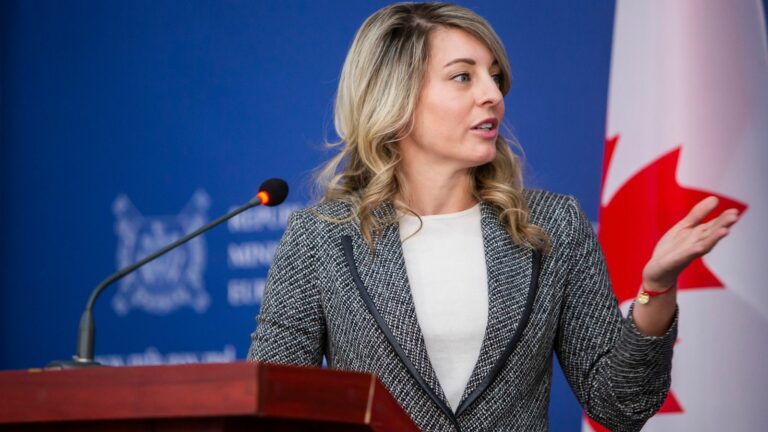
U.S. Ambassador Pete Hoekstra says American officials are monitoring comments and actions by Canadian political figures, including Industry Minister Mélanie Joly, that he believes could cross into election interference. Joly rejected the suggestion on October 14, insisting Canada would never interfere in American elections and expects the same respect in return.
The confrontation comes amid unresolved tariffs, stalled trade negotiations and increasingly heated political rhetoric on both sides of the border. It also raises a sensitive question: where does legitimate economic advocacy end and interference in another country’s democratic process begin?
The U.S. Ambassador Issues an Unusually Direct Warning
Joly Pushes Back as Trump’s Ambassador Warns Canada Over U.S. Election ‘Interference’
- The U.S. Ambassador Issues an Unusually Direct Warning
- Joly Rejects the Allegation and Defends Canada’s Position
- Retaliatory Tariffs Are at the Centre of the Dispute
- Ontario’s Ronald Reagan Advertisement Remains a Flashpoint
- Trudeau’s Comments Become Part of the Ambassador’s Complaint
- Trump’s Trade Adviser Had Already Threatened Canadian Lobbyists
- U.S. Election Law Draws Important Distinctions
- Michigan’s Senate Race Shows Why Canada Has Become an Election Issue
- The Warning Arrives While Trade Negotiations Remain Stalled
- Questions About Foreign Influence Extend in Both Directions
U.S. Ambassador Pete Hoekstra has put Canadian politicians on notice as Americans prepare for their November 3 midterm elections. During an interview on The Really Big Show podcast, published October 11, Hoekstra said American officials were closely monitoring political activities originating in Canada. He suggested that certain statements and actions by Canadian leaders could be interpreted as attempts to influence electoral outcomes in the United States. His warning extended beyond ordinary diplomatic criticism, raising the possibility that Washington could respond if it concluded Canadian activities crossed an unacceptable line.
Hoekstra specifically identified Industry Minister Mélanie Joly, former prime minister Justin Trudeau and an advertising campaign previously launched by Ontario’s government. He told Canadian politicians to keep their noses out of American politics and indicated that the United States would respond to conduct it considered election interference. The ambassador did not announce a formal investigation, specific sanctions or a legal finding of wrongdoing. Nevertheless, his remarks introduced another potential source of conflict into a relationship already struggling with tariffs, political disagreements and uncertainty about future trade arrangements.
Joly Rejects the Allegation and Defends Canada’s Position
Joly responded on October 14 during a Globe and Mail event in Ottawa focused on national defence. The industry minister rejected the suggestion that Canadian officials were interfering in American elections, making clear that Canada would not engage in such conduct. She also emphasized that Ottawa would not accept foreign interference in Canada’s domestic political affairs. Rather than treating Hoekstra’s warning as an accusation requiring a detailed defence, she presented Canada’s position as a basic principle of mutual respect between sovereign countries.
Joly also addressed her recent activities in the United States. She explained that she had met with both Democrats and Republicans during visits intended to attract American investment into Canada. Those discussions, she maintained, were part of her responsibilities as industry minister rather than an effort to influence American voters. She expressed optimism about future investment announcements involving U.S. companies. Her response highlighted the distinction Ottawa is trying to maintain: Canadian officials can promote economic interests, challenge foreign trade policies and meet American political leaders without necessarily participating in the country’s election campaigns.
Retaliatory Tariffs Are at the Centre of the Dispute
One of Hoekstra’s principal complaints concerns Joly’s earlier remarks about the political objectives behind Canadian counter-tariffs. Following Washington’s decision to impose 50% duties on approximately C$27.6 billion worth of Canadian goods in August, Ottawa announced corresponding measures against American products. Joly acknowledged that the Canadian response was designed partly to increase political pressure in sensitive American states. That strategy attracted renewed attention because several states affected by the trade conflict are also home to competitive congressional elections.
Canada introduced counter-tariffs of 15%, 25% and 50% on selected U.S. goods beginning September 8, covering approximately C$27.6 billion in imports. The measures targeted sectors including steel, dairy products, appliances, agricultural equipment, pulp and paper, and electronics. Ottawa described the response as necessary to protect Canadian workers and businesses. Hoekstra’s objection focuses on the political consequences of that strategy. However, using trade measures to influence another government’s policy is not automatically equivalent to illegally influencing an election. Establishing such a violation would require examining the specific actions and applicable American laws.
Ontario’s Ronald Reagan Advertisement Remains a Flashpoint
The ambassador’s warning also revived a controversy that disrupted trade negotiations in October 2025. Ontario Premier Doug Ford’s government launched a C$75 million advertising campaign aimed at American audiences, using excerpts from a 1987 speech by former U.S. president Ronald Reagan criticizing the economic consequences of tariffs. The advertisement reached viewers during the World Series, bringing Canada’s trade arguments into homes across the United States. President Donald Trump condemned the campaign and abruptly terminated trade negotiations with Ottawa.
The Ronald Reagan Presidential Foundation criticized the advertisement for presenting selected portions of the former president’s remarks without their full context. Independent fact-checkers confirmed that the words were authentic but rearranged and that the commercial omitted Reagan’s explanation of specific tariffs against Japan. They also found that its broader anti-protectionist message reflected much of Reagan’s original position. Ford subsequently agreed to pause the campaign after its scheduled World Series appearances. For Washington, the advertisement became an example of Canadian attempts to influence American opinion. For Ontario, it was an effort to defend industries threatened by U.S. tariffs.
Trudeau’s Comments Become Part of the Ambassador’s Complaint
Hoekstra also referenced remarks made by former prime minister Justin Trudeau during a September 22 appearance at Brown University in Rhode Island. Trudeau criticized the Trump administration’s trade approach, arguing that tariffs and disputes with Canada were increasing costs for American consumers without necessarily improving their economic circumstances. Speaking before an audience that included more than 1,300 university students, he described the deteriorating relationship as particularly troubling because of the countries’ longstanding economic and political connections.
Trudeau’s comments took place during a public discussion about international affairs, leadership and democracy, rather than at an American election campaign event. He was speaking as a former Canadian prime minister, not as a serving member of Carney’s cabinet. Hoekstra nevertheless included those remarks among the examples he believed warranted attention. The episode illustrates how the boundary between public criticism and alleged electoral influence has become politically contentious. A foreign public figure’s criticism of American government policy can enter domestic debate, even when it is not accompanied by an endorsement of a candidate or a request for Americans to vote in a particular way.
Trump’s Trade Adviser Had Already Threatened Canadian Lobbyists
Hoekstra is not the first senior Trump administration figure to raise the issue. On September 29, White House trade adviser Peter Navarro delivered a confrontational warning to Canadian lobbyists during an appearance at the American Growth Summit in Washington. Navarro criticized Canada’s history of lobbying American policymakers and suggested that Canadians seeking to influence political decisions should leave the country. He specifically mentioned Maine and Michigan, two states with important Senate contests in the approaching elections.
Navarro warned that Canada could face additional consequences if its activities were considered interference in those races. His remarks reflected frustration within the administration over Canadian efforts to persuade American officials to reconsider tariffs and other economic restrictions. Yet lobbying government representatives and providing prohibited election contributions are different activities under U.S. law. Navarro did not publicly establish that Canada’s trade lobbying constituted an electoral offence. For Canadian businesses that have long relied on relationships with American lawmakers, the message nevertheless creates uncertainty. Commercial advocacy that was once a routine part of cross-border relations is becoming entangled with accusations about political interference.
U.S. Election Law Draws Important Distinctions
American federal election law places strict limits on how foreign nationals can participate in elections. Under Section 30121 of Title 52 of the United States Code, foreign nationals generally cannot make campaign contributions, donations, independent expenditures or certain election-related communications intended to influence electoral outcomes. The Federal Election Commission also prohibits foreign nationals from directing or participating in decisions about election-related spending by political organizations. These restrictions apply to foreign governments and companies as well as many individuals who are not U.S. citizens or lawful permanent residents.
However, the commission also recognizes that foreign nationals may engage in political activity unrelated to supporting or opposing candidates. Expressing opinions about public policy, including trade disputes, is not automatically prohibited election activity. The legal distinction depends on factors such as the content of communications, spending, coordination and their connection to elections. Hoekstra’s warning did not identify a formal enforcement decision finding Canadian officials in violation of these restrictions. His statements therefore remain political and diplomatic allegations, rather than proof that Canada’s counter-tariffs, public speeches or investment discussions broke American election law.
Michigan’s Senate Race Shows Why Canada Has Become an Election Issue
The approaching November 3 elections help explain why the trade dispute has become politically sensitive. Republicans currently control both chambers of Congress, but competitive races could change that balance. Michigan is particularly important because its automotive industry depends heavily on cross-border manufacturing connections. Parts, raw materials and completed vehicles regularly move between Canada and the United States, leaving businesses exposed when tariffs increase production costs. The economic consequences have become a campaign issue for candidates seeking support from workers and consumers.
On October 7, Republican Senate candidate Mike Rogers publicly called for an end to the tariff conflict with Canada. In a campaign advertisement filmed in a bar, Rogers held a Labatt beer and emphasized Michigan’s close relationship with its northern neighbour. The advertisement represented a notable departure from his earlier support for Trump’s tariff policies. Rogers faces Democrat Abdul El-Sayed in a closely contested race. His change in messaging demonstrates that opposition to tariffs is not limited to Canadian politicians or American Democrats. Some Republican candidates are also confronting the economic consequences of Washington’s trade decisions.
The Warning Arrives While Trade Negotiations Remain Stalled
The latest diplomatic disagreement comes after another major breakdown in Canada–U.S. trade negotiations. On August 21, Prime Minister Mark Carney suspended formal discussions after concluding that revised American demands were unfair and economically damaging to Canadian interests. Washington subsequently implemented additional tariffs, while Ottawa responded with countermeasures and financial support for affected industries. Despite the suspension, communication between senior officials has continued. On October 8, U.S. Trade Representative Jamieson Greer confirmed that Washington remained in contact with Canadian counterparts but was holding to its negotiating position.
The economic stakes remain substantial. Statistics Canada reported that 71.7% of Canadian merchandise exports went to the United States in 2025, demonstrating how heavily Canadian producers depend on American customers. Conservative Leader Pierre Poilievre visited the Detroit-Windsor region on October 13 to promote a tariff-free automotive trade arrangement, arguing that integrated manufacturing benefits workers on both sides. His intervention showed that Canadian political parties remain committed to finding solutions, even as they disagree over Ottawa’s negotiating approach. Hoekstra’s accusations add diplomatic friction to an already complicated effort to restore predictable trading conditions.
Questions About Foreign Influence Extend in Both Directions
The dispute also comes as Canada confronts concerns about American political involvement within its own borders. An October investigation by The Globe and Mail reported that Republican political operatives had assisted Alberta separatist organizers and that some separatist leaders had sought support through meetings in Washington. The report generated controversy ahead of Alberta’s October 19 vote concerning the province’s future within Canada. Some individuals involved disputed descriptions of what had been discussed, and the reporting did not establish that the U.S. government had formally directed an interference campaign.
These developments demonstrate why Joly’s insistence on mutual non-interference carries significance beyond her immediate disagreement with Hoekstra. Canada wants to defend its interests in Washington while retaining control over its own democratic affairs. The United States, meanwhile, says it is concerned about foreign influence over its approaching elections. Both governments have legitimate interests in protecting democratic processes, but accusations require evidence and clear distinctions between political criticism, lawful advocacy and prohibited interference. For now, the exchange underscores a broader deterioration in trust. Whether that distrust leads to further retaliation or renewed diplomatic engagement will matter to businesses, workers and communities whose futures remain closely connected across the border.
This Options Discord Chat is The Real Deal
While the internet is scoured with trading chat rooms, many of which even charge upwards of thousands of dollars to join, this smaller options trading discord chatroom is the real deal and actually providing valuable trade setups, education, and community without the noise and spam of the larger more expensive rooms. With a incredibly low-cost monthly fee, Options Trading Club (click here to see their reviews) requires an application to join ensuring that every member is dedicated and serious about taking their trading to the next level. If you are looking for a change in your trading strategies, then click here to apply for a membership.