35,000+ smart investors are already getting financial news, market signals, and macro shifts in the economy that could impact their money next with our FREE weekly newsletter. Get ahead of what the crowd finds out too late. Click Here to Subscribe for FREE.
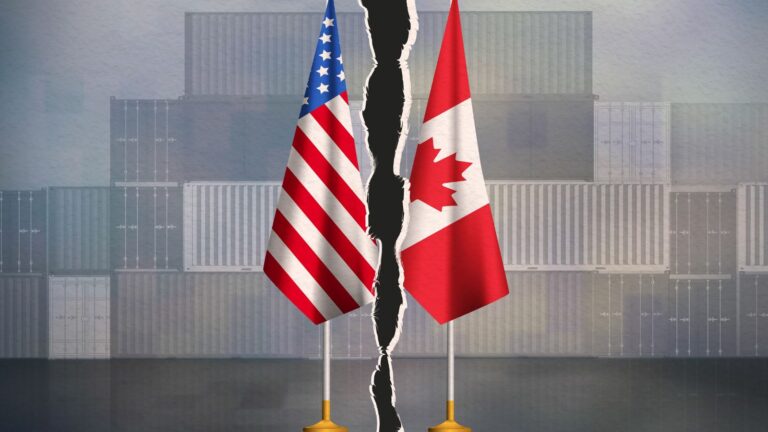
A bottle of Canadian beer has become an unlikely symbol of an American election fight. In Michigan, Republican Senate candidate Mike Rogers is urging an end to President Donald Trump’s tariff dispute with Canada, a neighbour whose factories, customers and workers are closely linked to the state’s economy.
His message arrives weeks before a competitive November 3 election and just as trade policy has become a point of confrontation with Democratic opponent Abdul El-Sayed. Rogers previously defended Trump’s use of tariffs, prompting questions about whether the change reflects economic concerns, campaign pressure, or both. Behind the political argument lies a more immediate worry: what prolonged trade barriers could mean for the prices people pay and the Michigan jobs that depend on cross-border business.
A Canadian Beer Delivers a Political Message
Michigan Republican Calls Canada “Not Our Enemy” as Trump’s Tariffs Become U.S. Election Issue
- A Canadian Beer Delivers a Political Message
- Why the New Position Attracted Scrutiny
- The Senate Contest Has Stakes Beyond Michigan
- The Trade Fight Reaches the Debate Stage
- Trump Reads the Advertisement as a Call for a Deal
- Canada Is Michigan’s Largest Foreign Customer
- The Auto Supply Chain Makes Tariffs Especially Costly
- How the Tariff Dispute Intensified
- Higher Prices Turn Trade Into a Household Issue
- El-Sayed Says Rogers Changed Course Too Late
- A Wider Republican Challenge Is Emerging
- What Happens After the Election Matters to Canada
In a 30-second advertisement released October 7, Rogers sits in a neighbourhood bar and begins with two familiar Michigan references: a Labatt beer and the Detroit Red Wings. The prop highlights Michigan’s cross-border ties. Rogers then states that Canada is not America’s enemy and calls for the tariff war to end immediately. The commercial makes a complicated trade dispute sound like a straightforward concern about neighbours and household budgets.
The message comes with an electoral promise. Rogers says he would work with both parties to lower prices if elected to the Senate, presenting cooperation as his answer to economic frustration. His campaign announced that the commercial would air statewide as part of a seven-figure advertising effort coordinated with the National Republican Senatorial Committee. Notably, Rogers does not mention Trump by name. That omission allows the Republican candidate to criticize a policy outcome without directly attacking the president who endorsed him.
Why the New Position Attracted Scrutiny
Rogers’ October message is striking because he had been far more supportive of Trump’s tariffs earlier in the campaign. Last year, he described the president’s tariff strategy as masterful. As recently as August 2026, he argued that tariffs were necessary when foreign countries treated American workers unfairly. In September, Reuters reported that Rogers continued to portray his relationship with Trump as an advantage, suggesting he could negotiate improvements rather than simply condemn the administration’s policies.
He now says the Canada dispute should end promptly, drawing a distinction between targeted pressure in trade talks and a prolonged confrontation that raises costs. He has not rejected all tariffs. The shift nevertheless presents an obvious question for voters: why was the tariff fight acceptable earlier but urgent to stop in October? Rogers’ answer emphasizes Michigan’s economic interests. He also promises bipartisan cooperation. His critics argue that the approaching election better explains the timing.
The Senate Contest Has Stakes Beyond Michigan
Rogers faces Democratic nominee Abdul El-Sayed in the November 3 election for the seat held by retiring Senator Gary Peters. Michigan matters because Democrats must defend an existing seat while gaining seats elsewhere to overcome the Republican Senate majority. Rogers narrowly lost Michigan’s 2024 Senate race to Democrat Elissa Slotkin. El-Sayed, a former public health official, won this year’s Democratic primary over Representative Haley Stevens.
The polls offer a picture of a competitive contest rather than a certain result. RealClearPolling’s average covering September 15 through October 6 showed El-Sayed ahead 48.1% to 44.9%, but individual surveys varied, with some measuring a one-point race. Michigan also backed Trump in the 2024 presidential election, underscoring its unpredictable electorate. In a contest this close, a campaign message about tariffs can serve several purposes at once: attracting independents, reassuring industrial communities and showing voters that a candidate will sometimes disagree with national party leadership.
The Trade Fight Reaches the Debate Stage
At their first televised debate in Grand Rapids on October 8, Rogers and El-Sayed confronted the tariff issue. Moderator Rick Albin raised gas prices, health care and foreign policy. The exchanges were frequently heated, with accusations and interruptions continuing even during a commercial break, according to local reporting. El-Sayed challenged Rogers over his changing position on Canada. Rogers replied that he wanted a negotiated deal, rather than an open-ended confrontation between two major trading partners.
The debate also exposed an important area of overlap. Neither candidate argued that every protective tariff must disappear. El-Sayed defended the possibility of carefully designed trade measures tied to industrial policy and union jobs, while criticizing Trump’s broader approach as clumsy. Rogers argued that tariffs could encourage investment and said some manufacturers had told him they benefited. The candidates disagreed over those claims. Voters were left weighing the competing claims about costs, production and jobs.
Trump Reads the Advertisement as a Call for a Deal
The White House did not treat Rogers’ advertisement as an outright rupture. Asked about it on October 7, Trump said he understood Rogers to be urging Canada to reach an agreement with Washington. Trump renewed his complaints about Canadian dairy restrictions. His response turned a candidate’s demand to end the tariff war into an argument for continuing negotiations until Canada offers terms the administration considers acceptable.
That response reveals how the two men frame the dispute differently. Rogers emphasizes economic uncertainty for Michigan; Trump emphasizes leverage over Canada’s trade policies. A settlement could serve both goals, but timing matters. After the October 8 debate, Rogers said he had contacted administration officials that week to press the issue and argued that the negotiations had gone on longer than expected. The distinction leaves voters to judge whether he is influencing the president or merely trying to separate himself from an unpopular policy.
Canada Is Michigan’s Largest Foreign Customer
The strength of Michigan’s economic relationship with Canada is measurable. According to the Office of the United States Trade Representative, the state exported US$60.3 billion in goods worldwide in 2025. Of that, US$23.2 billion went to Canada, accounting for about 39% of the total. Mexico, Michigan’s next-largest market, purchased US$16.6 billion. Those figures explain why Michigan businesses watch Canadian trade policies closely.
The relationship reaches well beyond giant carmakers. Federal data shows 13,631 companies exported goods from Michigan locations in 2024, and 88% were small or medium-sized businesses. The government estimates that Michigan’s merchandise exports to all countries supported 230,000 jobs in 2023. That employment figure must not be mistaken for jobs tied specifically to Canada, but it does illustrate how much of the state’s economy depends on access to foreign markets. For smaller suppliers, an uncertain order from Ontario can affect staffing and purchasing decisions at home.
The Auto Supply Chain Makes Tariffs Especially Costly
Michigan and Ontario do not build vehicles in separate economic worlds. They are parts of an interconnected manufacturing system in which engines, transmissions, metal components and other materials may move across the border during production. Canadian officials estimate some parts cross the border up to six times before final assembly. Tariffs or delays can therefore affect more than an individual imported product: they can add costs at several points in a production process.
The scale of the relationship is visible at Detroit and Windsor. In an October 2025 address, Michigan Governor Gretchen Whitmer said more than 10,000 commercial vehicles carrying materials crossed the Ambassador Bridge on a typical weekday. Michigan and Canada opened another connection in July 2026, when the Gordie Howe International Bridge began carrying traffic. Those investments aim to strengthen trade links despite political uncertainty. Suppliers need confidence that components can cross those bridges reliably and affordably.
How the Tariff Dispute Intensified
In July 2026, Trump invoked Section 338 of the U.S. Tariff Act of 1930 to announce additional duties of 50% on specified Canadian products. The White House said it was responding to discriminatory treatment of American vehicles, alcoholic beverages and dairy products. The three proclamations targeted specific goods, not all imports. Washington briefly postponed implementation, and the new duties took effect on August 22. U.S. trade officials estimated the affected imports at close to US$20 billion.
Canada answered with countermeasures. The federal government announced additional tariffs of 15%, 25% and 50% on selected American imports beginning September 8, affecting C$27.6 billion in goods. The product categories included steel, dairy, appliances, farm equipment, paper and electronics. Ottawa presented its response as a defence of Canadian workers and industries; Washington maintained that its original measures addressed unfair trade practices. Both governments defend their actions, while cross-border businesses face added costs and uncertainty.
Higher Prices Turn Trade Into a Household Issue
Research helps explain why a disagreement over import duties can matter to families who rarely think about customs rules. In a study revised in September 2026, economists at the Federal Reserve Bank of New York estimated that about 26% of the tariff increases they examined passed through to consumer prices. The study examined 2025 tariffs, not the 2026 Canada-specific measures. It also showed how tariffs affect imports and American-made products using foreign parts.
The researchers found that some indirect price effects took nine to twelve months to emerge. Michigan officials have reported that tariffs raised raw-material and production costs and contributed to slower investment or hiring for some companies. The findings do not isolate costs from the latest Canada dispute. They show why a trade confrontation invites scrutiny. Voters weighing wages, car payments and budgets may judge tariffs less by their stated negotiating purpose than by the prices they encounter.
El-Sayed Says Rogers Changed Course Too Late
Democratic nominee Abdul El-Sayed has made Rogers’ previous support for tariffs central to his response. After the advertisement, El-Sayed mocked the Labatt reference and accused his opponent of changing direction because of weakening poll numbers. At the debate, he returned to the same criticism, saying Rogers was pretending not to have supported the policy earlier. The accusation does not establish Rogers’ motives. Rogers did previously praise Trump’s approach.
El-Sayed is not campaigning on the elimination of every American trade barrier, either. During the debate, he spoke favourably about smart tariffs connected to industrial policy, echoing arguments made by parts of organized labour. The difference he seeks to draw is between carefully targeted protection for American workers and a confrontation that increases costs without securing clear benefits. Rogers counters that his working relationship with Trump could make him more effective in winning concessions. Voters must decide which approach protects Michigan’s economy.
A Wider Republican Challenge Is Emerging
Rogers’ recalibration fits a broader pattern across closely fought congressional races. In an October 7 review, Reuters examined 62 competitive contests and found Republican candidates in 41 were distancing themselves from Trump on at least one issue or playing down their ties to him. Most objections concerned individual policies, not the president’s broader agenda. For Rogers, Canada tariffs and the Iran war have become prominent examples of issues on which he has shown greater independence.
The calculation is delicate. Republicans need Trump’s supporters while competing for independents worried about costs. In another northern border state, Maine Republican Senator Susan Collins has also expressed concerns about tariffs and sought exceptions for affected industries. What these cases demonstrate is that trade policy can produce distinct political pressures in places where international commerce is local commerce. The messages sent from Michigan and Maine may matter in Washington even before election results are known.
What Happens After the Election Matters to Canada
Michigan’s election will not end the Canada-U.S. tariff dispute. Washington controls the tariffs, while broader agreements require negotiations. Uncertainty already surrounds the United States-Mexico-Canada Agreement. During its July 1, 2026 joint review, Washington declined to renew the agreement in its existing form. The agreement remains in force, an important distinction for firms operating under its rules. Trade disagreements still require negotiations.
As of October 8, U.S. Trade Representative Jamieson Greer said Washington was maintaining its negotiating position while remaining in communication with Canadian officials. Rogers wants a settlement sooner; El-Sayed argues his opponent helped defend the policy that created the confrontation. For Canadian and Michigan businesses, the question is whether the next weeks bring clearer terms for cross-border operations or more uncertainty. The Labatt advertisement captures a larger point: in a border state, a foreign trade partner can shape the livelihoods of voters who will soon choose their next senator.
This Options Discord Chat is The Real Deal
While the internet is scoured with trading chat rooms, many of which even charge upwards of thousands of dollars to join, this smaller options trading discord chatroom is the real deal and actually providing valuable trade setups, education, and community without the noise and spam of the larger more expensive rooms. With a incredibly low-cost monthly fee, Options Trading Club (click here to see their reviews) requires an application to join ensuring that every member is dedicated and serious about taking their trading to the next level. If you are looking for a change in your trading strategies, then click here to apply for a membership.