35,000+ smart investors are already getting financial news, market signals, and macro shifts in the economy that could impact their money next with our FREE weekly newsletter. Get ahead of what the crowd finds out too late. Click Here to Subscribe for FREE.
A resource that American space engineers hope to recover from lunar soil is already being collected at a nuclear facility east of Toronto. The rare gas is helium-3, an ingredient in some quantum-computing refrigeration systems and instruments used in security and medical research.
NASA awarded Seattle-based Interlune a US$6.9 million contract in May 2026 to develop technology for examining and extracting gases from Moon dust. Yet Ontario Power Generation’s subsidiary Laurentis Energy Partners has recovered helium-3 at Darlington for years.
That contrast prompted Chris Cassin, chief executive of Alberta-based Zero Point Cryogenics, to argue that Canada should treat its supply as a strategic asset. His proposal raises a bigger question: could an isotope already produced on Canadian soil become more valuable as international demand grows?
NASA’s $6.9 Million Award Is for Technology, Not a Working Mine
U.S. Spends $6.9 Million Pursuing Moon Resource That Ontario Nuclear Plants Already Produce, Canadian Executive Says
- NASA’s $6.9 Million Award Is for Technology, Not a Working Mine
- Darlington Is Already Recovering the Same Rare Gas
- The Science Begins With Tritium, Not With Moon Dust
- A Canadian Executive Wants Ottawa to Think Strategically
- Quantum Computers Explain Much of the Excitement
- Helium-3 Also Matters for Security and Medical Research
- Big Lunar Purchase Agreements Show Demand, Not Deliveries
- The Moon Has Helium-3, but Recovering It Is Another Problem
- The United States Is Developing Earth-Based Alternatives Too
- Ontario Has Already Built an International Sales Channel
- Federal Quantum Spending Raises the Stakes for Supply Chains
- A Strategic Reserve Could Help, but Trade Leverage Is Unproven
On May 4, NASA announced a fixed-price US$6.9 million contract with Interlune, spread over approximately 18 months. The company is developing instruments to scoop up lunar regolith, sort its particles, release trapped gases and measure what comes out. The target materials include helium-3 and hydrogen, alongside information valuable for future missions. The work is being funded through NASA’s Small Business Innovation Research program, which supports technology development by smaller companies.
The distinction between funding research and paying for a working mine is important. NASA has awarded a development contract; it has not announced that Interlune is commercially extracting helium-3 from the Moon or shipping it back to Earth. The planned equipment incorporates a mass spectrometer derived from NASA technology and is intended to be ready for a robotic lunar flight in 2028. Its results could show whether harvesting enough gas is technically practical. They cannot yet establish that extracting, transporting and selling it will be profitable.
Darlington Is Already Recovering the Same Rare Gas
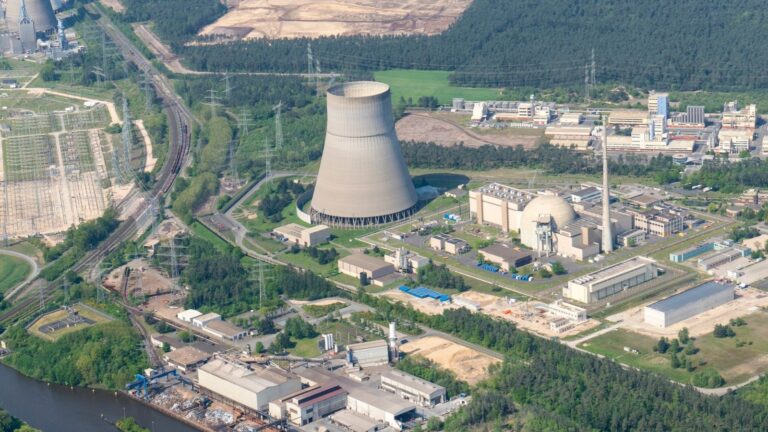
About 100 kilometres east of Toronto, the Darlington Nuclear Generating Station has a very different route to helium-3. The site is operated by Ontario Power Generation, whose subsidiary Laurentis Energy Partners developed equipment to recover the isotope from tritium stored at the facility. Laurentis announced its first extraction in November 2021, followed by a commercial distribution agreement in December. Unlike the proposed lunar project, this is an established Earth-based recovery process.
Ontario Power Generation describes Laurentis as the world’s largest civilian producer of helium-3. That is a significant claim from an operator directly involved in the business, but it should not be mistaken for a verified figure showing how many litres Canada could supply annually. Publicly cited announcements establish that helium-3 is recovered and distributed; they do not provide a complete, current accounting of domestic production, export volumes or available reserves. Those numbers would matter enormously if Ottawa were considering whether to redirect supply to Canadian customers or establish a stockpile.
The Science Begins With Tritium, Not With Moon Dust
The isotope has an unusual origin in Ontario’s CANDU nuclear reactors. These plants use heavy water, containing the hydrogen isotope deuterium, in their operations. Neutron interactions gradually produce tritium, a radioactive form of hydrogen. Darlington’s tritium-removal facility separates, concentrates and stores that material. As tritium decays, it turns into helium-3, which can then be recovered using specialized equipment. It is not simply bottled straight from the electricity-generating machinery.
Tritium has a half-life of approximately 12.3 years, meaning half of a given amount decays over that period. Helium-3, in contrast, is stable and non-radioactive. It is also different from helium-4, the much more common isotope associated with party balloons and industrial gas supplies. These distinctions explain both the opportunity and the limitation of Canada’s supply: Ontario has a predictable way to obtain helium-3 from stored tritium, but the available quantity depends on the tritium inventory, the rate of decay, recovery capacity and competing uses of the material.
A Canadian Executive Wants Ottawa to Think Strategically
Chris Cassin, the chief executive of Edmonton-based Zero Point Cryogenics, made the case in an October 10 Financial Post commentary. His company manufactures dilution refrigerators used for ultralow-temperature research and quantum technology, giving him a direct business interest in dependable helium-3 supplies. Cassin argued that Canada is missing an opportunity by selling the isotope internationally without building a dedicated domestic reserve or guaranteeing Canadian users first access.
The executive had made a similar point publicly on September 29, when engineering company AtkinsRéalis announced that Zero Point Cryogenics was joining its Canadians for CANDU initiative. The broader message is about economic security: a small but indispensable input can become strategically important when high-value industries rely on it. Cassin’s concerns deserve consideration, but they remain an industry leader’s policy argument, not a government finding that Canada has lost a measurable amount of trade leverage. Assessing that claim requires reliable figures for production, existing contracts and prospective Canadian demand.
Quantum Computers Explain Much of the Excitement
For certain quantum computers, extreme cold is an essential operating condition. Superconducting quantum processors and many spin-based systems need temperatures only thousandths of a degree above absolute zero to reduce thermal interference. Dilution refrigerators achieve those conditions by circulating a mixture of helium-3 and helium-4. That is where a gas most people have never encountered becomes an important part of the hardware supporting ambitious computing research.
Zero Point Cryogenics manufactures these refrigerators in Canada, while companies such as Finland’s Bluefors sell them internationally. Yet it would be misleading to claim every quantum computer requires helium-3. Researchers pursuing neutral-atom, trapped-ion and other architectures often depend instead on lasers, optics or vacuum systems. A September analysis by the Center for Strategic and International Studies stressed that quantum supply-chain needs differ according to the technology. Growing investment in quantum computing could lift helium-3 demand significantly, but forecasts depend on which machine designs succeed and whether alternative cooling methods improve.
Helium-3 Also Matters for Security and Medical Research
The appeal of helium-3 extends beyond quantum laboratories. Certain neutron detectors use the isotope to identify signals associated with nuclear materials, making it useful in security screening at borders and ports. The U.S. Department of Energy’s Isotope Program specifically identifies helium-3 as important for neutron-detection applications. Ontario Power Generation also points to medical imaging, including specialized research involving magnetic resonance imaging of the lungs, among the isotope’s uses.
These applications help explain why the conversation has moved from specialized science to industrial policy. A constrained supply can affect research equipment, security systems and medical projects long before any futuristic energy application becomes practical. Helium-3 is often discussed as a possible fuel for nuclear fusion, but commercial electricity generation from helium-3 fusion remains a research ambition, not an established market. Treating that prospect as guaranteed demand would exaggerate today’s opportunity. The stronger case for policy attention rests on demonstrable uses already supported by functioning instruments and customers willing to pay for reliable supplies.
Big Lunar Purchase Agreements Show Demand, Not Deliveries
Interlune says it has nearly US$500 million in binding purchase orders for helium-3 from government and private customers. Its announced customers include Bluefors, which agreed in September 2025 to purchase up to 10,000 litres annually between 2028 and 2037. Another customer, Maybell Quantum, announced plans to buy thousands of litres a year beginning in 2029. Such arrangements help explain why investors and engineers are exploring extraction methods far beyond conventional industrial gas production.
Those figures also require careful interpretation. The nearly US$500 million total is reported by Interlune, and contracts for future supply are not evidence that lunar material has already been produced or delivered. Their commercial value depends on terms, delivery milestones, and the company’s ability to create a dependable supply chain. The Bluefors deal is especially noteworthy because that company builds cooling equipment used in quantum research. Still, a commitment to buy a material if it becomes available cannot by itself answer how much the first lunar mine would cost to operate.
The Moon Has Helium-3, but Recovering It Is Another Problem
The Moon’s appeal comes partly from its long exposure to the solar wind. Charged particles from the Sun have reached the lunar surface for billions of years, embedding gases in the upper layers of rocky dust known as regolith. Earth has an atmosphere and magnetic environment that provide much greater protection. But the presence of an element in lunar soil is not equivalent to an accessible, concentrated deposit that a company can extract economically.
Interlune’s proposed 2028 payload is meant to address some of those unanswered questions. Its instruments would collect and sort samples, release gases through thermal or mechanical processes, and measure their concentrations. That information could help scientists determine how much material must be processed and how much energy the recovery process needs. Even after a successful experiment, substantial engineering challenges would remain, including equipment durability, abrasive dust, remote operations and transporting a refined product to Earth. Ontario’s existing system does not face a lunar launch or return journey, although it has its own production limits.
The United States Is Developing Earth-Based Alternatives Too
It would be inaccurate to suggest the United States has no terrestrial helium-3 supply and must depend on a future Moon mine. The Department of Energy already manages a federal inventory of the isotope, much of which has historically come from tritium associated with the nuclear weapons complex. Its Isotope Program distributes helium-3 for research and national-security applications, while American developers are looking for other ways to increase available supplies.
Interlune itself demonstrated an Earth-based approach in July 2026. The company said its Cold Capture technology had produced helium-3 at 99% purity from conventional helium gas, with support from a U.S. Air Force development program. That is a laboratory and technology milestone, not proof of industrial production at the volumes anticipated by quantum companies. It nevertheless changes the comparison with Canada: Washington’s approach includes space prospecting, government-managed material and new terrestrial separation technology. Canada’s established civilian supply is a potential advantage, but it is not the only pathway under development.
Ontario Has Already Built an International Sales Channel
Laurentis did not leave its recovered helium-3 sitting unused. In December 2021, it announced a long-term commercial arrangement with Air Liquide, the international industrial-gases company. Under that partnership, Laurentis supplies helium-3 recovered at Darlington, while Air Liquide performs further purification, packaging and distribution for customers in fields such as advanced research, security and health care. Ontario Power Generation has subsequently confirmed that the isotope is being sold through this relationship.
For Canada, that agreement illustrates both progress and a policy dilemma. The country has already created a route from a nuclear byproduct to paying international customers. A government decision to hold back more material for domestic laboratories could improve supply certainty for selected users, but it could also affect export sales and existing commercial arrangements. Cassin argues that too little is being retained in Canada, although public reporting does not provide a comprehensive inventory to verify the scale of that concern. Before changing allocation rules, policymakers would need to establish who buys the isotope, in what quantities and on what terms.
Federal Quantum Spending Raises the Stakes for Supply Chains
Canada has financial reasons to care about the equipment supporting quantum research. Ottawa’s 2025 budget allocated C$334.3 million over five years to strengthen the country’s quantum ecosystem, including up to C$92 million for the first phase of the Canadian Quantum Champions Program. That first phase was announced in December 2025. The funding is broader than helium-3 and should not be presented as a government purchase of the isotope or as money set aside for a national stockpile.
The strategic connection is nonetheless clear. Supporting promising quantum companies means paying attention not only to processors and software, but also to the physical systems that allow certain processors to function. Canada’s ability to manufacture dilution refrigerators and recover helium-3 could give domestic researchers and manufacturers useful supply-chain options. The precise benefit would depend on technology choices: some quantum platforms consume helium-3 through their cooling infrastructure, while others do not need that particular material. An effective national plan would distinguish those different requirements instead of treating the entire quantum industry as one market.
A Strategic Reserve Could Help, but Trade Leverage Is Unproven
Cassin wants Ottawa to establish a dedicated helium-3 reserve and give Canadian researchers, businesses and defence programs more reliable access before exporting surplus supply. One important qualification is that Canada already includes helium on its federal list of 34 critical minerals. That designation covers helium generally; it does not, by itself, establish a separate public reserve or a domestic allocation system for the rare helium-3 isotope. The policy gap Cassin identifies is therefore more specific than a total failure to recognize helium’s importance.
Whether a stockpile would also strengthen Canada’s hand in trade talks with Washington remains uncertain. Bargaining power would depend on actual inventories, American demand, alternative suppliers, contract obligations and the consequences of restricting exports. Neither the NASA contract nor Ontario’s confirmed recovery operation proves the size of that leverage. What they do show is an unusual contrast: one country is paying to test ways of accessing a difficult extraterrestrial resource, while its neighbour already has a commercial source on Earth. Turning that head start into long-term advantage would require evidence-based planning, not just an attention-grabbing comparison.
This Options Discord Chat is The Real Deal
While the internet is scoured with trading chat rooms, many of which even charge upwards of thousands of dollars to join, this smaller options trading discord chatroom is the real deal and actually providing valuable trade setups, education, and community without the noise and spam of the larger more expensive rooms. With a incredibly low-cost monthly fee, Options Trading Club (click here to see their reviews) requires an application to join ensuring that every member is dedicated and serious about taking their trading to the next level. If you are looking for a change in your trading strategies, then click here to apply for a membership.