35,000+ smart investors are already getting financial news, market signals, and macro shifts in the economy that could impact their money next with our FREE weekly newsletter. Get ahead of what the crowd finds out too late. Click Here to Subscribe for FREE.
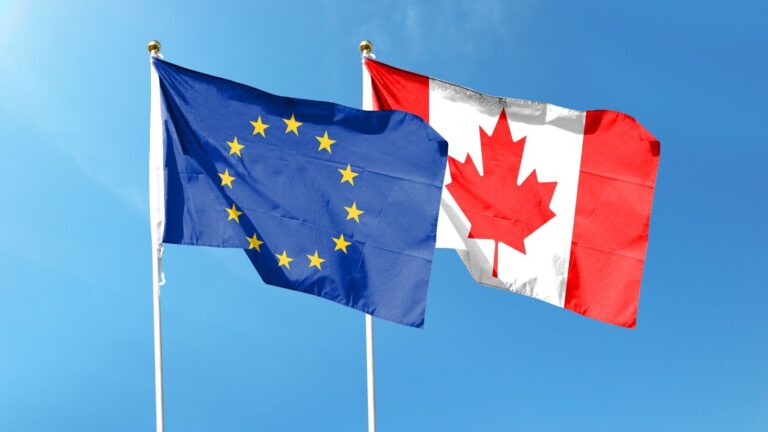
Canada’s effort to build deeper ties with Europe appears to have substantial public support. A new Leger poll suggests 70% of Canadians support the idea of Canada becoming an associate member of the European Union, even though neither Ottawa nor Brussels has settled exactly what that status would mean.
The result arrives as Prime Minister Mark Carney accelerates a broader strategy to reduce Canada’s economic dependence on the United States without abandoning the deeply integrated relationship between the two countries. Europe has become one of the most visible parts of that effort, with discussions now stretching well beyond conventional trade into defence procurement, critical minerals, artificial intelligence, research, energy and the ability of younger Canadians and Europeans to work and study across the Atlantic.
The Leger Numbers Show Broad Support — With Important Conditions
70% of Canadians Back Closer EU Ties as Carney Pushes Canada Away From U.S. Dependence: Leger
- The Leger Numbers Show Broad Support — With Important Conditions
- “Associate Member” Still Has No Settled Definition
- Canada’s U.S. Dependence Is Still Enormous
- CETA Means Canada and Europe Are Not Starting From Zero
- Defence Cooperation Is Already Moving Beyond Traditional Trade
- Work, Study, Research and Finance Could Make the Shift More Visible
- The Public Mandate Has Limits That Negotiators Cannot Ignore
- Europe Can Reduce Canada’s Exposure Without Replacing the United States
Leger’s online poll, conducted from September 19 to 21 among 1,533 Canadians, found that 70% supported the concept of Canada becoming an EU associate member. Another 18% were unsure, while 13% opposed the idea. Support was particularly high among older Canadians, approaching 80% among seniors, while more than 70% of respondents in Ontario and Quebec supported the proposal. Because the research was conducted using an online panel rather than a random probability sample, the Canadian Research Insights Council says a traditional margin of error cannot be assigned to the results.
The details reveal something more complicated than a blanket endorsement of European integration. Greater market access for Canadian and European businesses drew support above 60% in most provinces. More defence cooperation and increased freedom to live, work and travel across the Atlantic also received majority support nationally. But attitudes became more cautious when regulatory sovereignty entered the question. Only 25% said having to change some Canadian laws or regulations to align with the EU would make them more supportive of a deal, while 30% said it would make them less supportive. The polling therefore points toward strong interest in practical cooperation, but not necessarily in importing European governance wholesale.
“Associate Member” Still Has No Settled Definition
The unusual part of the debate is that the status Canadians are being asked about does not formally exist in current EU treaties. European Commission President Ursula von der Leyen opened the door on September 16 to Canada becoming the EU’s first “associate member,” describing a broader “Alliance for the Future” that could extend cooperation into technology, advanced manufacturing, defence, Arctic issues, energy, minerals and economic security. Carney welcomed the ambition when he addressed the European Parliament a day later, but Canadian officials have repeatedly emphasized that the eventual substance matters more than the name attached to it.
That leaves enormous questions still to be negotiated. It is not full EU membership, and Canada is not currently seeking to become a conventional member state. There is no agreed package of voting rights, financial obligations, regulatory requirements or single-market privileges. Some European governments have also expressed reservations about the terminology even while supporting stronger Canada-EU cooperation. Those uncertainties make the Montreal Canada-EU summit scheduled for October 29 and 30 particularly significant. It could provide the first clearer indication of whether “associate membership” becomes a meaningful institutional arrangement or whether the two sides instead assemble a collection of narrower agreements covering trade, security, research, mobility and strategic industries.
Canada’s U.S. Dependence Is Still Enormous
The political appeal of diversification becomes easier to understand when Canada’s trade numbers are considered. Statistics Canada reported that 71.7% of Canadian merchandise exports went to the United States in 2025. That was already down substantially from 75.9% in 2024, but it still means roughly seven out of every ten dollars in exported Canadian goods depended on the American market. Geographic proximity, integrated manufacturing networks, pipelines, railways and decades of cross-border investment cannot simply be recreated across the Atlantic.
There has nevertheless been measurable movement elsewhere. Statistics Canada reported that Canadian exports to countries other than the United States rose 17.2% in 2025, while total merchandise trade with non-U.S. countries climbed 14.3%. Global Affairs Canada has similarly said the non-U.S. share of Canadian exports reached its highest level since 1981. Carney’s government has turned that shift into an explicit economic objective, repeatedly stating that it intends to double non-U.S. exports over the coming decade, which Ottawa says could mean roughly $300 billion in additional orders for Canadian goods, resources and expertise. In practical terms, the policy is diversification rather than economic separation from the United States.
CETA Means Canada and Europe Are Not Starting From Zero
Closer integration with Europe would build on an economic relationship that has already expanded considerably. The Comprehensive Economic and Trade Agreement, better known as CETA, has been provisionally applied since September 2017. The European Commission says Canada-EU trade in goods and services reached approximately €130 billion in 2025, up about 80% from €72.1 billion in 2016. Canadian government figures put combined goods and services trade at C$178.6 billion in 2025, making the EU Canada’s second-largest global trading partner for goods and services after the United States.
CETA has also removed the vast majority of tariffs. About 98% of tariff lines were eliminated when provisional application began, and the European Commission says 99% had been abolished by 2024. The relationship extends beyond goods crossing ports. Canadian direct investment in the EU stood at roughly C$297 billion in 2024, while EU foreign direct investment in Canada was estimated at C$194 billion when measured using the ultimate-investor approach. Even so, unfinished business remains. CETA has still not completed national ratification in every EU member state, illustrating how slowly European agreements can move when decisions require approval across multiple governments and legislatures.
Defence Cooperation Is Already Moving Beyond Traditional Trade
One reason the current Canada-Europe relationship looks different from earlier diversification efforts is that defence has become central to it. Canada and the EU signed a Security and Defence Partnership in June 2025, creating a framework for deeper cooperation on military capabilities, maritime security, cyber threats and defence industries. Canada then formally joined the European Union’s Security Action for Europe, or SAFE, initiative in February 2026, becoming the first non-European country to obtain that level of access to the program.
SAFE provides up to €150 billion in loans to EU member states for defence procurement and investment. Canada’s agreement gives Canadian companies preferential participation rules: National Defence says Canadian industry can provide up to 80% of the contract value in qualifying SAFE procurements. That creates a commercial opportunity as European governments expand military spending, while also giving Canada additional potential suppliers and partners beyond the American defence industrial base. Carney has placed defence alongside critical minerals, artificial intelligence, energy security, space and advanced computing in his proposed European partnership. The significance is that diversification is no longer confined to finding different customers for Canadian commodities. Ottawa is increasingly trying to build alternative strategic supply chains as well.
Work, Study, Research and Finance Could Make the Shift More Visible
For many Canadians, the most noticeable consequences of a deeper relationship may have little to do with tariffs. Carney has proposed expanding opportunities for young Canadians and Europeans to live, work and study on either side of the Atlantic. He has specifically raised Canadian participation in Erasmus+, the European education and mobility program, as well as involvement in the next generation of Horizon, the EU’s large research and innovation framework. The objective would be to connect Canadian universities, researchers and students more closely with European institutions while increasing opportunities for international education and scientific collaboration.
Ottawa has also proposed exploring a more integrated market for financial services, alongside closer digital trade and technology cooperation. Those discussions could eventually affect everything from financial-sector competition to cross-border investment and the movement of professional talent. The Leger findings suggest these practical benefits may be among the easier elements to sell domestically: more flexibility to live, work and travel in Europe attracted majority support. But every such initiative would still require detailed negotiations. Immigration rules, professional licensing, financial regulation, privacy standards and government jurisdiction differ substantially across Canada and the 27-member European Union, meaning broad political aspirations would have to be converted into highly technical agreements.
The Public Mandate Has Limits That Negotiators Cannot Ignore
The strongest caution in the polling is that Canadians appear more comfortable with cooperation than with surrendering domestic policy control. Manitoba and Saskatchewan stood out from Ontario and Quebec, with more than a quarter of respondents in those Prairie provinces opposing associate membership and another quarter uncertain. Support for expanded reciprocal business access was also considerably lower there: 44%, compared with more than 60% in every other region reported by The Canadian Press. Leger executive Andrew Enns pointed to agriculture as one possible factor, noting the historically complicated relationship between Canadian farm exports and European rules.
The proposal has also become a domestic political dividing line. Conservative Leader Pierre Poilievre has said Canada should not become what he calls the EU’s “28th state” and has warned against accepting European taxes, laws or immigration policies. No agreement containing those measures has been announced, and the precise obligations of an associate arrangement remain undefined. Carney, meanwhile, has said any eventual partnership will preserve Canadian sovereignty and has indicated that Parliament will debate and vote on the final framework. That means the decisive stage begins when governments move from broad language about resilience and shared values to the actual terms Canadians would be asked to accept.
Europe Can Reduce Canada’s Exposure Without Replacing the United States
The 70% Leger result gives the federal government evidence that a large share of Canadians is receptive to a deeper European relationship. It does not establish support for every possible version of that relationship. The polling instead suggests a fairly clear distinction: Canadians appear interested in greater trade access, defence cooperation, mobility and economic diversification, while becoming more cautious when cooperation potentially requires significant changes to Canadian laws and regulations.
That distinction also reflects the economic reality confronting Ottawa. Europe can become a larger customer, investor, defence partner and source of technology, but it cannot erase the enormous advantages created by sharing the world’s longest international border with the United States. Canada still sends more than 70% of its merchandise exports south, while the EU remains a much smaller share of the country’s trade. Carney’s strategy is therefore better understood as an attempt to reduce the risks of dependence rather than end the Canada-U.S. economic relationship. Whether the European opening meaningfully changes that balance will depend less on the symbolism of “associate membership” than on the market access, investment, mobility and industrial agreements that Ottawa and Brussels actually manage to negotiate.
This Options Discord Chat is The Real Deal
While the internet is scoured with trading chat rooms, many of which even charge upwards of thousands of dollars to join, this smaller options trading discord chatroom is the real deal and actually providing valuable trade setups, education, and community without the noise and spam of the larger more expensive rooms. With a incredibly low-cost monthly fee, Options Trading Club (click here to see their reviews) requires an application to join ensuring that every member is dedicated and serious about taking their trading to the next level. If you are looking for a change in your trading strategies, then click here to apply for a membership.