35,000+ smart investors are already getting financial news, market signals, and macro shifts in the economy that could impact their money next with our FREE weekly newsletter. Get ahead of what the crowd finds out too late. Click Here to Subscribe for FREE.
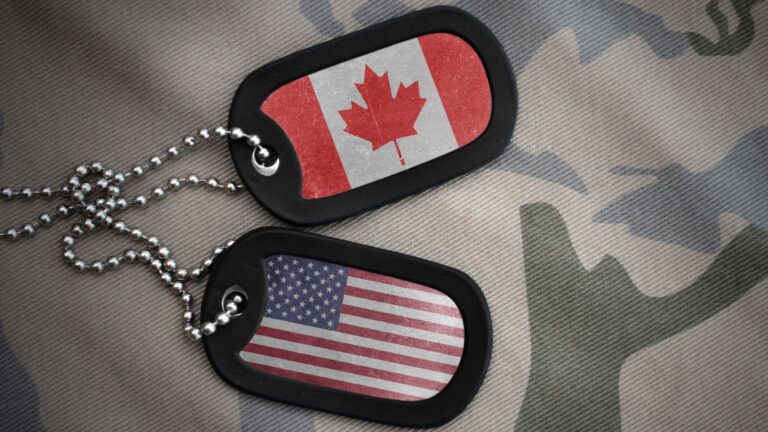
Prime Minister Mark Carney has disclosed that Canada examined an extraordinary scenario few Canadians would once have expected their government to contemplate: possible U.S.-led military action against the country. In a New York Times interview published September 23, Carney described such an event as an “extreme tail risk” rather than an outcome his government expects. He said considering it was part of responsible risk management and declined to disclose what any preparations involved.
The distinction matters. Carney was not predicting an American attack, and President Donald Trump previously ruled out using military force to annex Canada. The disclosure instead shows how dramatically Ottawa’s thinking about economic dependence, defence procurement and national resilience has changed during a prolonged period of Canada-U.S. tension.
What Carney Actually Said About the Risk
Carney Says He Prepared for ‘Extreme Tail Risk’ of U.S. Military Action Against Canada
- What Carney Actually Said About the Risk
- Trump Previously Ruled Out Military Force Against Canada
- “Tail Risk” Comes From the Language of Crisis Planning
- Canada and the United States Still Share an Integrated Defence System
- The Trade Fight Has Changed Ottawa’s View of Dependence
- Fighter Jets and Satellites Are Part of the Same Debate
- Canada Is Building More Options Outside the United States
- Carney and Trump Are Still Talking Despite the Dispute
- Why the Disclosure Is Significant Without Assuming War Is Coming
Carney’s comments emerged when he was asked how seriously he had taken Trump’s repeated statements about Canada becoming the 51st U.S. state. Rather than saying his government expected military action, Carney framed the issue in the language of contingency planning. He said leaders have a responsibility to examine “extreme tail risk” and described that exercise as risk management. Crucially, he added that military action was “not a base case,” meaning it was not the scenario the government regarded as the normal or most likely outcome. Carney did not publicly describe military deployments, operational plans or specific responses Canada had developed.
That qualification changes how the remarks should be understood. Governments routinely prepare for events they hope and expect will never happen, from natural disasters to financial crises and national-security emergencies. Carney’s background in central banking also makes the terminology familiar. Bank of Canada research describes extreme events as rare but potentially highly consequential, while IMF stress-testing guidance has long examined “extreme but plausible” shocks precisely because historical experience may provide little guidance about unprecedented events.
Trump Previously Ruled Out Military Force Against Canada
The immediate history behind Carney’s answer stretches back to January 2025. During a news conference at Mar-a-Lago, Trump was directly asked whether he would consider military force to acquire Canada after discussing possible coercive action involving Greenland and the Panama Canal. His answer regarding Canada was no. Instead, Trump said he would use “economic force” and argued that removing the Canada-U.S. border would produce economic and national-security benefits.
Trump subsequently continued talking about Canada as a potential 51st state, making the subject more than a one-day controversy even though his original response explicitly excluded military force against Canada. That record is important when assessing Carney’s latest remarks. There is no public statement from Carney establishing that Washington has adopted a policy of military action toward Canada, and his own description places the possibility at the far edge of the risk spectrum. The significance lies less in evidence of an impending attack than in the fact that Canada’s prime minister considered the possibility serious enough to examine at all.
“Tail Risk” Comes From the Language of Crisis Planning
The phrase Carney chose is unusually technical for a discussion about relations between neighbouring countries. In finance and economics, a tail risk generally refers to a relatively rare outcome sitting at the extreme end of a probability distribution but carrying potentially enormous consequences. Bank of Canada researchers have noted that events such as major economic crises are infrequent and therefore difficult to model accurately, even though their impact can be severe.
That helps explain why acknowledging such a scenario does not mean assigning it a high probability. Stress-testing frameworks deliberately ask institutions to explore shocks outside the expected case. IMF guidance notes that tail-risk exercises often use scenarios such as one-per-cent-probability events or unprecedented situations for which historical evidence is inadequate. Carney essentially applied that risk-management vocabulary to geopolitics. His public wording suggested a distinction between preparing for a catastrophic possibility and expecting it to happen. That distinction is especially important with an issue as consequential as possible military action between two NATO allies whose defence systems have been intertwined for decades.
The hypothetical scenario is striking because Canada and the United States are not conventional military rivals. They jointly operate the North American Aerospace Defense Command, or NORAD, which provides aerospace warning, aerospace control and maritime warning for the continent. Approximately 1,000 Canadian Armed Forces personnel support NORAD missions, while Canada contributes fighter aircraft, bases, command systems and forward operating locations. Ottawa is also proceeding with a multidecade modernization program developed in close cooperation with Washington.
Canada’s planned NORAD modernization represents $38.6 billion in investment over 20 years. Projects include over-the-horizon radar, communications and command systems, infrastructure in the North, weapons and other capabilities intended to detect and respond to threats approaching North America. The relationship is therefore much deeper than a traditional alliance in which two militaries simply promise to assist each other. Canadian and American defence infrastructure, surveillance and planning are institutionally interconnected. Carney’s willingness to consider a U.S. military tail risk sits alongside that continuing cooperation rather than replacing it.
The Trade Fight Has Changed Ottawa’s View of Dependence
The security discussion cannot be separated from the economic dispute that has reshaped Canada-U.S. relations. In August 2026, the United States moved to impose 50 per cent tariffs on roughly $28 billion of Canadian goods after negotiations failed to produce a settlement. Canada responded with matching countermeasures covering $27.6 billion in U.S. imports, with tariff rates of 15, 25 or 50 per cent depending on the product. Canadian measures took effect September 8 and targeted sectors including steel, dairy, appliances, agricultural equipment, pulp and paper, and electronics.
Those disputes matter because Canada remains heavily tied to the American economy even after recent diversification. Statistics Canada reported that 71.7 per cent of Canada’s merchandise exports went to the United States in 2025, down from 75.9 per cent in 2024. Canada still recorded an $81.6-billion merchandise trade surplus with the U.S. that year. Those numbers illustrate why Ottawa increasingly talks about resilience and strategic autonomy: disruptions involving the United States can spread rapidly through Canadian manufacturing, investment, supply chains and employment.
Fighter Jets and Satellites Are Part of the Same Debate
Carney connected the broader issue of dependence to major technologies Canada relies on for defence and communications. Reporting on his New York Times interview said he discussed reducing reliance on Elon Musk’s Starlink satellite network and examining alternatives to a full purchase of American-made F-35 fighters. Canada originally committed to acquire 88 F-35A aircraft, but Carney ordered a review of that decision in March 2025. The procurement has continued during the review rather than being cancelled.
The scale of the fighter decision shows why changing suppliers is not straightforward. National Defence lists an acquisition budget of $27.7 billion for the 88-aircraft program, including training, equipment, support and new facilities. More than 110 Canadian companies had received over $5.2 billion in F-35-related contracts as of May 2026, and the government expected the first aircraft used for Canadian pilot training to arrive at Luke Air Force Base during 2026-27. Any effort to reduce U.S. technological dependence therefore has to be balanced against existing contracts, interoperability requirements, industrial benefits and the practical challenge of replacing deeply embedded systems.
Canada Is Building More Options Outside the United States
Ottawa’s response has increasingly centred on diversification rather than severing U.S. ties. During September, Carney pursued deeper cooperation with the European Union in defence, critical minerals, energy, artificial intelligence, space and other strategically important fields. Canada became the first non-European country to participate in the EU’s Security Action for Europe initiative in February 2026, giving Canadian defence companies access to new procurement opportunities. The government has also applied to join the U.K.-led Joint Expeditionary Force.
Economic diversification is part of the same strategy. The EU was Canada’s second-largest trading partner for goods and services in 2025, with approximately $178 billion in total trade, according to the Prime Minister’s Office. Canada has simultaneously pushed negotiations in Asia: Trade Minister Maninder Sidhu said this week that negotiations with both the Philippines and ASEAN were more than 90 per cent complete. None of these relationships can quickly replace the scale of the U.S. market, but they give Canadian governments more potential suppliers, customers and strategic partners when relations with Washington become difficult.
Carney and Trump Are Still Talking Despite the Dispute
Carney’s contingency planning has not ended direct engagement with the White House. On September 10, he said he had spoken with Trump “a couple of times” in recent days and that the two governments could compartmentalize their disputes. Their conversations included international issues such as Ukraine and Iran even while the bilateral trade conflict continued. The New York Times interview similarly reported that the two leaders remained in frequent contact after the latest trade negotiations broke down.
That combination — private or direct cooperation alongside public contingency planning — captures the unusual state of the relationship. Canada continues to work with the United States through NORAD, NATO, economic supply chains and international diplomacy while simultaneously trying to reduce vulnerabilities created by excessive dependence on one country. Carney’s “extreme tail risk” comment is therefore better read as evidence of how broadly Ottawa is now stress-testing Canada’s exposure than as a prediction of military conflict. His own public characterization remains the clearest limitation: it is not Canada’s base-case expectation.
Why the Disclosure Is Significant Without Assuming War Is Coming
For generations, Canada’s relationship with the United States has rested on an unusual combination of an undefended border, enormous trade flows, integrated military planning and close diplomatic cooperation. Those foundations have not disappeared. Defence officials continue modernizing NORAD with their U.S. counterparts, the two economies remain deeply connected, and Carney continues communicating directly with Trump.
What has changed is the range of risks Canada’s government says it is willing to consider. Ottawa is reviewing American defence purchases, seeking European alternatives, expanding non-U.S. trade and explicitly discussing strategic autonomy. Carney’s acknowledgement that military action entered a tail-risk exercise adds an extraordinary dimension to that shift, but it should not be confused with evidence that an attack is expected or imminent. Trump previously rejected military force against Canada, and Carney himself explicitly placed the possibility outside the base case. The immediate policy story is therefore one of contingency planning and diversification during a deeply strained bilateral period — not a declaration that armed conflict between Canada and the United States is approaching.
This Options Discord Chat is The Real Deal
While the internet is scoured with trading chat rooms, many of which even charge upwards of thousands of dollars to join, this smaller options trading discord chatroom is the real deal and actually providing valuable trade setups, education, and community without the noise and spam of the larger more expensive rooms. With a incredibly low-cost monthly fee, Options Trading Club (click here to see their reviews) requires an application to join ensuring that every member is dedicated and serious about taking their trading to the next level. If you are looking for a change in your trading strategies, then click here to apply for a membership.