35,000+ smart investors are already getting financial news, market signals, and macro shifts in the economy that could impact their money next with our FREE weekly newsletter. Get ahead of what the crowd finds out too late. Click Here to Subscribe for FREE.
A disagreement at the top of Alberta’s governing party has spilled into public view just weeks before voters make a consequential choice about the province’s future in Canada. Premier Danielle Smith is rejecting UCP president Rob Smith’s assertion that she deliberately softened the government’s pro-Canada messaging around the Oct. 19 referendum, insisting she has been consistent about wanting Alberta to remain in Confederation.
The clash matters because it exposes a deeper tension inside the United Conservative Party. While Danielle Smith has publicly advocated for a more autonomous Alberta that remains within Canada, a significant segment of the conservative coalition is sympathetic to independence — leaving the premier trying to speak to both provincial grievances and national unity at the same time.
The Dispute Began With a Remarkably Direct Claim From the UCP President
Danielle Smith Rejects UCP President’s Claim She Watered Down Alberta Separation Messaging
- The Dispute Began With a Remarkably Direct Claim From the UCP President
- Alberta Is Not Actually Voting to Separate on October 19
- Danielle Smith Has Publicly Said for Months That She Wants Alberta to Stay
- This Is Not the First Time the Premier and UCP President Have Disagreed on Separation
- Polling Helps Explain Why Smith Is Walking Such a Narrow Line
- The Internal Fight Has Now Reached Smith’s Own Party Organization
- The Government’s Advertising Budget Adds Another Layer to the Argument
- Even a Future Vote for Independence Would Only Begin a Much Longer Process
- The Bigger Question Is Who Defines the UCP’s Position
UCP president Rob Smith, who is not related to the premier, sparked the latest disagreement with a social-media post about the provincial government’s referendum advertising. He said Danielle Smith had assured him that messaging surrounding the separation-related question would be kept “as neutral as possible.” According to his account, the government intended to put considerably more emphasis behind Questions 1 through 9, which cover issues including immigration and Alberta’s relationship with Ottawa, than behind the question dealing with the province’s future in Canada.
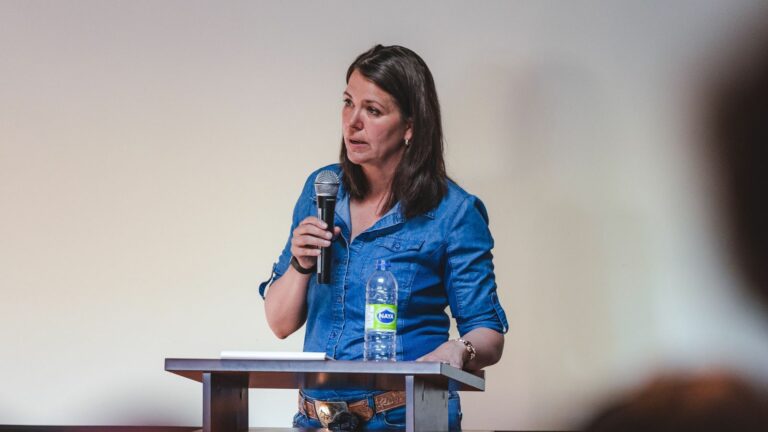
Danielle Smith rejected that characterization when reporters asked her about it in Airdrie on Sept. 21. Asked whether she had promised neutrality on the separation question, she responded, “That’s not true.” The premier said she has consistently supported what she describes as a “sovereign Alberta within a united Canada” and maintained that the government’s approximately $4-million referendum advertising campaign reflects that position. In other words, the disagreement is unusually concrete: the party president says he was personally assured of relative neutrality, while the party leader says that description is incorrect.
Alberta Is Not Actually Voting to Separate on October 19
One of the most important distinctions in the debate is what Albertans are actually being asked to decide. Question 10 does not ask voters simply whether Alberta should become an independent country. Instead, voters must choose between Alberta remaining a province of Canada and directing the provincial government to begin the constitutional process required to hold a future binding referendum on separation. Elections Alberta describes Question 10 as non-binding and says voters will select one of those two options.
That structure creates an unusual political dynamic. Someone can support holding another referendum without necessarily supporting independence itself, which makes the October result more complicated to interpret than a straightforward stay-or-leave vote. Angus Reid Institute polling in August illustrated the difference: 33 per cent said they would support beginning the process toward another referendum, while 30 per cent said they would actually vote for Alberta to leave Canada when presented with a simpler hypothetical independence question. The distinction helps explain why both sides are paying close attention to how the government describes Question 10.
Danielle Smith Has Publicly Said for Months That She Wants Alberta to Stay
The premier’s latest comments are consistent with several public statements she has made since the separation question was added to the ballot. In a televised address on May 21, Smith said explicitly that she supports Alberta remaining in Canada and would vote that way herself. She also described staying in Confederation as the position of her government and caucus. At the same time, she argued that Albertans frustrated with Ottawa should be allowed to express those concerns democratically through the referendum process.
Her position became even more visible shortly before the dispute with Rob Smith erupted. At a Sept. 19 online forum co-hosted by former Reform leader Preston Manning and former British Columbia premier Gordon Campbell, Smith made an emotional case against leaving Canada. She spoke about long-standing western grievances and acknowledged anger toward Ottawa, but argued that recent progress in Alberta’s relationship with the federal government provided a reason to remain. Her broader message has therefore combined two ideas that can sound contradictory to different audiences: Alberta has serious grievances with Confederation, but separation is not her preferred solution.
This Is Not the First Time the Premier and UCP President Have Disagreed on Separation
The September confrontation follows an earlier public disagreement between the same two figures. In May, Rob Smith said the United Conservative Party would remain neutral during the referendum campaign rather than officially taking a side on whether Alberta should stay in Canada. Danielle Smith publicly contradicted him soon afterward, saying she speaks for the party and that the UCP’s position was to remain within Canada while seeking greater provincial autonomy.
That distinction reflects an important feature of the UCP itself. The party’s current policy declaration stresses defending provincial jurisdiction, negotiating fairer treatment from Ottawa and distancing Alberta from the federal government in certain areas while remaining “a productive member of Confederation.” Its formal policy documents do not establish separation as the party’s objective. At the same time, party members and supporters include people who favour independence, creating room for disagreement over whether the organization should campaign against separation or simply allow its members to choose individually.
Polling Helps Explain Why Smith Is Walking Such a Narrow Line
Province-wide polling has consistently found significantly more support for remaining in Canada than for advancing toward independence, although results vary depending on question wording and methodology. Angus Reid Institute reported in August that 61 per cent preferred Alberta to remain a province, compared with 33 per cent who wanted the government to begin the process toward a future separation referendum. An August Léger study found 65 per cent favouring remaining in Canada, 23 per cent supporting the next step toward another referendum and 10 per cent undecided.
The picture looks different inside the conservative electorate. An Ipsos poll released in June found that among current UCP supporters, 50 per cent preferred remaining in Canada while 40 per cent supported proceeding toward a binding separation referendum. Earlier Angus Reid polling showed an even larger share of UCP voters at least leaning toward independence, demonstrating how results can change with wording, timing and response options. That gap between the province as a whole and segments of the UCP coalition helps explain why a message that sounds clearly pro-Canada to one group may still be viewed as unacceptable by separatist-minded party activists.
The Internal Fight Has Now Reached Smith’s Own Party Organization
The dispute is unfolding alongside a separate challenge from within the UCP’s constituency-association network. The Highwood constituency association — in an area Smith previously represented in the legislature — recently backed a motion seeking a leadership review. Reporting on the decision has linked at least some of the local dissatisfaction to Smith’s opposition to separation, although the riding association’s action alone cannot force a leadership vote. Highwood MLA RJ Sigurdson has publicly backed the premier and said the constituency association does not broadly represent his constituents’ views.
Under the UCP’s bylaws, a special general meeting must be called if identical motions are approved by one-quarter of the party’s constituency associations. Alberta has 87 constituencies, meaning 22 associations would constitute at least one-quarter. The party’s governance manual separately provides that a leadership review can be held at such a special general meeting when the required number of constituency associations invokes that process. Smith nevertheless enters this period with a substantial previous mandate from members: she received more than 90 per cent support in her 2024 UCP leadership review.
The Government’s Advertising Budget Adds Another Layer to the Argument
The disagreement over whether the government campaign is neutral matters partly because Edmonton is spending substantially more than most individual referendum organizations can. The Smith government has allocated about $4 million to advertise ahead of the vote. Separately, Elections Alberta regulates registered referendum third-party advertisers, which must register once they cross specified contribution or expense thresholds and are subject to campaign finance requirements. Elections Alberta currently states that a registered referendum third-party advertiser can spend up to $607,000 on referendum advertising.
That disparity has generated criticism from participants on different sides of the debate, because government communications are not operating under the same framework as a typical third-party campaign. It also makes the exact wording of provincial advertising politically significant. Rob Smith’s argument is essentially that the premier promised to restrain the government’s advocacy on Question 10 while aggressively promoting her preferred answers on the other questions. Danielle Smith’s response is the opposite: she says Albertans should already understand that she favours remaining in Canada and that the campaign’s language reflects that position.
Even a Future Vote for Independence Would Only Begin a Much Longer Process
A future vote in favour of leaving Canada would not automatically make Alberta independent. The Supreme Court of Canada established in its 1998 Quebec Secession Reference that a province cannot unilaterally secede under the Constitution. A clear majority on a clear question favouring secession would create an obligation for governments to negotiate, but the referendum result itself would not legally separate the province from Canada. Those negotiations would involve constitutional principles including federalism, democracy, the rule of law, minority rights and the interests of other participants in Confederation.
Parliament’s Clarity Act subsequently established a framework under which the House of Commons assesses whether a proposed secession question is clear and, after a referendum, whether there has been a clear expression of support by a clear majority. The law also states that lawful secession would require a constitutional amendment and negotiations involving at least Ottawa and the provinces, with issues such as assets, liabilities, borders, Indigenous rights and minority protections requiring consideration. That means Oct. 19 represents an early political decision in what could become a far more complicated constitutional process — not a shortcut to independence.
The Bigger Question Is Who Defines the UCP’s Position
The immediate controversy centres on a relatively narrow question: did Danielle Smith promise her party president that government messaging around separation would be deliberately muted? Rob Smith says she did; the premier says she did not. Unless additional documentation or correspondence emerges, those competing accounts cannot independently establish what was said in a private conversation. What can be established is that their disagreement over how the UCP should position itself on separation has now surfaced publicly more than once.
The approaching Oct. 19 referendum will therefore test more than public attitudes toward independence. It will also show how effectively Smith can maintain a coalition that includes committed federalists, provincial-autonomy conservatives and outright separatists. Recent polling indicates most Albertans currently favour remaining in Canada, while support for taking another step toward a separation vote is notably stronger among UCP supporters than among the province overall. For Smith, the challenge is maintaining her long-standing “sovereign Alberta within a united Canada” position while persuading dissatisfied conservatives that staying in Confederation does not require abandoning their grievances with Ottawa.
This Options Discord Chat is The Real Deal
While the internet is scoured with trading chat rooms, many of which even charge upwards of thousands of dollars to join, this smaller options trading discord chatroom is the real deal and actually providing valuable trade setups, education, and community without the noise and spam of the larger more expensive rooms. With a incredibly low-cost monthly fee, Options Trading Club (click here to see their reviews) requires an application to join ensuring that every member is dedicated and serious about taking their trading to the next level. If you are looking for a change in your trading strategies, then click here to apply for a membership.