35,000+ smart investors are already getting financial news, market signals, and macro shifts in the economy that could impact their money next with our FREE weekly newsletter. Get ahead of what the crowd finds out too late. Click Here to Subscribe for FREE.
Canada’s confrontation with Washington has produced an unusual moment in Canadian politics: Stephen Harper, the former Conservative prime minister who spent nearly a decade managing one of the world’s deepest bilateral economic relationships, has publicly defended Liberal Prime Minister Mark Carney’s decision to walk away from U.S. trade negotiations.
Harper called the breakdown sad but necessary, arguing that preserving Canadian sovereignty now requires less dependence on the United States. His remarks do not amount to a call for Canada to abandon its southern neighbour. Instead, they reinforce a broader shift already underway in Ottawa: keep the American relationship where possible, while building enough markets, investment, infrastructure and industrial capacity elsewhere that Washington can no longer exercise the same economic leverage over Canada.
Harper Endorses the Walkout, but Not a Permanent Rupture
Stephen Harper Backs Carney’s Break With Washington, Says Canada Had ‘No Choice’ but to Walk Away
- Harper Endorses the Walkout, but Not a Permanent Rupture
- Why the “No Choice” Line Carries Political Weight
- The August Breakdown Changed the Trade Relationship
- Canada’s Dependence on the U.S. Is Still Enormous
- Harper Had Already Spent Years Diversifying Canadian Trade
- Carney Is Turning Diversification Into an Investment Strategy
- Europe Is Emerging as the Most Obvious Second Pillar
- The Pivot Comes With Real Economic Costs
- Harper’s Support Is Not a Blank Cheque for Carney
- Washington Is Still Too Important to Ignore
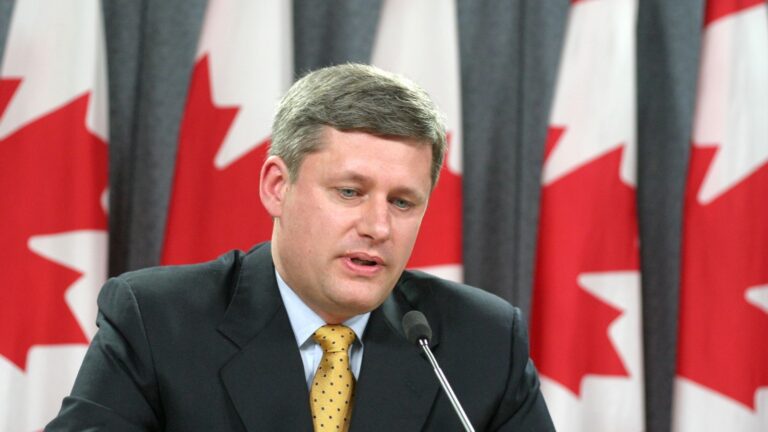
Stephen Harper’s closing remarks at the Canada Investment Summit were unusually direct. The former prime minister said the federal government had “no choice” but to leave the U.S. trade negotiations after the latest attempt at a deal collapsed. Harper argued that the current American administration views the extraordinary degree of Canada-U.S. economic integration as being in tension with Canada’s separate sovereignty. His conclusion was that Canada must now pursue diminished reliance on the United States, even if doing so carries substantial economic costs.
That distinction matters. Harper also described himself as a great admirer of the United States and characterized Canada’s proximity to the American economy as one of the country’s most valuable advantages. His argument was not that decades of continental integration had suddenly become worthless. It was that dependence becomes a vulnerability when access to the larger market can be used as negotiating leverage. Diversification, in Harper’s formulation, is therefore less about replacing America than ensuring Canada has credible alternatives when Washington demands terms Ottawa considers unacceptable.
Why the “No Choice” Line Carries Political Weight
Harper’s intervention stands out partly because of who delivered it. He led a Conservative government from 2006 to 2015, while Carney now heads a Liberal government. Former prime ministers frequently offer advice on national affairs, but an explicit defence of a rival party’s decision during a major trade confrontation gives the government’s position a degree of cross-partisan validation it would otherwise lack. Harper did not merely say Ottawa faced a difficult decision; he argued that rejecting the proposed arrangement was necessary.
His reasoning was framed around sovereignty rather than party politics. Harper said Canada could not allow its industrial capacity to be hollowed out and argued that the country must become more competitive internally, more connected internationally and more sovereign economically. That framing overlaps substantially with Carney’s argument that Canada must become stronger at home before negotiating again from a position of greater resilience. The agreement between them is significant precisely because it coexists with sharp disagreements elsewhere over taxation, regulation, government spending and economic policy.
The August Breakdown Changed the Trade Relationship
The confrontation Harper was addressing traces directly to the collapse of Canada-U.S. negotiations in August. Carney suspended the talks after Ottawa concluded that the terms being sought by Washington would not sufficiently protect Canadian workers, strategic sectors and sovereignty. The federal government described the American proposal as demanding too much while offering too little in return, and Carney publicly framed the decision as walking away from a bad deal rather than accepting an agreement simply to restore calm.
The consequences arrived quickly. The United States imposed additional tariffs of up to 50 per cent on targeted Canadian products, with Ottawa subsequently matching American measures through counter-tariffs on $27.6 billion worth of U.S. imports. Canada’s response covers industries ranging from steel and agricultural equipment to dairy, electronics, pulp and paper. Washington has since announced further restrictions on selected Canadian products. That escalating sequence helps explain Harper’s language: the disagreement has moved well beyond ordinary bargaining over a few tariff schedules and into a larger argument about economic leverage and sovereignty.
Canada’s Dependence on the U.S. Is Still Enormous
Reducing reliance on Washington will be easier to announce than to accomplish. Statistics Canada reported that 71.7 per cent of Canadian merchandise exports went to the United States in 2025. That was already down substantially from 75.9 per cent in 2024, while Canada’s exports to countries outside the United States climbed strongly. Even after that diversification, however, no other market comes remotely close to matching the scale of American demand for Canadian energy, vehicles, metals, machinery and other goods.
The physical geography behind those numbers cannot be rewritten through policy alone. Factories in Ontario are embedded in continental production networks. Western oil pipelines feed U.S. refineries. Trucks cross a land border instead of crossing an ocean, allowing parts, food and manufactured goods to move with extraordinary efficiency. Carney himself has acknowledged that roughly four-fifths of bilateral trade remains tariff-free despite the dispute. The emerging strategy is therefore not economic separation. It is reducing the consequences Canada faces whenever the remaining portion becomes vulnerable to political pressure.
Harper Had Already Spent Years Diversifying Canadian Trade
There is another reason Harper’s position is less surprising than the party labels might suggest: diversification was a major component of his own economic agenda. His government formally launched negotiations for the Comprehensive Economic and Trade Agreement with the European Union in 2009 and announced an agreement in principle in 2013. The completed text was released in 2014, creating the foundation for the CETA framework that Canada now hopes to use as a platform for much deeper European integration.
Harper’s government also pursued Asia aggressively. The Canada-Korea Free Trade Agreement entered into force in January 2015, becoming Canada’s first bilateral free-trade agreement in the Asia-Pacific region. Canada also joined negotiations for the Trans-Pacific Partnership under Harper and was among the countries that concluded the original TPP negotiations in October 2015. Those initiatives were driven by growth opportunities rather than a rupture with Washington, but the underlying economic logic was similar: a trading country gains resilience and bargaining power when Canadian companies can reach multiple large markets instead of relying overwhelmingly on one customer.
Carney Is Turning Diversification Into an Investment Strategy
Carney’s approach goes beyond finding new destinations for Canadian exports. Ottawa is trying to reshape where companies invest, where infrastructure is built and where long-term capital flows. At the first Canada Investment Summit in Toronto, the government said investors from nearly 30 countries managing more than $100 trillion in assets participated. Ottawa subsequently announced nearly $500 billion in investment commitments and partnerships connected to the summit, while maintaining its broader objective of catalyzing $1 trillion in investment over five years.
Tax policy is being folded into the same strategy. Carney announced a permanent Productivity Mega Deduction designed to allow immediate expensing across a much broader range of new capital investment. The government calculates that the changes would lower Canada’s marginal effective tax rate on new business investment from roughly 13 per cent to 6.4 per cent. The political message to global capital is straightforward: Canada wants companies considering new factories, energy projects, data centres, mines and transportation infrastructure to see the country as an investment destination in its own right, not merely as a branch of the U.S. market.
Europe Is Emerging as the Most Obvious Second Pillar
Europe occupies a particularly important place in the diversification strategy because much of the institutional groundwork already exists. CETA has been provisionally applied since 2017, and Canada-EU trade has grown substantially since then. Global Affairs Canada says combined trade in goods and services between Canada and the EU reached $178.6 billion in 2025, making the bloc Canada’s second-largest trading partner after the United States. Two-way trade in goods has increased by more than 75 per cent since CETA’s provisional implementation.
Carney now wants to move considerably further. Canada became the first non-European country to participate in the EU’s SAFE defence procurement initiative, and his government has proposed discussions on what it describes as a unique security and economic alliance with Europe. Cooperation under consideration reaches beyond conventional trade into defence, critical minerals, artificial intelligence, energy and other strategic capabilities. Harper’s endorsement of diversification therefore arrives as Ottawa is attempting to turn an existing European commercial relationship into a much broader economic and security partnership.
The Pivot Comes With Real Economic Costs
Harper was careful not to portray diversification as painless. He explicitly acknowledged that reducing dependence on the United States will carry significant costs. That warning reflects the practical economics of redirecting trade. Canadian companies cannot simply exchange one customer for another overnight. Exporting energy to Europe or Asia can require pipelines, liquefied natural gas terminals, ports and long-term contracts. Manufacturers may need new supply chains, regulatory approvals or product standards. Smaller businesses often face especially high costs when entering an unfamiliar foreign market.
The current tariffs add another layer of pressure. Ottawa says the latest U.S. duties covered $27.6 billion in Canadian goods, while Canada’s retaliatory package targets the same value of American imports. Tariffs can protect bargaining leverage, but they also raise costs somewhere in the supply chain. For a business dependent on imported equipment or components, a trade dispute can quickly become a cash-flow problem. Harper’s message was therefore not simply that Canada should endure economic pain. It was that the country must use the disruption to build infrastructure and productive capacity that reduces future vulnerability.
Harper’s Support Is Not a Blank Cheque for Carney
The appearance of political consensus should not be overstated. Harper praised several measures taken by the Carney government, including efforts to accelerate approvals for major projects, particularly in energy. But he also argued that Canada must remove regulatory burdens and restrictions that make investment more difficult than in competing jurisdictions. His support for the trade walkout therefore came with a clear demand that Ottawa make the domestic economy more competitive if it expects international diversification to work.
The current Conservative leadership has also maintained its own critique of Carney’s economic record. Pierre Poilievre welcomed the investment summit itself while questioning whether the government was producing tangible results for households and businesses. Ottawa, meanwhile, says the summit generated nearly $500 billion in investment commitments, including almost $100 billion in new capital commitments from major Canadian institutional investors. Those competing interpretations underline an important point: Harper’s agreement with Carney concerns the strategic response to Washington. It does not erase broader debates over how Canada should tax, regulate, spend or develop its resources.
Washington Is Still Too Important to Ignore
For all the talk of diminished reliance, neither Harper nor Carney is describing a future in which the United States disappears from Canada’s economic strategy. Geography, infrastructure and decades of investment make that impossible in any realistic timeframe. Carney has said Canada will remain the neighbour and partner of the United States and has left the door open to renewed negotiations when conditions change. His argument is that returning to the previous relationship cannot itself be the plan. As he put it at the investment summit, “nostalgia is not a strategy.”
Harper’s comments arrive at essentially the same destination from a different political tradition. Canada should preserve the enormous advantages of access to the American economy, but it should no longer assume that deep integration automatically guarantees stability. Europe, Asia and other markets will have to become more meaningful commercial alternatives, while Canadian infrastructure and industry become capable of serving them. The test will not be whether Canada can walk away from America. It will be whether Canada can build enough alternatives that walking away from one unacceptable negotiation becomes economically survivable.
This Options Discord Chat is The Real Deal
While the internet is scoured with trading chat rooms, many of which even charge upwards of thousands of dollars to join, this smaller options trading discord chatroom is the real deal and actually providing valuable trade setups, education, and community without the noise and spam of the larger more expensive rooms. With a incredibly low-cost monthly fee, Options Trading Club (click here to see their reviews) requires an application to join ensuring that every member is dedicated and serious about taking their trading to the next level. If you are looking for a change in your trading strategies, then click here to apply for a membership.