35,000+ smart investors are already getting financial news, market signals, and macro shifts in the economy that could impact their money next with our FREE weekly newsletter. Get ahead of what the crowd finds out too late. Click Here to Subscribe for FREE.
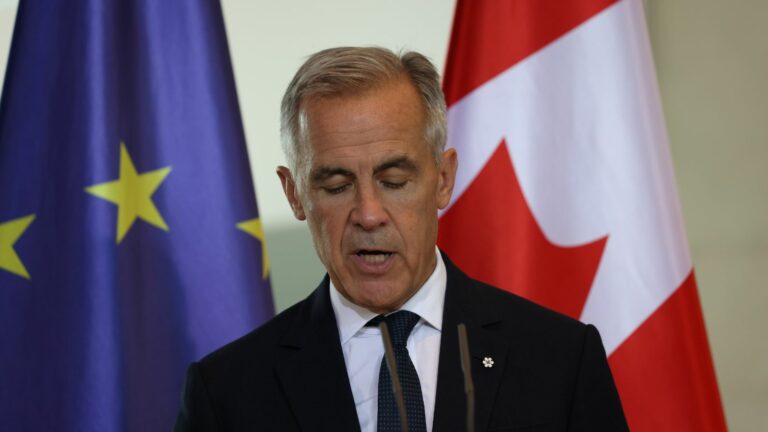
Canada’s effort to loosen its extraordinary economic dependence on the United States is bringing an unfinished piece of transatlantic business back into focus. Prime Minister Mark Carney is urging European countries to complete ratification of the Canada-European Union trade agreement while Ottawa pursues a much broader economic and security partnership with Europe.
The timing is hardly accidental. Canada-U.S. trade relations have deteriorated after another round of tariffs, retaliation and failed negotiations, leaving businesses confronting risks that once seemed almost unthinkable between two deeply integrated neighbours. Europe cannot replace the American market, and Ottawa is not pretending otherwise. Instead, Carney’s strategy is increasingly about building enough alternative markets, investment channels and strategic partnerships that a disruption in Washington no longer has the power to define Canada’s economic future.
A Nine-Year-Old Trade Deal Is Suddenly Strategically Important Again
Carney Urges Europe to Cement Canada Trade Deal as Ottawa Cuts Reliance on U.S.
- A Nine-Year-Old Trade Deal Is Suddenly Strategically Important Again
- The Economic Relationship Has Already Grown Dramatically
- The U.S. Trade Fight Has Changed Ottawa’s Calculation
- Canada Is Already Sending More Trade Somewhere Else
- Carney Wants Something Deeper Than Conventional Free Trade
- Defence Is Showing How Fast Integration Can Move
- Ottawa Is Trying to Pair New Markets With New Capital
- Europe Cannot Simply Replace the United States
- The Bigger Goal Is Economic Room to Manoeuvre
The Comprehensive Economic and Trade Agreement, better known as CETA, was signed in October 2016 and has been provisionally applied since September 2017. Much of the agreement therefore already governs Canada-EU commerce. Tariffs were eliminated on 98% of tariff lines when provisional application began, and the European Commission says that figure had risen to 99% by 2024. Canadian and European exporters have consequently spent years operating under most of the agreement’s commercial benefits.
Yet CETA has still never entered fully into force. Because it was concluded as a mixed EU agreement, ratification is required not only at the European level but by all EU member states. Only 17 of the bloc’s 27 countries have completed that process. Belgium, Bulgaria, Cyprus, France, Greece, Hungary, Ireland, Italy, Poland and Slovenia remain outstanding. That distinction matters because portions of CETA, particularly elements involving investment protection and dispute settlement, cannot fully take effect until ratification is complete. Carney is effectively asking Europe to finish a job that began nearly a decade ago.
The Economic Relationship Has Already Grown Dramatically
Carney is not making the case for deeper European trade from a blank sheet of paper. EU figures show that bilateral trade in goods and services reached roughly €130 billion in 2025, up about 80% from €72.1 billion in 2016, the final full year before CETA began provisional application. Goods trade alone reached €81.5 billion, while two-way services trade climbed to approximately €49 billion. The European Union remains Canada’s second-largest trading partner behind the United States.
Those numbers give Ottawa an argument that differs significantly from a conventional free-trade sales pitch. Canada and Europe already have a functioning commercial framework, substantial investment relationships and nearly a decade of businesses learning how to operate under CETA. The challenge is to make that relationship bigger, easier to use and strategically broader. Canada is also attractive to Europe as a producer of energy, metals, agricultural products and critical minerals at a time when governments increasingly view secure supply chains as a national-security issue rather than simply a question of finding the lowest-cost supplier.
The U.S. Trade Fight Has Changed Ottawa’s Calculation
The renewed European push is taking place against a much harsher Canada-U.S. backdrop. Carney suspended negotiations with Washington in August after saying last-minute American demands made a proposed agreement unacceptable. The United States subsequently imposed 50% duties on a range of Canadian products, including goods that had previously benefited from continental trade arrangements. Canada announced matching countermeasures at rates of 15%, 25% and 50% covering C$27.6 billion in American imports, with the measures taking effect September 8.
Washington then escalated again. The Trump administration announced import bans targeting certain Canadian alcohol, dairy products and motorcycles, scheduled to begin September 29, while altering tariffs on other Canadian goods. The dispute has reached industries that symbolize how tightly the two economies have historically operated together, from autos and metals to food, equipment and consumer products. For Canadian executives who built business models around predictable access to the American market, the lesson is increasingly uncomfortable: geographic proximity is valuable, but it no longer guarantees predictable trade policy.
Canada Is Already Sending More Trade Somewhere Else
The diversification campaign is beginning to appear in Canada’s trade data. Statistics Canada reported that the United States received 71.7% of Canadian merchandise exports in 2025, down from 75.9% in 2024. Exports to countries other than the United States increased 17.2% over the year, while total merchandise trade with non-U.S. countries rose 14.3% to C$553 billion. Those changes do not amount to an economic separation from Washington, but they are significant for a country whose trading patterns have historically been remarkably difficult to shift.
The figures also explain why Ottawa talks about reducing dependence rather than eliminating it. More than seven out of every ten dollars of Canadian merchandise exports still head to the United States. Cross-border manufacturing, energy infrastructure and transportation networks developed over generations cannot simply be redirected across the Atlantic. The emerging strategy instead resembles portfolio diversification: keep the extraordinarily valuable American relationship where it works, while increasing Canada’s exposure to Europe, Asia and other markets so a single government has less leverage over the entire economy.
Carney Wants Something Deeper Than Conventional Free Trade
Carney has been careful to reject suggestions that Canada is trying to become an EU member. Instead, he has described the goal as a “unique alliance” built around areas where Canadian and European strategic interests increasingly overlap. Current discussions extend beyond tariffs into energy, artificial intelligence, critical minerals, defence, digital infrastructure and secure supply chains. Recent reporting has also pointed to possible deeper labour mobility and cooperation involving major infrastructure such as data centres and undersea connections.
That would mark an important change in the nature of Canada-EU relations. CETA largely answers the traditional question of how companies can sell goods and services across borders. A deeper partnership would ask how the two economies can jointly build strategic industries and reduce vulnerabilities to third countries. Ottawa’s September European itinerary reflects that ambition. Carney is due to address the European Parliament in Strasbourg and meet European lawmakers before travelling to Britain, where discussions are expected to include defence, energy, artificial intelligence and critical minerals. Trade is becoming one component of a much wider economic-security relationship.
Defence Is Showing How Fast Integration Can Move
Some of the strongest evidence for Canada’s European strategy is already coming from defence rather than traditional trade. In February 2026, Canada formally joined the European Union’s Security Action for Europe initiative, known as SAFE, becoming the first non-European country to participate. The EU mechanism is designed around as much as €150 billion in loans supporting joint procurement and expansion of European defence capabilities, making it potentially important for Canadian aerospace, technology and defence manufacturers searching for new international customers.
The arrangement has already moved beyond diplomatic statements. Canada announced in June that Montréal-based Marconi Technologies had secured a contract worth more than C$10 million to supply tactical radios to Poland’s Cyber Command, with the project expected to involve nearly 100 Canadian suppliers. The example helps explain Ottawa’s broader thinking. Market diversification becomes far more meaningful when Canadian companies are incorporated into allied procurement networks rather than simply encouraged to find occasional overseas buyers. Defence partnerships can create multi-year contracts, industrial capacity and supply chains that are considerably harder to unwind when political conditions change.
Ottawa Is Trying to Pair New Markets With New Capital
Opening markets abroad matters only if Canada can build enough productive capacity at home to supply them. That is why Carney’s European outreach is occurring alongside the government’s first Canada Investment Summit in Toronto. Ottawa says its broader objective is to catalyse C$1 trillion in total investment over five years. Reuters reported that more than 160 prospective projects were being presented around areas including mining, energy, infrastructure and technology, while participating international investors collectively oversee enormous pools of global capital.
Europe is particularly relevant to that effort because the investment relationship already runs deep. Federal figures put European Union foreign direct investment stock in Canada at about C$218.8 billion in 2025, while Canadian direct investment in the EU stood around C$297 billion. The opportunity for Ottawa is therefore not simply to persuade European consumers to buy more Canadian products. It is to attract European capital into the mines, electricity systems, defence factories, computing infrastructure and transportation links required to make diversification commercially realistic. Without that physical investment, trade diplomacy alone would struggle to change Canada’s economic geography.
Europe Cannot Simply Replace the United States
The greatest risk in interpreting Carney’s pivot is assuming that signing agreements automatically redirects trade. Even CETA demonstrates how difficult that process can be. A 2026 analysis by Global Affairs Canada found that companies still encounter practical barriers when trying to use CETA preferences, including complicated rules of origin, logistics challenges and shipments routed through third countries. For some exporters, moving goods through the United States can actually make qualifying for CETA preferences more cumbersome, illustrating just how deeply American transportation infrastructure remains embedded in Canadian commerce.
There are political hurdles in Europe as well. Ten EU countries still have not ratified CETA, and agricultural concerns have remained particularly sensitive. France’s Senate rejected authorization to ratify the agreement in 2024, even though provisional application continues. Meanwhile, Reuters has reported that Canada’s access to the enormous U.S. market remains one of its biggest attractions to foreign investors. Geography, existing factories, pipelines, roads and decades of integrated supply chains guarantee that the United States will remain Canada’s most important commercial partner. Diversification therefore means creating alternatives and bargaining power, not replacing one economic centre with another.
The Bigger Goal Is Economic Room to Manoeuvre
Carney’s European push ultimately reflects a broader change in how Ottawa thinks about economic security. For decades, Canada’s extraordinary access to the American market was treated largely as an advantage to be maximized. The latest trade battles have exposed the other side of that arrangement: dependence on a single customer can become a vulnerability when the political rules governing that relationship suddenly change. Ottawa’s answer is to build stronger domestic industries while constructing a denser network of overseas trade, investment and security relationships.
Europe offers an unusually strong foundation for that strategy because much of the architecture already exists. CETA is operating, trade has expanded sharply, investment flows are substantial and defence cooperation is moving rapidly. Full CETA ratification would not transform Canada’s economy overnight, nor would it make American commerce less important. What it could do is reinforce a much larger strategic shift. Ottawa is trying to ensure that the next time access to its dominant market becomes a political bargaining chip, Canadian businesses have more customers, more investors and more options than they did before.
This Options Discord Chat is The Real Deal
While the internet is scoured with trading chat rooms, many of which even charge upwards of thousands of dollars to join, this smaller options trading discord chatroom is the real deal and actually providing valuable trade setups, education, and community without the noise and spam of the larger more expensive rooms. With a incredibly low-cost monthly fee, Options Trading Club (click here to see their reviews) requires an application to join ensuring that every member is dedicated and serious about taking their trading to the next level. If you are looking for a change in your trading strategies, then click here to apply for a membership.