35,000+ smart investors are already getting financial news, market signals, and macro shifts in the economy that could impact their money next with our FREE weekly newsletter. Get ahead of what the crowd finds out too late. Click Here to Subscribe for FREE.
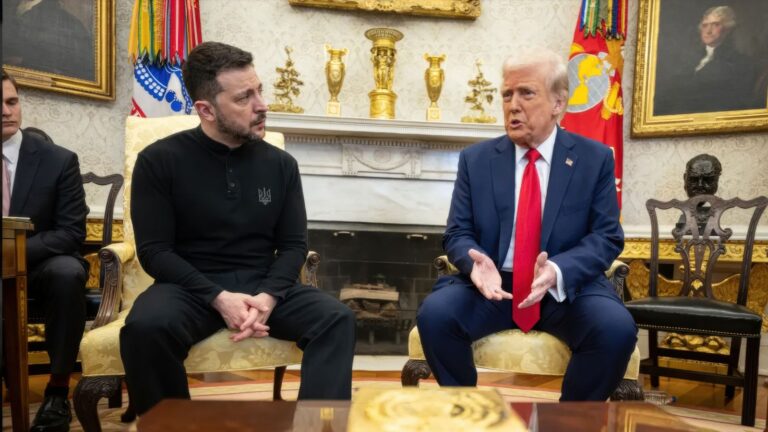
Canada’s increasingly unusual confrontation with its closest ally is no longer attracting attention only in Ottawa and Washington. Ukrainian President Volodymyr Zelenskyy has reportedly described U.S. rhetoric about annexing Canada as “dangerous,” bringing the dispute into a wider international conversation about sovereignty, borders and the conduct expected between democratic allies.
The significance goes well beyond another diplomatic exchange involving Donald Trump. Canada and the United States share the world’s longest international boundary, one of its deepest trading relationships and decades of joint defence institutions. When talk of making Canada an American state collides with tariffs and economic pressure, political language starts carrying strategic weight. For Zelenskyy, whose country has spent years defending the principle that borders cannot simply be rewritten by a stronger neighbour, that distinction is especially difficult to ignore.
Zelenskyy’s Intervention Changes the Audience
Zelenskyy Calls U.S. Threats to Annex Canada ‘Dangerous’ as Ottawa-Washington Rift Draws Global Attention
- Zelenskyy’s Intervention Changes the Audience
- Trump’s ‘51st State’ Talk Stopped Sounding Like a One-Off Joke
- Canada’s Economic Exposure Makes the Language More Potent
- Ukraine Gives Zelenskyy a Distinct Perspective on Sovereignty
- Canada and Ukraine Have an Unusually Deep Relationship
- The Dispute Creates an Awkward Question for NATO
- NORAD Shows Just How Closely the Two Countries Already Cooperate
- Trade Tensions Turn Provocative Language Into an Economic Issue
- Other Allies Have Reasons to Watch Closely
- The Biggest Effect May Be on Canadian Politics
Until now, much of the argument over Trump’s rhetoric toward Canada has been treated as a uniquely North American confrontation. Canadians hear it through the lens of trade, tariffs and sovereignty, while Americans often encounter it as another provocative line from a president who has repeatedly challenged diplomatic convention. A reported warning from Zelenskyy changes the audience. It places the dispute alongside a much broader international debate over whether powerful countries should speak casually about absorbing the territory of their neighbours.
That comparison requires care. Canada faces no Russian-style military invasion, and Trump said in January 2025 that he would use “economic force,” rather than military force, when discussing Canada. The differences are enormous. Yet sovereignty is also a principle, not merely a description of battlefield conditions. The Canada–U.S. frontier stretches roughly 8,891 kilometres, and generations have treated its stability as evidence that two powerful neighbours can remain separate while becoming extraordinarily close. That makes annexation rhetoric conspicuous far beyond Canada.
Trump’s ‘51st State’ Talk Stopped Sounding Like a One-Off Joke
Trump’s language about Canada became politically significant because it did not disappear after a single remark. Beginning before his return to the White House, he repeatedly described Canada as a potential “51st state” and referred mockingly to then-prime minister Justin Trudeau as a governor. At a January 7, 2025 news conference, Trump was asked directly about using force against Canada and answered that he envisioned “economic force.”
That distinction reassured few Canadian politicians. Economic coercion is fundamentally different from military action, but it still connected the sovereignty rhetoric to issues that affect households and businesses directly. Tariffs, market access and control over integrated supply chains suddenly became part of the same political argument. Trudeau later told business leaders that Trump’s interest in absorbing Canada was a “real thing,” comments widely reported after audio from the gathering emerged. What initially sounded implausible was therefore treated in Ottawa less as comedy and more as a political message requiring a sustained response.
Canada’s Economic Exposure Makes the Language More Potent
Geography gives Washington economic leverage that rhetoric alone would not possess. The United States has long purchased roughly three-quarters of Canadian merchandise exports, making American market access central to Canadian manufacturing, agriculture, energy and employment. Factories in Ontario can depend on components crossing the border several times before a finished vehicle is sold. Western oil producers rely heavily on pipelines leading into U.S. refineries. Quebec sends electricity into northeastern American markets.
That integration is normally portrayed as an advantage for both countries, and for decades it largely has been. It also explains why talk of “economic force” carries unusual weight. A conventional diplomatic disagreement might affect statements and summits; a serious Canada–U.S. trade confrontation can affect shifts at an assembly plant, orders at a metal producer or grocery prices hundreds of kilometres from the border. Zelenskyy’s reported characterization of the rhetoric as dangerous therefore lands against a relationship in which political pressure has obvious economic channels through which it can be applied.
Ukraine Gives Zelenskyy a Distinct Perspective on Sovereignty
Few serving leaders have stronger reasons than Zelenskyy to treat territorial sovereignty as something more than diplomatic vocabulary. Russia illegally annexed Crimea in 2014 and launched its full-scale invasion of Ukraine in February 2022, attempting to seize and permanently control additional Ukrainian territory. Canada, the United States and their European allies responded with military assistance, financial support and sanctions while repeatedly grounding their position in Ukraine’s right to remain sovereign within internationally recognized borders.
That history does not make Canada and Ukraine equivalent cases. Canada is a secure NATO member without a foreign army crossing its frontier. The relevance lies instead in the principle behind Zelenskyy’s worldview. Ukraine has argued for years that normalization of territorial revisionism makes international security more fragile. Against that background, even rhetorical suggestions that a larger state should absorb a friendly neighbour can sound less amusing abroad than they might to domestic political audiences. Words about borders inevitably carry different weight in Kyiv.
Canada and Ukraine Have an Unusually Deep Relationship
Zelenskyy is also speaking about a country with which Ukraine has unusually strong political and social ties. Canada was among the first Western countries to recognize Ukrainian independence in 1991 and has become one of Kyiv’s significant supporters since Russia’s full-scale invasion. Ottawa has committed billions of dollars in military, financial, humanitarian and development assistance, while Canadian personnel have trained Ukrainian forces through Operation UNIFIER.
The relationship is visible inside Canada as well. The 2021 census counted roughly 1.26 million people reporting Ukrainian origins, giving Canada one of the world’s largest Ukrainian diasporas outside Ukraine and Russia. Communities across the Prairies, particularly in Alberta, Saskatchewan and Manitoba, have Ukrainian roots stretching back more than a century. Zelenskyy has addressed Canada’s Parliament and met Canadian leaders repeatedly during the war. As a result, comments from Kyiv about Canadian sovereignty carry a different political resonance than criticism from a government with few direct connections to the country.
The Dispute Creates an Awkward Question for NATO
Canada and the United States were both founding members of NATO in 1949, and the alliance is built around the principle that members protect one another from external attack. Article 5 famously treats an armed attack against one member as an attack against all. The treaty was designed to deter hostile powers, not resolve a scenario in which one ally repeatedly talks about acquiring another ally’s territory.
No serious comparison should confuse rhetoric with an Article 5 military crisis. There is no American invasion of Canada. But the political awkwardness remains important. NATO depends not only on weapons and treaties but on confidence that members recognize each other’s borders and sovereignty without qualification. Zelenskyy has spent much of his presidency asking NATO states to defend precisely those norms in Ukraine. A public dispute in which Washington treats Canadian statehood as a subject for negotiation therefore creates an uncomfortable contrast for an alliance that presents itself internationally as a defender of sovereign democracies.
NORAD Shows Just How Closely the Two Countries Already Cooperate
The annexation rhetoric is also unusual because the United States already receives enormous strategic benefits from cooperation with an independent Canada. The two countries created the North American Aerospace Defense Command in 1958, producing one of the world’s most deeply integrated binational defence arrangements. Canadian and American personnel jointly monitor aerospace threats, missile warnings and approaches to the continent.
That history undermines the notion that political independence has prevented close continental security. Canada does not need to become an American state for the two countries to coordinate radar networks, Arctic surveillance or air defence. They have been doing exactly that for decades. Both governments have also committed substantial sums to modernizing northern detection capabilities as Russia and China expand their Arctic activity. Against that backdrop, a sovereignty fight introduces political distrust into a partnership whose effectiveness has historically depended on remarkable institutional confidence. That is one reason international observers can view annexation rhetoric as strategically counterproductive even without treating it as an imminent territorial threat.
Trade Tensions Turn Provocative Language Into an Economic Issue
The political atmosphere would be less combustible if sovereignty comments were occurring during an otherwise calm economic relationship. Instead, Canada and the United States have been wrestling with tariffs, industrial policy and the future rules governing continental trade. CUSMA, known as USMCA in the United States, entered into force on July 1, 2020 and was designed with a major joint review after six years, ensuring that 2026 would become a pivotal year regardless of the broader political climate.
For Canada, the stakes run from automotive production in Ontario to aluminum in Quebec and energy exports from the West. These sectors cannot quickly recreate the U.S. market somewhere else. Washington also has vulnerabilities: American manufacturers rely on Canadian components and minerals, while U.S. refineries process enormous volumes of Canadian crude. That mutual dependence is why punitive measures rarely remain neatly contained. When annexation language and trade coercion appear in the same political conversation, a rhetorical dispute can rapidly become a question of investment, jobs and prices.
Other Allies Have Reasons to Watch Closely
Canada may be the immediate subject, but other governments have their own reasons to pay attention. Trump has previously challenged longstanding assumptions about Greenland and the Panama Canal as well as Canada, creating an international discussion about how literally allies should interpret territorial rhetoric from Washington. Denmark, another NATO member, has faced its own sovereignty dispute because Greenland is an autonomous territory within the Kingdom of Denmark.
For smaller and medium-sized countries, the concern is larger than any particular Trump statement. The post-1945 international system rests heavily on the expectation that recognized borders cannot simply be changed because a more powerful country considers another territory strategically or economically useful. That rule has never been applied perfectly, but Canada, European governments and the United States have repeatedly invoked it in condemning Russia’s actions in Ukraine. Zelenskyy’s reported warning therefore highlights an uncomfortable credibility problem: democracies weaken their argument against territorial revisionism when similar concepts become normalized inside their own alliances.
The Biggest Effect May Be on Canadian Politics
Repeated sovereignty threats can produce the opposite of their intended political effect. Instead of making Canadians more receptive to integration with the United States, Trump’s “51st state” rhetoric became a rallying point for Canadian nationalism. Political leaders across ideological lines rejected annexation, businesses promoted Canadian-made products, and consumers increasingly debated how much of their spending should remain at home during periods of tariff confrontation. Polling conducted during the height of the 2025 dispute consistently showed overwhelming opposition to Canada becoming part of the United States.
That reaction matters because Canada has traditionally managed the American relationship pragmatically. Prime ministers of different parties have generally accepted that close cooperation with Washington is unavoidable and usually desirable. The current dispute tests that model. Canadians still have powerful incentives to maintain trade, defence and cultural ties with the United States, but accepting those connections is very different from accepting diminished sovereignty. Zelenskyy’s reported intervention reinforces the point that the argument is no longer being heard solely as bilateral political theatre. It is increasingly being judged against wider rules about how allies treat one another.
This Options Discord Chat is The Real Deal
While the internet is scoured with trading chat rooms, many of which even charge upwards of thousands of dollars to join, this smaller options trading discord chatroom is the real deal and actually providing valuable trade setups, education, and community without the noise and spam of the larger more expensive rooms. With a incredibly low-cost monthly fee, Options Trading Club (click here to see their reviews) requires an application to join ensuring that every member is dedicated and serious about taking their trading to the next level. If you are looking for a change in your trading strategies, then click here to apply for a membership.