35,000+ smart investors are already getting financial news, market signals, and macro shifts in the economy that could impact their money next with our FREE weekly newsletter. Get ahead of what the crowd finds out too late. Click Here to Subscribe for FREE.
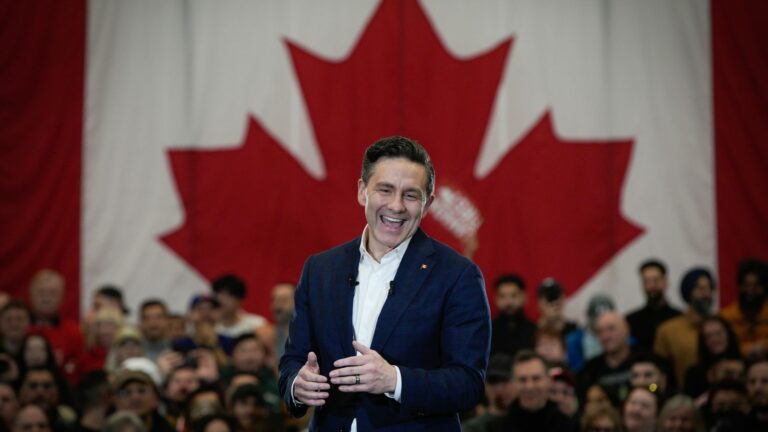
Pierre Poilievre has taken Canada’s case against U.S. trade barriers directly to New York at an unusually delicate moment in the relationship between the two countries. The Conservative leader is meeting business and investment figures, speaking to American audiences and preparing to participate in events marking the 25th anniversary of the September 11 attacks.
What makes the visit politically notable is the coordination behind it. According to a senior Conservative source cited in reporting on the trip, Poilievre is travelling with the blessing of Prime Minister Mark Carney’s office after an earlier U.S. visit was delayed when the PMO indicated the timing would be unhelpful. The PMO had not immediately confirmed that account when approached for comment. Against the backdrop of new tariffs, import bans and stalled negotiations, the trip offers a rare glimpse of government and opposition trying to keep their external message aligned while remaining fierce rivals at home.
A Rare Cross-Party Green Light
Poilievre Takes Canada’s Trade Case to New York With Carney PMO’s Blessing
- A Rare Cross-Party Green Light
- New York Gives Poilievre a Different Kind of Stage
- The Strategy Is to Reach Americans Beyond Washington
- The Trade Fight Has Become Much More Serious
- The Numbers Explain Why Canada Keeps Talking to U.S. Business
- Energy and Manufacturing Give Canada an American Argument
- Political Unity Abroad Does Not Mean Unity at Home
- The Earlier Delay Shows Why Timing Matters
- September 11 Adds a Powerful Human Dimension
- What Poilievre’s Visit Can — and Cannot — Accomplish
The most striking element of Poilievre’s New York visit may be the political choreography that happened before his plane ever left Canada. A senior Conservative source told CTV News that the trip was being undertaken with the Prime Minister’s Office aware and supportive of it. The same source said Poilievre had wanted to visit the United States earlier but backed away after the PMO advised that the timing could be unhelpful to Canada’s position. That detail matters because an opposition leader conducting high-profile diplomacy during a trade confrontation could easily create competing messages.
There is also an important qualification. Initial reporting said the PMO did not immediately respond when asked to confirm the arrangement, so the description of its “blessing” remains attributed to the Conservative source rather than a public statement from Carney’s office. Even with that caveat, Poilievre’s decision to heed earlier advice suggests his office was paying attention to the government’s negotiating calendar. In a political environment where the Conservatives continue to attack Carney’s handling of the dispute, even limited coordination is noteworthy.
New York Gives Poilievre a Different Kind of Stage
Poilievre is not in New York to sit across a formal negotiating table from the Trump administration. The current visit is focused instead on investors, business representatives and media, with Poilievre telling reporters that his main audience is the American people. Reports on the trip also indicate plans for appearances on major business networks and a broader appeal for free trade and economic co-operation. That places the visit firmly in the realm of public and commercial diplomacy rather than government-to-government bargaining.
New York is a natural setting for that approach. Carney himself travelled there in May to meet executives, investors and capital managers and to address the Economic Club of New York. His government used that visit to pitch Canada as a destination for investment while arguing that Canada-U.S. economic integration strengthens both countries. Poilievre is now entering many of the same conversations from the opposition benches. The political brands are different, but the underlying sales pitch has considerable overlap: disrupting one of the world’s most integrated commercial relationships carries costs on both sides of the border.
The Strategy Is to Reach Americans Beyond Washington
Poilievre has been developing this style of U.S. outreach for months. Before an earlier American tour in March, he argued that Canadians should engage not only the administration in Washington but American business leaders, unions, governors, mayors, investors, media organizations and civic leaders. His argument was that Canada could not dictate decisions coming from the White House but could build political and economic support among Americans who benefit from an open northern border.
That earlier trip took him through Michigan, Texas and New York. In Michigan he focused on the integrated auto industry. In Texas he promoted Canadian energy. His New York stop was devoted to the broader bilateral relationship and tariff-free trade. He also appeared on Joe Rogan’s podcast during the trip, describing mass-audience platforms as a way to make Canada’s free-trade case directly to Americans. The new New York visit therefore is not an abrupt change of strategy. It is a return to an approach Poilievre has already tested: trying to expand the Canadian argument beyond presidents, cabinet secretaries and official negotiating rooms.
The Trade Fight Has Become Much More Serious
The environment surrounding this visit is considerably harsher than it was during Poilievre’s March tour. Canada’s latest countermeasures took effect on September 8, placing tariffs of 15, 25 or 50 per cent on products covering C$27.6 billion of U.S. imports. Ottawa says the measures match U.S. tariffs dollar for dollar and concentrate pressure on products including steel and aluminum, dairy goods, appliances, agricultural equipment, pulp and paper, plastics and electronics.
Washington responded quickly. President Donald Trump signed measures on September 8 that will exclude selected Canadian products from the U.S. market beginning September 29. Separate proclamations cover certain dairy products, alcoholic beverages and motor-vehicle-related goods, with motorcycles among the products identified in reporting on the package. The administration has also moved against Canadian participation in U.S. government procurement. That means Poilievre is arriving in New York as the dispute moves beyond ordinary tariff adjustments toward outright market restrictions. For businesses dependent on predictable cross-border access, the difference is significant.
The Numbers Explain Why Canada Keeps Talking to U.S. Business
Despite Ottawa’s push to diversify trade, the American market remains extraordinarily important to Canadian companies. Statistics Canada reported that 71.7 per cent of Canada’s merchandise exports went to the United States in 2025. That was down from 75.9 per cent in 2024, showing some diversification, but it still leaves more than seven out of every ten export dollars in goods tied to the U.S. market.
The relationship runs deeply in both directions. Global Affairs Canada says almost C$3.6 billion worth of goods and services crossed the border every day in 2024. The United States remains Canada’s largest trading partner, while Canada ranks as the second-largest U.S. trading partner. That scale helps explain why Canadian politicians keep trying to speak directly to American executives, workers and local political leaders. Behind every headline about tariffs are factories ordering components, trucking companies moving freight, farms selling commodities and small businesses trying to price their next shipment. Even relatively narrow restrictions can create uncertainty far beyond the products formally named on a tariff schedule.
Energy and Manufacturing Give Canada an American Argument
Canada’s strongest case in the United States is not simply that tariffs hurt Canadians. Ottawa and the Conservatives both increasingly emphasize situations where American consumers and industries depend on Canadian supply. In his May New York speech, Carney cited figures showing Canada provides roughly 99 per cent of U.S. natural-gas imports, 85 per cent of its electricity imports and 60 per cent of its crude-oil imports. U.S. Energy Information Administration data likewise identify Canada as the dominant foreign supplier of natural gas to the United States.
Manufacturing creates similar interdependence. Canadian and U.S. automotive production has been integrated across the border for decades, with vehicles and components moving repeatedly between plants before a finished product reaches a dealership. Poilievre highlighted that integration during his Michigan visit in March and proposed an auto arrangement aimed at restoring tariff-free access. Carney has made much the same structural argument from a different political starting point: North America is more competitive when its production network functions as one market. Poilievre’s task in New York is to make those Canadian advantages look like American interests.
Political Unity Abroad Does Not Mean Unity at Home
The New York co-ordination should not be mistaken for a political truce between Poilievre and Carney. Only days before this trip, Poilievre was demanding that the prime minister reveal the expected costs of Canada’s counter-tariffs to consumers and businesses. He has also called on the government to release the text of the trade arrangement that collapsed in August and has pushed Carney to reconvene Parliament so MPs can debate Canada’s response.
That distinction may actually make the New York visit more politically interesting. Poilievre can continue arguing domestically that Carney has mishandled parts of the relationship while telling Americans that Canada’s core interests transcend party competition. During earlier U.S. outreach, he explicitly said negotiations should remain the responsibility of the Canadian government. The result is a two-track posture: opposition at home and national advocacy abroad. That balancing act will be closely watched. A Canadian opposition leader can strengthen the country’s message by reinforcing shared interests, but any suggestion of negotiating a different Canadian position could quickly undermine the value of the exercise.
The Earlier Delay Shows Why Timing Matters
The reported decision to delay an earlier U.S. visit is especially revealing because the bilateral situation has been changing rapidly. Canada and the United States spent weeks in intensive negotiations during the summer before talks were suspended in August. Canadian officials said substantial issues remained unresolved, and Carney subsequently moved ahead with the counter-tariff package. Formal negotiations are not currently proceeding as they were before the breakdown, although officials on both sides have maintained communication.
That gives the New York visit a different risk profile. During an active negotiation, an opposition leader publicly floating proposals or meeting influential Americans could potentially complicate the government’s leverage. During a period when formal bargaining has stalled, broader outreach may be less disruptive and potentially more useful. The sequence described by the Conservative source — proposed visit, PMO caution, delay, then a later green light — suggests both offices recognized that distinction. It is a small example of how diplomacy often depends not only on the message being delivered but on precisely when someone chooses to deliver it.
September 11 Adds a Powerful Human Dimension
Poilievre is also expected to remain in New York for ceremonies marking the 25th anniversary of the September 11, 2001 terrorist attacks. That gives the trip a significance extending well beyond tariffs. Canada’s response on September 11 remains one of the most remembered examples of practical solidarity between the two countries. When American airspace was closed, Canada’s Operation Yellow Ribbon helped handle 224 diverted aircraft carrying more than 33,000 displaced passengers.
Nowhere was that story more vivid than Gander, Newfoundland and Labrador. Thirty-eight aircraft carrying 6,656 people landed there, suddenly adding a population roughly two-thirds the size of the town itself. Residents opened community buildings and their own homes to travellers stranded for several days. The episode became an enduring symbol of the social ties underneath the economic relationship. Twenty-five years later, attending memorial events in New York allows a Canadian political leader to invoke something tariffs cannot easily measure: the history of two populations repeatedly treating continental security and moments of crisis as shared responsibilities.
What Poilievre’s Visit Can — and Cannot — Accomplish
A few television interviews and meetings with investors cannot produce a trade agreement. Poilievre does not negotiate on behalf of the federal government, and he has previously acknowledged that formal bargaining belongs to Ottawa. The current disagreement also involves detailed questions about tariffs, market access, automobiles, dairy, government procurement and the durability of any future agreement. Those issues require negotiators with authority to make commitments.
The value of the trip is therefore more indirect. Canadian officials need influential Americans to see Canadian trade not as a concession to a foreign country but as part of their own economic infrastructure. Business executives worried about costs, governors protecting employers, unions guarding integrated jobs and consumers facing higher prices can all affect the political environment in which Washington makes decisions. Poilievre’s New York mission tests whether an opposition leader can add another credible Canadian voice to that effort without creating another negotiating channel. If the reported co-ordination with Carney’s office holds, the most important message may be less about party politics than about something simpler: Canada’s political rivals disagree on plenty, but preserving mutually beneficial trade with the United States remains a national objective.
This Options Discord Chat is The Real Deal
While the internet is scoured with trading chat rooms, many of which even charge upwards of thousands of dollars to join, this smaller options trading discord chatroom is the real deal and actually providing valuable trade setups, education, and community without the noise and spam of the larger more expensive rooms. With a incredibly low-cost monthly fee, Options Trading Club (click here to see their reviews) requires an application to join ensuring that every member is dedicated and serious about taking their trading to the next level. If you are looking for a change in your trading strategies, then click here to apply for a membership.