35,000+ smart investors are already getting financial news, market signals, and macro shifts in the economy that could impact their money next with our FREE weekly newsletter. Get ahead of what the crowd finds out too late. Click Here to Subscribe for FREE.
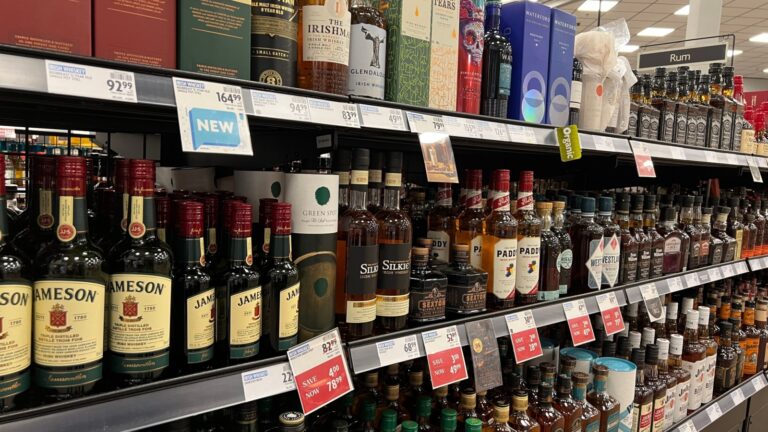
Ontario’s decision to clear American alcohol from provincial shelves created an unexpected opening for local producers. Breweries, wineries and distillers gained visibility, consumers shifted toward Canadian brands, and provincial data eventually showed Ontario-made alcohol sales climbing by roughly 22%. Now that same trade fight is threatening to close an important door in the opposite direction.
The United States has ordered an import ban on a broad range of Canadian alcoholic beverages beginning September 29, escalating an earlier 50% tariff into an outright market restriction for many products. For Ontario producers, the timing is particularly awkward. The domestic market has strengthened considerably, but manufacturers that spent years building American distribution may suddenly find that stronger sales at home cannot fully replace customers south of the border.
Washington Is Turning a 50% Alcohol Tariff Into an Import Ban
Ontario Alcohol Makers Face U.S. Ban After Local Sales Jumped 22% Under Ford’s U.S.-Booze Boycott
- Washington Is Turning a 50% Alcohol Tariff Into an Import Ban
- Ontario’s Boycott Had Removed Nearly $1 Billion in U.S. Alcohol Sales
- The 22% Local-Sales Jump Was Real, but the Time Period Matters
- Stronger LCBO Sales Did Not Mean Every Ontario Winery Was Booming
- Spirits Producers Have Much More U.S. Exposure to Lose
- American Producers Have Already Learned How Powerful the Canadian Boycott Can Be
- Ontario Has a Bigger Domestic Safety Net, but It Cannot Fully Replace the U.S.
The latest U.S. measure is more severe than an ordinary tariff because affected Canadian products will no longer simply become more expensive at the border. President Donald Trump’s September 8 proclamation says specified Canadian alcoholic beverages will be excluded from importation beginning at 12:01 a.m. Eastern time on September 29. Those products had already been exposed to an additional 50% duty under an earlier proclamation. Goods imported before the new ban takes effect but not yet entered for consumption remain subject to that 50% rate rather than automatically escaping the trade penalty.
The product list is broad enough to matter to many Ontario producers. It covers categories including packaged malt beer, numerous grape wines, cider, gin, vodka, liqueurs, brandies and other spirits. Still, calling it a universal ban on every bottle of Canadian alcohol would be inaccurate. Several classifications contain packaging or container-size limitations. In practical terms, a Niagara winery exporting finished bottles or an Ontario craft distiller sending retail-ready cases can face a different outcome from a large producer shipping bulk liquid for bottling in the United States. Customs classification has suddenly become commercially critical.
Ontario’s Boycott Had Removed Nearly $1 Billion in U.S. Alcohol Sales
The roots of the dispute stretch back to March 4, 2025, when Ontario directed the LCBO to stop purchasing and selling U.S.-made beverage alcohol in response to American tariffs. The decision went far beyond removing a few recognizable bourbon or California wine labels from LCBO stores. Online sales were halted, U.S. products were removed from wholesale catalogues, and grocery stores, convenience retailers, bars and restaurants could no longer order those products through the provincial system. Beer, wine, spirits, cider, ready-to-drink beverages and even American non-alcoholic products were included.
The size of the market made the decision economically meaningful. At the time, the LCBO said American products accounted for as much as $965 million in annual sales and that its assortment contained more than 3,600 U.S. products originating in 35 states. That suddenly left a substantial amount of shelf and catalogue space to be filled. Ontario producers did not automatically inherit every lost American sale—European, Australian and other Canadian products remained competitors—but local breweries, wineries and distillers were placed in front of shoppers who previously might have reached instinctively for an established U.S. brand.
The 22% Local-Sales Jump Was Real, but the Time Period Matters
Ontario’s 2026 budget provided the clearest evidence that domestic producers benefited during the boycott. Using LCBO data covering April 1, 2025 through January 31, 2026, the province reported that sales of Ontario alcohol products had increased approximately 22%. Local craft products were up about 35%, while Vintners Quality Alliance wines jumped roughly 52%. Those numbers help explain why the boycott became more than a political gesture for producers: it coincided with a measurable shift in what consumers were buying while U.S. labels remained unavailable through Ontario’s dominant distribution system.
Later LCBO figures covering the full fiscal year provide useful perspective rather than contradicting those earlier numbers. From April 2025 through March 2026, Ontario-made product sales rose 20%, adding more than half a billion dollars. VQA wine sales increased 44%, while Ontario beer and ready-to-drink beverages each rose 25% and Ontario-made spirits gained 9%. The differences reflect different reporting periods. Together, the figures show that the initial surge moderated somewhat as the year progressed, but the larger trend—substantially stronger demand for locally produced alcohol—persisted.
Stronger LCBO Sales Did Not Mean Every Ontario Winery Was Booming
The headline growth numbers hide an important complication: where people bought alcohol mattered almost as much as what they bought. Wine Growers Ontario reported that, during the 12 months ending March 31, 2026, total Ontario wine sales rose 4.8% by value but only 0.9% by volume. Sales through winery retail and on-site stores actually dropped 16.6% by value and 20.6% by volume. Meanwhile, VQA sales through the LCBO exceeded $264 million and climbed 43.7%. The boycott therefore helped create a powerful retail-channel shift without producing uniform gains across every winery business model.
That distinction matters because Ontario wine is tied to much more than bottles moving through LCBO checkouts. Wine Growers Ontario estimates the province’s wine and grape industry generates $5.49 billion in economic impact and supports more than 22,300 jobs. It includes grape growers, cellar workers, hospitality employees, restaurants and tourism operations. More than 18,000 acres of Ontario grapes produced 70,746 tonnes for winemaking in 2025. For a winery that depends heavily on tasting-room traffic, restaurant accounts or exports, booming LCBO demand elsewhere in the system does not necessarily solve its individual financial pressures.
Spirits Producers Have Much More U.S. Exposure to Lose
The most serious export vulnerability sits in distilled spirits. Spirits Canada reported that Canada exported $948.6 million worth of spirits to the United States in 2025, representing roughly 93% of the country’s total spirits export value. The industry group also estimates that close to half of Canadian spirits production is tied to U.S. demand. That degree of concentration makes replacing the American market exceptionally difficult in a short period. A distiller can seek buyers in Europe or Asia, but distribution agreements, regulatory approvals, marketing relationships and consumer recognition take time to build.
Ontario’s domestic sales improvement therefore offers only a partial cushion. A craft operation gaining new LCBO listings may be able to increase production for provincial customers, yet an exporter losing a U.S. distributor could still face excess inventory or cancelled production plans. Spirits Canada has already warned about potential cancelled orders, inventory challenges and production disruptions from the trade dispute. The imbalance is especially stark because only about 7% of Canadian spirits exports went to markets outside the United States in 2025. Domestic patriotism can help a brand, but it cannot instantly recreate an export market built over decades of largely tariff-free North American trade.
American Producers Have Already Learned How Powerful the Canadian Boycott Can Be
Washington’s retaliation did not emerge in an economic vacuum. American alcohol exporters suffered a sharp deterioration after Canadian provinces began removing U.S. products in 2025. The Distilled Spirits Council of the United States reported that American spirits exports to Canada fell more than 70% from March through December compared with the previous year. Excluding Canada, total U.S. spirits exports actually increased 2.5% in 2025, highlighting how heavily the Canadian boycott influenced the industry’s overall export performance.
Wine producers were hit even harder. The California-based Wine Institute says U.S. wine exports to Canada fell 78% in 2025, wiping about $357 million from export value. Canada had represented 36% of worldwide U.S. wine exports in 2024, making its sudden disappearance unusually disruptive. Those losses help explain why alcohol has become such a prominent bargaining chip. The White House explicitly argues that Canadian provincial restrictions discriminate against American commerce while allowing alcohol from other countries to continue competing. Canadian governments regard their measures as retaliation for U.S. trade actions. Producers on both sides, however, increasingly find themselves carrying costs created by decisions far beyond the brewery, vineyard or distillery.
Ontario Has a Bigger Domestic Safety Net, but It Cannot Fully Replace the U.S.
Ontario producers enter this latest escalation with considerably more domestic selling capacity than they had several years ago. The LCBO reported in June that consumers had access to more than 4,600 Ontario-made beverages, after 1,060 local options were added across alcohol categories during the previous year. Ontario’s broader retail overhaul has also put beer, wine, cider and ready-to-drink beverages into more than 6,600 licensed convenience and grocery stores. In July, Ontario joined eight other provinces in a direct-to-consumer alcohol agreement intended to make it easier for Canadian producers to sell across provincial boundaries.
Those changes give businesses more places to search for revenue if American orders disappear, but they do not make the U.S. restriction harmless. Washington’s proclamation can be suspended, amended or revoked, and the detailed tariff classifications mean some bulk shipments may receive different treatment from finished retail packages. Reuters also reported that Canadian and U.S. trade officials remained in contact after the latest escalation, suggesting negotiation has not completely stopped. Until policy changes, though, Ontario producers face a peculiar reversal: the same trade confrontation that helped put more local bottles into Ontario shopping baskets is now threatening to make many of those bottles considerably harder—or impossible—to sell in the United States.
This Options Discord Chat is The Real Deal
While the internet is scoured with trading chat rooms, many of which even charge upwards of thousands of dollars to join, this smaller options trading discord chatroom is the real deal and actually providing valuable trade setups, education, and community without the noise and spam of the larger more expensive rooms. With a incredibly low-cost monthly fee, Options Trading Club (click here to see their reviews) requires an application to join ensuring that every member is dedicated and serious about taking their trading to the next level. If you are looking for a change in your trading strategies, then click here to apply for a membership.