35,000+ smart investors are already getting financial news, market signals, and macro shifts in the economy that could impact their money next with our FREE weekly newsletter. Get ahead of what the crowd finds out too late. Click Here to Subscribe for FREE.
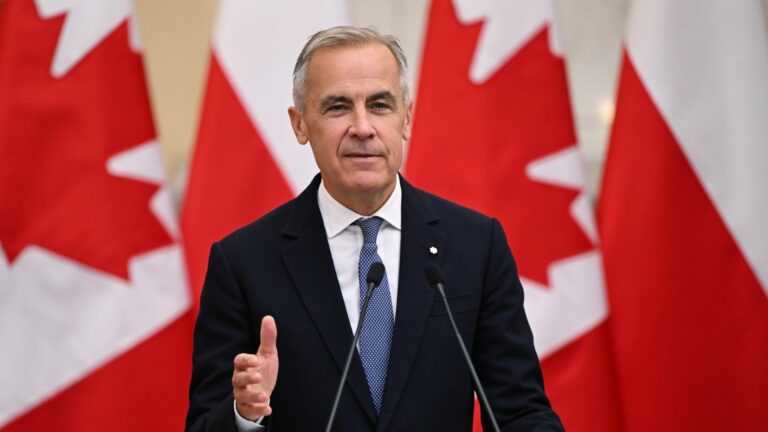
Canada’s economic break with its closest trading partner is no longer being described as painless. Prime Minister Mark Carney has acknowledged that reducing dependence on the United States “will come at a cost,” arguing that standing still would be more damaging. Conservative Leader Pierre Poilievre is turning that admission into a political demand: spell out what the counter-tariffs, lost trade, industry supports and broader economic shift will cost households and businesses.
The clash comes as Canada’s newest retaliatory tariffs take effect after another breakdown in negotiations with Washington. It is therefore about more than rhetoric. The dispute now reaches store shelves, factory floors, investment plans and federal spending, while Canada tries to build new markets without severing an economic relationship that still moves billions of dollars in goods and services across the border every day.
Carney Acknowledges the Pivot Has a Price
Carney Says Breaking From the U.S. ‘Will Come at a Cost’; Poilievre Demands He Show Canadians the Bill
- Carney Acknowledges the Pivot Has a Price
- The First $27.6 Billion Part of the Bill Is Already Here
- Decades of U.S. Integration Cannot Be Unwound Quickly
- Some Tariff Costs Are Likely to Reach Store Shelves
- Ottawa Is Spending Billions to Cushion the Shock
- Canada’s Auto Industry Shows How Difficult the Break Could Be
- Trade Diversification Is Already Happening
- CUSMA Makes a Clean Break Even More Complicated
- Poilievre Wants the Rejected U.S. Deal Put on the Table
- There May Never Be One Simple Number for the Final Cost
Carney’s warning marked a shift in tone because it openly attached a price to the government’s strategy. In a September 8 national video address, he said Canada had what it needed to “pivot and prosper,” but added that the pivot would come at a cost. His argument was comparative: action may be expensive, but continued dependence on an unpredictable U.S. trade relationship could be more expensive over time.
Poilievre sharpened the same issue a day earlier. He said Canadians should be told how much the new counter-tariffs will cost consumers and businesses and what Ottawa will do to offset those costs. He has also demanded the full text of the U.S. trade arrangement that fell apart in August. That creates a political test for Carney: if the government wants public support for a costly transition, voters will expect a clearer accounting of the sacrifice involved for Canadians today.
The First $27.6 Billion Part of the Bill Is Already Here
The first part of the bill is already visible. Canada’s new counter-tariffs took effect on September 8 and cover $27.6 billion in imports from the United States. The federal government says the duties are set at 15%, 25% or 50%, depending on the product, and are designed to match U.S. tariff rates. Targeted categories include steel and aluminum, dairy, appliances, agricultural equipment, pulp and paper, plastics and electronics.
Tariffs are taxes collected at the border, but the economic burden does not necessarily stay there. Importers can absorb part of the cost, seek cheaper suppliers, renegotiate contracts or pass higher costs to customers. Ottawa has kept a remission process for cases where businesses cannot reasonably source inputs domestically or from non-U.S. suppliers. Even with that relief, the scale of the measures means decisions will change, from industrial components to consumer goods, making the transition tangible rather than theoretical.
Decades of U.S. Integration Cannot Be Unwound Quickly
Canada can diversify, but geography and decades of integration make a rapid pivot difficult. Statistics Canada reported that 71.7% of Canadian merchandise exports went to the United States in 2025, down from 75.9% in 2024. The U.S. also supplied 58.8% of Canada’s merchandise imports. Those shares are lower than before, but they still describe a trading relationship with few global equivalents.
The broader numbers matter. Global Affairs Canada says the two countries exchanged nearly $3.5 billion in goods and services every day in 2025. Supply chains often cross the border multiple times before a finished product reaches a customer, particularly in manufacturing. That means “breaking” from the U.S. is unlikely to resemble flipping a switch. It looks more like a long re-engineering project: new customers, suppliers, ports, transportation routes and capital investment. Each change can improve resilience, but each can also carry upfront costs.
Some Tariff Costs Are Likely to Reach Store Shelves
For households, the clearest risk is that some tariff costs eventually appear in retail prices. Bank of Canada researchers studied Canada’s 2025 counter-tariffs using daily prices for more than 110,000 products at seven major retailers. They found prices of tariffed goods rose about 6% relative to comparable non-tariffed products at the peak, implying roughly one-quarter of the 25% tariff was passed through to consumers.
Earlier Bank research on the 2018 trade dispute found a larger average pass-through over time, around 60% after six quarters across affected product categories. The lesson is not that every new tariff will raise prices by a fixed amount. Businesses can absorb costs, switch suppliers or obtain relief, and responses vary. The lesson is that counter-tariffs are not costless. When they persist, some combination of importers, retailers, manufacturers and households tends to pay. That gives Poilievre’s demand for a breakdown economic weight beyond partisan messaging.
Ottawa Is Spending Billions to Cushion the Shock
Ottawa is trying to cushion the transition with public money, adding to the bill. The federal government announced a $7.5 billion package for workers and businesses affected by U.S. tariffs, on top of nearly $25 billion in supports it says had already been provided. The package includes $1.5 billion more for the Regional Tariff Response Initiative and a $500 million Business Development Bank liquidity stream.
It also includes a $2 billion Canada Strong Diversification Fund and $3.5 billion in rapid-response supports for workers and employers. These programs are meant to help companies manage cash pressure, retool plants, find markets and avoid layoffs while trade patterns shift. For a small manufacturer facing a tariff on a key input, that support can keep a production line moving. Politically, however, it reinforces Poilievre’s point: diversification has a fiscal cost as well as a private-sector cost, and both deserve scrutiny.
Canada’s Auto Industry Shows How Difficult the Break Could Be
No sector shows the stakes more than autos. Federal figures say Canada’s auto industry supports more than 500,000 workers, contributes more than $16 billion annually to GDP and produced over 1.2 million passenger vehicles in 2025. More than 90% of Canadian-made vehicles and 60% of Canadian-made auto parts are exported to the United States, while 125,000 direct jobs depend on automotive manufacturing.
Those numbers explain why replacing U.S. demand is not a short-term exercise. A vehicle assembled in Ontario may contain components made on both sides of the border, supported by suppliers using just-in-time continental logistics. Redirecting finished vehicles to Europe or Asia does not recreate that ecosystem. New safety rules, shipping routes, dealer networks and consumer preferences matter. Diversification can reduce vulnerability over time, but autos show why Carney is warning about transition costs: some industries were designed around North America, not interchangeable global markets.
Trade Diversification Is Already Happening
The government has evidence that diversification is already happening. Statistics Canada reported that merchandise exports to countries other than the United States rose 17.2% in 2025, while total merchandise trade with non-U.S. partners increased 14.3% to $553 billion. Global Affairs Canada has made doubling non-U.S. exports over the next decade a formal policy goal, backed by export-promotion initiatives.
Still, growth outside the U.S. should not be confused with replacing the American market. Some of the recent increase was concentrated in commodities such as gold and energy, which do not solve the market-access problem for every manufacturer. A Quebec aerospace supplier, an Ontario auto-parts plant and a Prairie food processor face different barriers in Europe or Asia. Promisingly, Canadian trade routes are becoming more diverse. The harder question is how quickly manufacturers and smaller businesses can follow without losing competitiveness during the difficult adjustment period today.
CUSMA Makes a Clean Break Even More Complicated
The debate unfolds while CUSMA itself enters a period of uncertainty. The Canada-United States-Mexico Agreement came into force in 2020 and its first mandatory six-year review fell in 2026. Global Affairs Canada stresses that the review is not an expiry date: under the agreement, CUSMA remains in force until 2036 unless the parties take other formal steps, including withdrawal.
The economic value of that framework is substantial. Canada and the United States traded nearly $3.5 billion in goods and services per day in 2025, and bilateral goods-and-services trade has increased by more than 27% since CUSMA entered into force. That is why political language about “breaking” from the U.S. needs context. Canada is trying to reduce dependence while preserving as much favourable access as possible. The costly scenario is not simply diversification. It is diversification occurring while the rules governing the continent’s largest commercial relationship become less predictable.
Poilievre Wants the Rejected U.S. Deal Put on the Table
Poilievre’s transparency argument reaches beyond tariffs. He has called on Carney to release the text of the trade arrangement that collapsed in August so Canadians can judge what Ottawa rejected. Carney’s explanation is that late U.S. demands were unfair, uneconomic and threatened Canadian flexibility and sovereignty. He also said Canada would not compromise protections tied to the French language and culture or undermine key industries.
Those positions are not contradictory, but they create a disclosure problem. Trade negotiations involve confidential bargaining positions, while accountability grows more important once government asks the public to absorb measurable costs. Canadians know the government’s reasons for walking away and the shape of its retaliatory strategy. They do not have a single public document showing the rejected package beside an estimate of the alternative path. Poilievre is betting that gap will matter more if prices rise, layoffs spread or federal support grows more expensive.
There May Never Be One Simple Number for the Final Cost
The bill is unlikely to arrive as one number. It will be spread across higher prices on some tariffed goods, lost or delayed exports, business investment decisions, government support programs, supply-chain changes and jobs displaced during the transition. The Department of Finance’s spring outlook projected real GDP in 2029 to remain about 1.6% below the path anticipated before the tariff shock, reflecting weaker investment and economic reallocation.
The Bank of Canada added another warning on September 2, saying new U.S. tariffs and Canadian counter-tariffs could raise business costs and feed into consumer prices while making growth more uncertain. That frames the Carney-Poilievre clash. Carney argues Canada must pay now to reduce a larger strategic vulnerability. Poilievre argues Canadians should see a detailed invoice before accepting that bargain. Both political positions turn on the same unresolved question: how much resilience is Canada willing to buy, and at what price?
This Options Discord Chat is The Real Deal
While the internet is scoured with trading chat rooms, many of which even charge upwards of thousands of dollars to join, this smaller options trading discord chatroom is the real deal and actually providing valuable trade setups, education, and community without the noise and spam of the larger more expensive rooms. With a incredibly low-cost monthly fee, Options Trading Club (click here to see their reviews) requires an application to join ensuring that every member is dedicated and serious about taking their trading to the next level. If you are looking for a change in your trading strategies, then click here to apply for a membership.