35,000+ smart investors are already getting financial news, market signals, and macro shifts in the economy that could impact their money next with our FREE weekly newsletter. Get ahead of what the crowd finds out too late. Click Here to Subscribe for FREE.
Canada’s wildfire season has crossed an important statistical threshold even as autumn begins to cool parts of the country. As of September 5, the Canadian Wildland Fire Information System reported roughly 4.48 million hectares burned in 2026, slightly above the 10-year year-to-date average of about 4.41 million hectares. The national tally also stood at 5,289 fires, with 531 still active.
That does not make 2026 another 2023, when Canada experienced a record-breaking fire season. It does show how quickly a year that began relatively slowly accelerated through July and August. The headline number now reflects a season shaped by large remote fires, evacuations in several regions, prolonged heat and dryness, hazardous smoke, and a firefighting system that has relied on both domestic and international support.
The 10-Year Threshold Has Been Crossed, But Only Narrowly
Canada’s 2026 Wildfire Burn Area Passes 10-Year Average With 4.48 Million Hectares Burned
- The 10-Year Threshold Has Been Crossed, But Only Narrowly
- A Slow Start Turned Into a Rapid Summer Escalation
- Northwestern Ontario and Southern B.C. Became Major Pressure Points
- Evacuations Reveal a Much More Unequal Human Impact
- Smoke Makes Remote Wildfires a National Health Issue
- Fire Size Matters More Than the Raw Number of Ignitions
- Canada’s Changing Climate Is Raising the Background Risk
- International Firefighters and New Aircraft Have Bolstered the Response
- Burned Hectares Do Not Translate Directly Into Financial Losses
- The National Picture Is Quieting, But the Season Is Not Necessarily Finished
The 4.48-million-hectare figure is significant because it has moved just beyond the 10-year benchmark for this point in the season. CWFIS listed the 10-year year-to-date average at 4,414,903 hectares on September 5, compared with 4,484,335 hectares burned in 2026. The difference is about 69,000 hectares, or roughly 1.6 per cent. In other words, Canada has crossed the line, but only narrowly. It is a meaningful threshold without being a sign of unprecedented national damage.
That distinction matters because recent wildfire years have reset public expectations. The five-year average shown by CWFIS is much higher, at more than 7.1 million hectares, heavily influenced by exceptionally severe recent seasons. Canada’s 2023 fires burned well above 17 million hectares under agency-based reporting, making 2026 far less extreme by comparison. Still, surpassing the decade benchmark before the season is fully over shows that an apparently moderate year can become an above-average burn year without approaching record territory.
A Slow Start Turned Into a Rapid Summer Escalation
The most striking feature of 2026 is how sharply the season accelerated after a relatively slow start. On June 10, federal officials reported 1,747 fires and only 166,400 hectares burned. By July 9, the area had climbed to 1.4 million hectares. On August 18, it had reached 4.1 million hectares, meaning the national total expanded by several million hectares in barely two months.
That progression helps explain why early-season assessments can change so quickly. Fire danger depends not only on the number of ignitions, but also on heat, humidity, wind, fuel dryness and whether large fires become established in places where suppression is difficult. Federal forecasts had warned that above-normal summer temperatures could raise danger as vegetation dried. The warning proved consequential: July brought worsening conditions in parts of northern and central Canada, while August saw serious activity in southern British Columbia. By early September, the cumulative total had edged above the decade comparison.
Northwestern Ontario and Southern B.C. Became Major Pressure Points
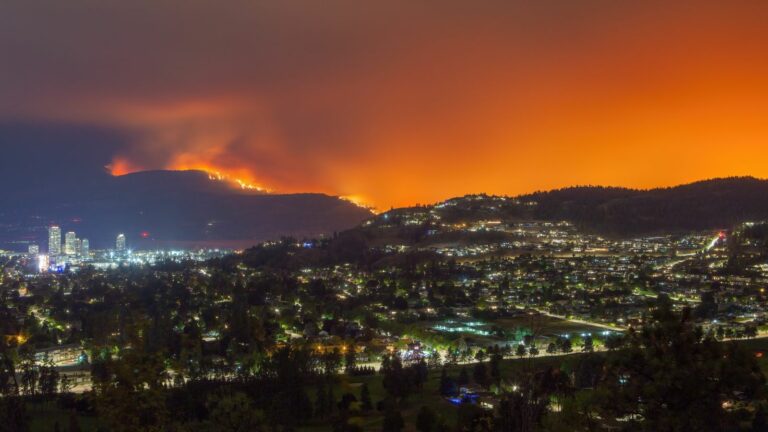
The national total hides a season that was highly uneven from region to region. Federal officials said intense fires in Northwestern Ontario during mid-July caused significant damage and forced evacuations, including from First Nations communities. Southern British Columbia later faced persistent heat and below-normal precipitation, with major fire activity affecting the Fraser Canyon and Okanagan Valley and prompting evacuations around Summerland and Peachland.
By August 18, more than 10,000 people were still under evacuation orders in British Columbia, according to the federal wildfire update. Ontario’s fire season also remained active into September. On September 5, the province reported 59 active fires in its Northwest Region and nine in the Northeast Region. That regional concentration is important: a small number of large incidents can dominate the national burned-area total even when many other provinces are experiencing relatively quiet conditions. For communities near those fires, the season can feel severe regardless of what the national average says.
Evacuations Reveal a Much More Unequal Human Impact
Wildfire statistics become more human when measured in evacuations rather than hectares. The 2026 season again exposed the vulnerability of remote and Indigenous communities, where road access can be limited and evacuations may require aircraft. In July, the Canadian Armed Forces deployed four CC-130 Hercules aircraft to help evacuate Eabametoong First Nation in Northern Ontario as a rapidly advancing wildfire threatened the community.
The broader pattern extends beyond this year. Federal emergency-management information estimates that First Nations communities account for about 42 per cent of wildfire-related evacuations while representing roughly 5 per cent of Canada’s population. In 2025 alone, tens of thousands of people from on-reserve First Nations were displaced by wildfires. That history explains the growing emphasis on local preparedness, evacuation planning, firefighter training and emergency infrastructure. The national burn total is therefore more than an environmental statistic. Behind it are families leaving home, communities organizing temporary shelter and local leaders facing repeated emergency decisions under difficult conditions.
Smoke Makes Remote Wildfires a National Health Issue
Wildfire smoke expands the footprint of a fire far beyond its perimeter. Health Canada notes that smoke can travel thousands of kilometres and contains gases, volatile compounds and fine particles. The greatest health concern is PM2.5, particles small enough to penetrate deeply into the respiratory system. Poor air quality can occur even when smoke is not particularly visible or easy to smell.
That makes a remote fire relevant to people hundreds or even thousands of kilometres away. During 2026, federal officials reported periods of heavy smoke in both Northwestern Ontario and southern British Columbia, with winds carrying pollution far beyond the fire zones. Satellite monitoring in early September continued to show Canadian smoke moving across several provinces and into the United States. Health Canada estimates that wildfire-smoke air pollution contributes to hundreds to several thousand premature deaths in Canada in recent years, depending on fire severity and location, while estimating the annual economic cost of associated health impacts at roughly $5 billion to $21 billion.
Fire Size Matters More Than the Raw Number of Ignitions
The number of fires tells only part of the story. On September 5, CWFIS counted 5,289 fires for the year, only slightly above its 10-year average of 5,236. Yet the area burned had already moved above the corresponding decade average. That gap illustrates a familiar wildfire pattern: the size and behaviour of a relatively small number of major fires can matter far more than the raw ignition count.
Natural Resources Canada notes that large wildland fires represent only a small percentage of fires but account for almost all of the area burned. The current CWFIS breakdown reinforces that point. More than 2.68 million hectares of the 2026 total were associated with fires classified as being monitored, while roughly 1.2 million hectares were associated with full-response fires. Canada’s immense boreal landscape means not every fire presents the same threat to people or infrastructure. A year can therefore accumulate millions of burned hectares through a relatively limited collection of very large incidents spread across remote parts of the country.
Canada’s Changing Climate Is Raising the Background Risk
The 2026 season is unfolding within a climate becoming more favourable to extreme fire weather, but that does not mean climate change alone explains every ignition or every burned hectare. Canada’s Changing Climate Report 2026 says the country has warmed by about 2.0 C over the past 50 years, while Northern Canada has warmed by approximately 2.6 C. It also concludes with high confidence that fire seasons have lengthened across most of Canada and will lengthen further as temperatures rise.
Researchers have found stronger links between human-caused warming and the probability of extreme wildfire seasons. A peer-reviewed attribution study examining the record 2023 season found that human influence on the climate made a fire season of comparable length more than five times as likely across most Canadian ecozones. It also increased the likelihood of exceptionally large burned areas in several regions. Those findings cannot simply assign a percentage of the 2026 burn total to climate change. They do explain why hotter and drier conditions increasingly raise the background risk surrounding individual fires.
International Firefighters and New Aircraft Have Bolstered the Response
Canada’s response system has had to scale up as wildfire seasons become more complex and simultaneous. During the summer of 2026, more than 500 firefighters from Mexico, Costa Rica, New Zealand and Australia came to assist Canadian agencies, particularly in Ontario and British Columbia. Their presence reflects the importance of international mutual-aid arrangements when several jurisdictions need crews and specialized resources at the same time.
The federal government also entered the season with expanded aviation capacity. Budget 2025 directed $316.7 million over five years to the Canadian Interagency Forest Fire Centre to establish national aerial firefighting surge capacity. For 2026, that included 10 leased firefighting aircraft and two support assets that could be repositioned according to need. By early September, international crews were beginning to demobilize as conditions quieted, although Canada remained at National Preparedness Level 3. The season has consequently tested more than firefighting strength; it has tested national coordination and the ability to move people, aircraft and equipment where pressure is greatest.
Burned Hectares Do Not Translate Directly Into Financial Losses
A large national burn area does not automatically produce equally large insured losses. Morningstar DBRS said during the 2026 season that many of the largest fires were concentrated in remote parts of Northwestern Ontario and Northern Quebec, limiting direct property and commercial insurance claims. That is a crucial distinction: hectares burned measure landscape impact, while financial losses depend heavily on where flames intersect with homes, businesses, roads and other infrastructure.
Past disasters demonstrate how quickly that calculation can change. Statistics Canada found that business activity potentially affected by wildfires represented less than one per cent of national GDP during the record 2023 season, yet the effects were dramatically larger in certain local economies. The 2024 Jasper wildfire later generated insured losses approaching $1.3 billion after 358 homes and businesses were destroyed. The lesson for 2026 is straightforward: a vast remote wildfire can dominate acreage statistics, while a much smaller blaze entering a populated community can produce far greater economic damage.
The National Picture Is Quieting, But the Season Is Not Necessarily Finished
Crossing the 10-year burn-area average does not mean the 2026 season is still accelerating at midsummer speed. CWFIS’s September 2 national assessment said agencies were generally reporting quieting conditions, with no outstanding requests for interagency resources at that time. International crews had begun demobilizing, and most provincial or territorial agencies had moved to lower preparedness levels even as Canada remained at National Preparedness Level 3.
The season is not necessarily finished, however. Federal modelling released in August projected higher-than-normal September fire danger across much of Canada, except Alberta and Saskatchewan, while emphasizing that northern fire danger normally declines at this time of year and above-normal conditions do not automatically mean major fire growth. The final 2026 total can also change as agencies revise fire perimeters and later satellite analysis refines the amount of land actually burned. For now, the conclusion is measured: Canada has moved above its 10-year year-to-date burn-area average while remaining far below the extraordinary national scale reached during the record 2023 season.
This Options Discord Chat is The Real Deal
While the internet is scoured with trading chat rooms, many of which even charge upwards of thousands of dollars to join, this smaller options trading discord chatroom is the real deal and actually providing valuable trade setups, education, and community without the noise and spam of the larger more expensive rooms. With a incredibly low-cost monthly fee, Options Trading Club (click here to see their reviews) requires an application to join ensuring that every member is dedicated and serious about taking their trading to the next level. If you are looking for a change in your trading strategies, then click here to apply for a membership.