35,000+ smart investors are already getting financial news, market signals, and macro shifts in the economy that could impact their money next with our FREE weekly newsletter. Get ahead of what the crowd finds out too late. Click Here to Subscribe for FREE.
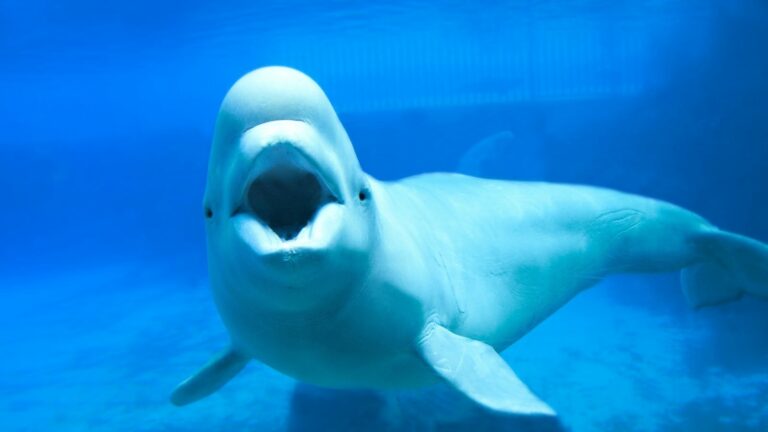
A grey, rain-soaked afternoon at Marineland marked another turning point for Canada’s last large group of captive belugas. Six whales were moved out of the shuttered Niagara Falls attraction on August 12, continuing an international relocation effort that began only weeks earlier. Four females were bound for Chicago’s Shedd Aquarium, while two males were headed to Georgia Aquarium in Atlanta.
The latest departure reduces Marineland’s original group of 30 belugas to just 11 still awaiting relocation. What appears on paper to be a simple decline in numbers is actually an unusually complicated operation involving veterinarians, transport specialists, federal regulators and several aquariums. It also represents the closing phase of a years-long dispute over what should happen to the whales after Marineland ceased regular public operations and said it could no longer afford their long-term care.
Six Whales Depart in a Carefully Watched Third Transfer
Six More Marineland Belugas Leave Canada for U.S. Aquariums, Leaving Just 11 at the Park
- Six Whales Depart in a Carefully Watched Third Transfer
- Three Transfers Have Already Moved 19 Belugas
- A Failed China Proposal Led to the U.S. Rescue Plan
- Moving a Beluga Is Part Transport Job, Part Medical Procedure
- Canada’s 2019 Captivity Law Still Shapes Every Decision
- Eleven Belugas Remain as the Final Phase Approaches
The latest group consists of two males, Zephyr and Balor, and four females, Caspian, Peekachu, Secord and Rain. The females were assigned to Shedd Aquarium in Chicago, while Zephyr and Balor were destined for Georgia Aquarium in Atlanta. The U.S. government’s emergency import documentation had already identified those facilities as the intended homes for the animals, allowing teams to prepare for their arrival well before transport day.
The scene at Marineland demonstrated how quickly plans can change when living animals weighing hundreds of kilograms are involved. Workers guided each beluga into a custom sling before a crane lifted the animal into a transport container. One female was temporarily held while veterinarians examined a cut on her tail. She was treated, cleared to travel and given extra foam padding around the sling. Weather was another concern, with organizers watching approaching thunderstorms before the convoy finally departed for Toronto Pearson International Airport. A retired Marineland employee who had worked there for four decades came to watch, describing the day as a chance to say goodbye to animals he had known for years.
Three Transfers Have Already Moved 19 Belugas
Marineland had 30 belugas when the current relocation effort began, meaning the three completed or initiated waves have now removed 19 animals — nearly two-thirds of the original population. The first major transfer began July 20. Four females, Acadia, Osiris, Sierra and Lillooet, went to Shedd Aquarium, while males Bertie Botts and Frankie were moved to SeaWorld San Antonio. Shedd said the four females were deliberately transported together because of their existing social relationships.
A second move followed on August 3, when seven female belugas — Xena, Gemini, Skyla, Meeka, Eve, Neva and Calypso — left for SeaWorld San Antonio. With another six departing August 12, only 11 belugas remain at Marineland. The emphasis on social groupings is significant. Peer-reviewed research published in Scientific Reports has found that belugas form complex, dynamic social networks involving both relatives and unrelated animals. That helps explain why planners consider social bonds alongside health, age and destination capacity when deciding which whales should travel together rather than simply moving them in whatever order is most convenient.
A Failed China Proposal Led to the U.S. Rescue Plan
The current U.S.-led operation emerged only after a previous solution collapsed. In 2025, Marineland sought Canadian authorization to export all 30 belugas to Chimelong Ocean Kingdom in China. Federal records show Fisheries Minister Joanne Thompson rejected that proposal in October. The government said the proposed destination had not committed to avoiding breeding and that the animals would likely have been used for public entertainment, conflicting with requirements governing Canadian cetacean exports.
By January 2026, the situation had become considerably more urgent. Federal briefing documents say Marineland informed the minister that its belugas and dolphins faced an imminent threat of euthanasia if they could not be exported. Thompson granted conditional approval on January 26 for transfers to identified U.S. facilities, subject to individual veterinary assessments, confirmed destinations and detailed transport plans. The American side subsequently moved through its own regulatory process. In July, NOAA Fisheries entered into an emergency cooperative agreement allowing SeaWorld, Georgia Aquarium and Shedd Aquarium to import as many as 28 of Marineland’s belugas, while the broader relocation plan sends two others to Oceanogràfic València in Spain.
Moving a Beluga Is Part Transport Job, Part Medical Procedure
The sight of cranes and trucks can make the operation resemble oversized freight handling, but moving a beluga is much closer to a travelling veterinary procedure. Specialized slings support the animals as they leave the water, while water-filled transport containers help control temperature and provide support during the journey. Previous Marineland transfers have involved trucks, cargo aircraft and animal-care teams accompanying the whales. Canadian veterinarians must also determine that individual animals are fit enough to travel before they leave.
The August 12 transfer showed why that flexibility matters. The tail injury discovered on one female could have delayed her departure if veterinarians had considered transportation unsafe. Organizers have repeatedly said individual whales can be held for a later trip rather than forcing a predetermined schedule. U.S. rules impose additional safeguards after arrival. NOAA’s cooperative agreement requires the imported belugas to be housed at federally licensed facilities and cared for under U.S. Animal Welfare Act standards. It also restricts how public display can occur and requires veterinary and animal-care considerations to take priority, making the journey only the first stage of what could be years of individualized monitoring.
Canada’s 2019 Captivity Law Still Shapes Every Decision
Marineland’s predicament cannot be separated from the major change Canada made to cetacean policy in 2019. Amendments to the Fisheries Act and Criminal Code established restrictions on keeping, breeding, importing and exporting whales, dolphins and porpoises. Animals already legally held when the legislation took effect could remain in captivity, which meant Marineland was not required to release its existing belugas. The changes nevertheless made acquiring new captive cetaceans or moving existing ones across international borders far more tightly controlled.
Canadian facilities exporting a living cetacean generally need both a Fisheries Act authorization and documentation required under the Convention on International Trade in Endangered Species, or CITES. Under the Fisheries Act, an export can be approved for scientific research or when keeping the animal at another facility is considered to be in its welfare interests. The U.S. authorization adds an unusual layer: NOAA’s agreement treats the imported Marineland belugas as animals held for rehabilitation and requires authorities to consider whether eventual release is feasible. At the same time, receiving aquariums have prepared for potentially long-term care, reflecting the practical difficulty of releasing captive animals with widely differing ages, histories and medical needs.
Eleven Belugas Remain as the Final Phase Approaches
After the latest group leaves, Marineland will still have 11 belugas and four dolphins requiring new homes. Marineland adviser Andrew Burns said three more moves were planned, including an overnight operation expected to take two belugas and the dolphins toward Spain. SeaWorld San Diego and Oceanogràfic València are among the facilities designated to receive animals under the broader relocation plan. Marineland has said it hopes to complete the moves by the end of August, although organizers have emphasized that health concerns can override any target date.
The urgency is sharpened by Marineland’s recent history. Provincial information obtained by The Canadian Press and cited by the Associated Press showed that 20 whales — 19 belugas and Kiska, the park’s final killer whale — died there from 2019 onward. The figure does not by itself establish why individual animals died, but it helps explain the intense scrutiny surrounding every remaining transfer. Marineland has been closed to the public since 2024 and its property remains part of a broader sale and redevelopment process. Relocating the final animals may resolve the immediate care crisis, but the larger Canadian debate over captive cetaceans, aquariums and marine sanctuaries is unlikely to leave with the last transport truck.
This Options Discord Chat is The Real Deal
While the internet is scoured with trading chat rooms, many of which even charge upwards of thousands of dollars to join, this smaller options trading discord chatroom is the real deal and actually providing valuable trade setups, education, and community without the noise and spam of the larger more expensive rooms. With a incredibly low-cost monthly fee, Options Trading Club (click here to see their reviews) requires an application to join ensuring that every member is dedicated and serious about taking their trading to the next level. If you are looking for a change in your trading strategies, then click here to apply for a membership.