35,000+ smart investors are already getting financial news, market signals, and macro shifts in the economy that could impact their money next with our FREE weekly newsletter. Get ahead of what the crowd finds out too late. Click Here to Subscribe for FREE.
Canada’s plan to rebuild its submarine fleet has gained another sign of momentum from Germany. Just weeks after Ottawa selected TKMS as the preferred supplier for up to 12 Type 212CD submarines, the German naval shipbuilder sharply upgraded its financial outlook, reflecting booming demand for warships, sensors and other maritime defence technology.
The timing matters. Canada is trying to replace an aging submarine fleet while taking on more responsibility inside NATO, just as Washington reduces some of the forces it has traditionally earmarked for the alliance’s European defence plans. TKMS’s stronger business position does not guarantee Canada a smooth procurement, nor has Ottawa signed the final submarine contract. But it reinforces a broader shift: Canada is increasingly treating European defence partnerships, industrial capacity and long-term strategic autonomy as central parts of its security planning.
TKMS’s Stronger Forecast Arrives at an Important Moment
Canada’s German Submarine Pick Gets a Boost as TKMS Raises Forecast Amid Reduced U.S. Defence Support
- TKMS’s Stronger Forecast Arrives at an Important Moment
- Ottawa Has Picked a Preferred Supplier, Not Signed the Final Deal
- The Type 212CD Fits Canada’s Most Difficult Naval Requirements
- Washington’s Pullback Makes Allied Naval Capacity More Valuable
- Germany and Norway Offer Canada a Ready-Made Submarine Partnership
- Canadian Industry Will Expect More Than Boats Built in Germany
- Delivery and Execution Are Now the Biggest Tests
TKMS entered August with considerably more momentum than investors had expected. On August 12, the company raised its fiscal 2025/26 sales-growth forecast to between 10% and 12%, up dramatically from its previous expectation of 2% to 5%. It also lifted its operating-margin outlook to as much as 6.5%. Nine-month operating profit rose 13% to €110 million, while TKMS shares climbed as much as 15.7% during trading, reaching their highest level in nearly six months.
Those figures matter to Canada because Ottawa is contemplating a relationship with TKMS that could last for decades. The company would not simply be expected to construct submarines; it would need to support training, maintenance, upgrades, technology integration and a Canadian sustainment system throughout the fleet’s operational life. TKMS still faces the usual defence-industry pressures involving skilled labour, production capacity and long delivery schedules, but the stronger outlook makes the Canadian selection look less like an isolated win and more like part of a rapidly expanding order pipeline.
Ottawa Has Picked a Preferred Supplier, Not Signed the Final Deal
Canada crossed a major procurement threshold on July 6 when Prime Minister Mark Carney announced TKMS as the preferred supplier for the Canadian Patrol Submarine Project. The government intends to negotiate for up to 12 submarines, describing the program as the largest defence procurement in Canadian history. Ottawa expects contracting to be completed no later than the end of 2027, with the first four new submarines scheduled for delivery in 2034.
There is still an important escape clause. South Korea’s Hanwha Ocean, which competed against TKMS with its KSS-III design, has been designated the reserve supplier. If Canada and TKMS cannot settle issues such as price, industrial participation, technical arrangements or contractual protections, Ottawa can return to Hanwha. That distinction keeps competitive pressure alive during negotiations. It also means headlines describing the German victory as a completed purchase go slightly too far. Canada has clearly chosen its preferred path, but billions of dollars in contractual details still have to be converted into binding obligations before construction for Canada becomes irreversible.
Canada is not shopping for an ordinary coastal submarine. Its stated requirements include stealth, lethality, persistence, extended range and endurance, as well as the ability to operate in Arctic conditions. The Type 212CD was jointly developed for Germany and Norway and builds on the earlier Type 212A family. TKMS says the design combines diesel propulsion with hydrogen fuel-cell air-independent propulsion, allowing lengthy submerged operations without the frequent surfacing associated with traditional diesel-electric boats.
The design also incorporates a larger, distinctively shaped hull intended to reduce detectability and advanced sensors designed for demanding anti-submarine and surveillance missions. Ottawa has highlighted the platform’s low acoustic and magnetic signatures, NATO interoperability and suitability for Arctic patrols, special-forces operations and undersea surveillance. Those characteristics are especially relevant for a country bordered by the Atlantic, Pacific and Arctic oceans. Canada’s challenge has never simply been owning submarines; it has been keeping enough capable boats available to monitor enormous maritime approaches while still contributing vessels to allied operations far from Canadian waters.
The Canadian decision also sits inside a changing NATO burden-sharing arrangement. The United States has begun reducing some of the military capabilities assigned to NATO’s Force Model, the pool of forces that can be activated during a crisis. U.S. officials have explicitly urged Canada and European allies to provide more aircraft and naval vessels as Washington shifts resources toward other potential theatres. Reported reductions have covered capabilities ranging from fighter aircraft and drones to refuelling planes and warships.
That does not mean the United States is abandoning NATO. In fact, NATO’s top military commander said in July that European allies had already filled most of the gaps caused by the U.S. reductions. But the strategic message is difficult to miss: countries that previously relied heavily on American conventional power are being pushed to provide more capability themselves. A Canadian fleet of up to 12 modern submarines would therefore serve more than domestic sovereignty. It could give NATO another meaningful pool of undersea surveillance and deterrence assets at a time when alliance members are being asked to carry a larger share of collective defence.
Germany and Norway Offer Canada a Ready-Made Submarine Partnership
One of TKMS’s strongest arguments was that Canada would not be buying an entirely stand-alone fleet. The Type 212CD is already the centre of a German-Norwegian submarine partnership built around common equipment, logistics, training and maintenance. Germany originally ordered the class alongside Norway, while subsequent orders expanded the program. Canada’s entry would transform that bilateral arrangement into a much larger trilateral ecosystem.
That commonality could have practical advantages that are easy to overlook when attention focuses on the submarines themselves. Shared parts inventories, technical knowledge, simulators, maintenance procedures and training standards can reduce the burden of operating a relatively small national fleet. Kongsberg is also involved in the Type 212CD combat system through the ORCCA system partnership. For Canadian sailors, the long-term effect could be greater opportunities to train and operate alongside German and Norwegian crews using closely related equipment. For Ottawa, it offers something equally important: a European support network that does not depend entirely on one national navy keeping a uniquely Canadian submarine configuration alive for several decades.
Canadian Industry Will Expect More Than Boats Built in Germany
Political support for such an enormous foreign procurement will depend heavily on what Canada receives beyond the submarines. Ottawa says the project will fall under its modernized Industrial and Technological Benefits framework, which is designed to channel defence spending into Canadian jobs, companies, skills and supply chains. TKMS has promised a sovereign Canadian sustainment capability and has projected substantial economic activity over the fleet’s lifetime, although those figures remain company estimates rather than a final government-approved accounting of benefits.
Some industrial partnerships are already taking shape. Norway’s Kongsberg, a major Type 212CD technology partner, signed an agreement with British Columbia-based OSI Maritime Systems involving submarine navigation technology and potential integration into the wider combat-system supply chain. Deals like that illustrate what Ottawa means by building sovereign sustainment capacity rather than merely importing finished vessels. The larger question is how much high-value work Canadians will actually control once the contract is negotiated: software access, maintenance, technical data, upgrades, intellectual property and supply-chain participation may prove more important over 30 or 40 years than the location where the hulls are assembled.
Delivery and Execution Are Now the Biggest Tests
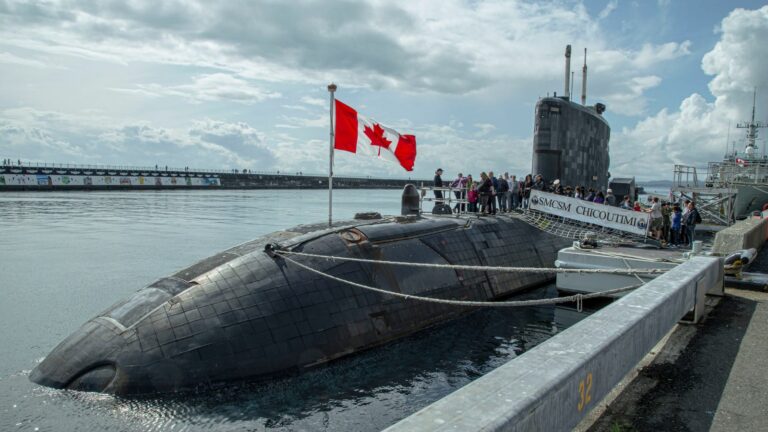
Canada has strong reasons to move quickly. Its four Victoria-class submarines were commissioned for the Royal Navy between 1990 and 1993 before Canada purchased them used in 1998. Their Canadian service has included lengthy maintenance periods and operational difficulties; one boat suffered a fire while travelling to Canada in 2004 and was not accepted into Royal Canadian Navy service until 2015. At the July 2026 TKMS announcement, the Prime Minister’s Office said only one of the four submarines was seaworthy.
Modernization work is intended to keep the Victoria class operating into the mid-to-late 2030s, making the arrival of replacements a race against an aging fleet. Ottawa says TKMS can provide the first four new boats in 2034, partly through production arrangements involving existing German and Norwegian orders. That timetable gives Canada little room for prolonged disputes or major construction delays. The German selection therefore represents a strategic milestone rather than the finish line. TKMS’s improving financial performance provides reassurance that it is expanding into rising demand, but Canada’s ultimate measure of success will be much simpler: capable submarines delivered when promised, supported in Canada and available when the navy needs them.
This Options Discord Chat is The Real Deal
While the internet is scoured with trading chat rooms, many of which even charge upwards of thousands of dollars to join, this smaller options trading discord chatroom is the real deal and actually providing valuable trade setups, education, and community without the noise and spam of the larger more expensive rooms. With a incredibly low-cost monthly fee, Options Trading Club (click here to see their reviews) requires an application to join ensuring that every member is dedicated and serious about taking their trading to the next level. If you are looking for a change in your trading strategies, then click here to apply for a membership.