35,000+ smart investors are already getting financial news, market signals, and macro shifts in the economy that could impact their money next with our FREE weekly newsletter. Get ahead of what the crowd finds out too late. Click Here to Subscribe for FREE.
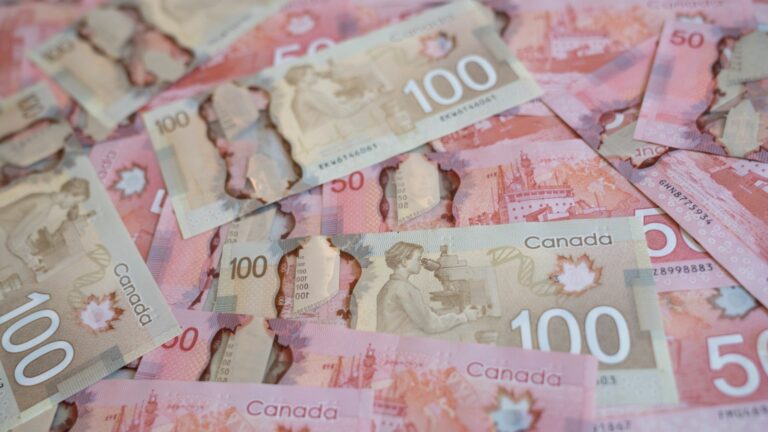
Currency markets rarely shout, but the latest positioning against the Canadian dollar sends a clear warning. Speculators built roughly US$12.5 billion in net bearish bets on the loonie, making it the most heavily shorted major currency in Chicago futures at the time and marking its largest net short since December 2024. The move arrived as President Donald Trump prepared new 50% tariffs on selected Canadian goods and Washington declined to give the North American trade pact a clean long-term extension.
Yet the loonie has not collapsed. It has stabilized near 71 U.S. cents as stronger oil prices and improving Canadian growth data offset some of the anxiety. That tension—deep pessimism in positioning but resilience in price—has turned the currency into a real-time test of confidence in Canada’s economy.
The Bearish Bet Behind the Headline
Canadian Dollar Becomes the Most-Shorted Major Currency as Trump Tariffs Test Confidence
- The Bearish Bet Behind the Headline
- Trump’s Tariff Threat Lands Directly on the Currency
- Why the Loonie Became an Easier Target Than the Yen
- The Interest-Rate Gap Strengthens the Bearish Case
- Canada’s U.S. Dependence Magnifies Every Threat
- Canada’s Rebound Complicates the Pessimistic Story
- A Weaker Dollar Creates Winners and Losers
- Heavy Shorting Does Not Guarantee a Currency Collapse
Calling the loonie the “most-shorted” major currency does not mean every bank, pension fund or investor expects Canada to fail. The label comes from weekly Commodity Futures Trading Commission data covering futures positions on the Chicago Mercantile Exchange. In the reported week, non-commercial traders held about US$12.5 billion more in bearish Canadian-dollar positions than bullish ones. That was the largest net short among the major currencies traded there for a second consecutive week and the loonie’s most negative reading since December 2024.
These traders are often hedge funds and other speculative accounts trying to profit from price movements rather than businesses hedging ordinary commercial risks. Their positioning is influential, but it is still only one slice of the enormous global foreign-exchange market. The data therefore capture a powerful mood, not a guaranteed forecast. In practical terms, funds had decided that Canada offered a cleaner downside trade than competing currencies, largely because tariffs, softer long-term growth and monetary-policy differences were pointing in the same direction.
Trump’s Tariff Threat Lands Directly on the Currency
The newest pressure comes from Washington’s plan to impose 50% duties on a wide range of selected Canadian products beginning August 19. White House proclamations cover goods ranging from wine and dairy products to hockey sticks, cement and certain vehicles. Energy, potash, critical minerals, fish and products already covered by separate national-security tariffs are among the stated exclusions. Reuters estimated the newly targeted trade at nearly US$20 billion, making the measures serious but far from a blanket tariff on everything Canada sells south of the border.
The broader uncertainty is just as important as the tariff list. The United States declined to extend the Canada–United States–Mexico Agreement for another 16 years in its current form. The pact remains active, but it now enters annual reviews and could expire in 2036 if the countries never agree on an extension. For an Ontario parts supplier deciding whether to add a production line, a decade of rolling negotiations can be nearly as unsettling as an immediate duty because investment depends on knowing which rules will survive.
Why the Loonie Became an Easier Target Than the Yen
Currency traders compare opportunities, not countries in isolation. The Canadian dollar overtook the Japanese yen as the largest speculative short partly because betting against other currencies had become more dangerous. Several major central banks had already raised interest rates in 2026, while Japanese authorities had intervened to support the yen. Those actions can produce sudden rallies that force bearish traders to exit at a loss. Canada, by contrast, appeared less likely to deliver an immediate policy surprise powerful enough to punish short positions.
The loonie still has important supports. Canada is a major energy exporter, and firmer oil prices can improve export income and demand for Canadian dollars. That helped the currency stabilize near 1.41 per U.S. dollar after touching 1.4248, or about 70.19 U.S. cents, its weakest level since April 2025. The relationship is not automatic, however. Bank of Canada research has found that oil’s influence on the exchange rate has weakened over time, partly because energy producers now respond to price increases with less capital spending than in earlier cycles.
The Interest-Rate Gap Strengthens the Bearish Case
Interest rates provide another reason traders have preferred the U.S. dollar. The Bank of Canada held its policy rate at 2.25% in July, unchanged since the beginning of 2026. At the same time, markets were increasingly considering another Federal Reserve increase. By late July, Canada’s two-year government bond yielded about 1.44 percentage points less than the comparable U.S. Treasury, the widest disadvantage for Canada since May 2025.
That gap matters because global investors can earn more on short-term U.S. assets than on similar Canadian securities, all else being equal. A fund can therefore sell Canadian dollars, buy U.S. dollars and potentially benefit from both the yield advantage and any decline in the loonie. The trade is not risk-free: stronger Canadian inflation or growth could force the Bank of Canada to raise rates sooner than expected, while weaker U.S. data could reverse Federal Reserve expectations. For now, however, Canada’s patient central bank and America’s higher yields have given the bearish position a straightforward financial logic beyond the tariff headlines.
Canada’s U.S. Dependence Magnifies Every Threat
Canada has reduced its reliance on the U.S. market, but not enough to make Washington’s decisions a secondary concern. Statistics Canada reported that 71.7% of Canadian merchandise exports went to the United States in 2025, down from 75.9% in 2024. That represents meaningful diversification, yet it still means roughly seven of every ten export dollars depend on American demand. Automotive products, metals, lumber, food and manufactured components are especially exposed to changes in border costs and rules.
The tariff picture is also more nuanced than the loudest numbers suggest. Ottawa estimated in its 2026 spring update that approximately 85% of Canadian goods trade remained tariff-free and that Canada faced an average U.S. tariff rate of about 5.2%, below the global average of 11.4%. The problem is concentration. A small exporter may be untouched, while a steel fabricator or winery can face a business-changing increase. Currency traders focus on that uneven damage because layoffs, delayed equipment orders and weaker investment can spread from targeted industries into the wider economy.
Canada’s Rebound Complicates the Pessimistic Story
The economy has recently performed better than the most bearish narrative suggests. Statistics Canada reported real GDP growth of 0.3% in May after revising April’s increase to 0.6%. Its preliminary estimate pointed to another 0.2% gain in June, implying annualized second-quarter growth of roughly 3.4%—the strongest quarterly pace in more than three years. The official expenditure-based estimate is not due until August 28, so that figure remains subject to revision.
The rebound does not erase the underlying weakness. The Bank of Canada still expects full-year growth of only 0.7% in 2026 after a year in which output, exports, housing and business investment struggled. July business surveys also painted a split picture: the manufacturing purchasing managers’ index rose to 53.5, its strongest expansion in more than four years, while the services index remained below the 50 growth threshold at 49.1. For the loonie, this mixed evidence matters. Traders are betting on vulnerability, but current data are making an outright downturn harder to assume.
A Weaker Dollar Creates Winners and Losers
A cheaper loonie can cushion part of the tariff shock by making Canadian goods less expensive for foreign buyers and increasing the Canadian-dollar value of revenue earned in U.S. dollars. The Bank of Canada expects the recent depreciation to support export competitiveness as businesses adjust to the new trade environment. For an Alberta producer or a software company billing American clients, the exchange rate can soften some of the damage from weaker demand.
The cost appears elsewhere. Canadian companies pay more for U.S.-priced machinery, software, components and fuel, potentially discouraging the investment needed to improve productivity. Households can also feel the change through imported food, electronics, gasoline and travel. Statistics Canada has found that a weaker Canadian dollar can pass through into import prices, while the Bank of Canada lists persistent exchange-rate pass-through as an upside risk to inflation. The effect is neither instant nor complete because retailers may absorb some costs, use existing inventories or have currency hedges. Still, prolonged weakness can turn a market trade into a broader cost-of-living issue.
Heavy Shorting Does Not Guarantee a Currency Collapse
Crowded bearish trades can become vulnerable when the expected bad news is already reflected in prices. The loonie touched 1.4248 per U.S. dollar in June but later strengthened to around 1.40, including a six-week high near 1.3993 at the end of July. Higher oil prices, stronger domestic activity and broad weakness in the U.S. dollar helped offset tariff anxiety. A trade agreement, delayed implementation or unexpectedly hawkish Bank of Canada could force speculators to buy Canadian dollars back quickly.
Professional forecasters are cautious rather than catastrophic. A Reuters poll of 34 currency analysts conducted from July 31 to August 5 placed the median three-month forecast at 1.40 per U.S. dollar and projected a 2.6% improvement to 1.366 over 12 months. Those forecasts can be wrong, but they show that the largest speculative short is not the same as a consensus call for a breakdown. The decisive signals will be the August tariff deadline, weekly CFTC positioning, Canada–U.S. negotiations, oil prices and the policy gap between the Bank of Canada and Federal Reserve.
This Options Discord Chat is The Real Deal
While the internet is scoured with trading chat rooms, many of which even charge upwards of thousands of dollars to join, this smaller options trading discord chatroom is the real deal and actually providing valuable trade setups, education, and community without the noise and spam of the larger more expensive rooms. With a incredibly low-cost monthly fee, Options Trading Club (click here to see their reviews) requires an application to join ensuring that every member is dedicated and serious about taking their trading to the next level. If you are looking for a change in your trading strategies, then click here to apply for a membership.