35,000+ smart investors are already getting financial news, market signals, and macro shifts in the economy that could impact their money next with our FREE weekly newsletter. Get ahead of what the crowd finds out too late. Click Here to Subscribe for FREE.
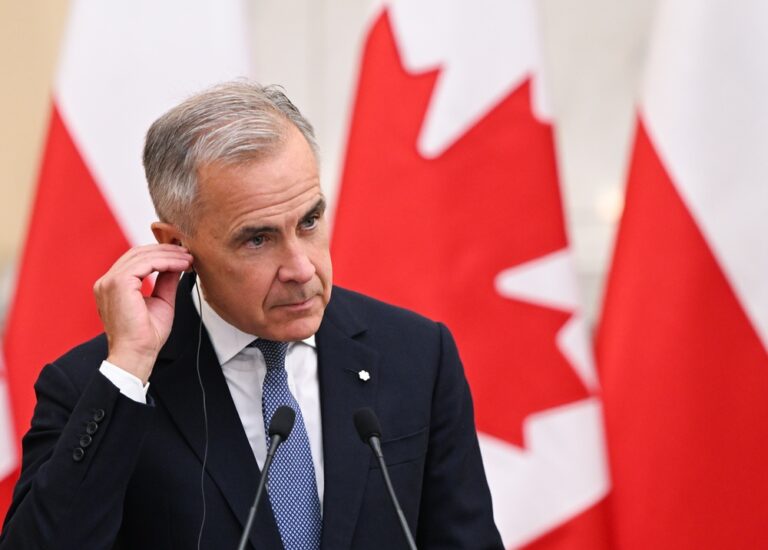
Ottawa is dismantling the federal office meant to scrutinize human-rights abuses linked to Canadian companies abroad just as Washington is threatening another tariff weapon against Canada. Prime Minister Mark Carney says the Canadian Ombudsperson for Responsible Enterprise, known as CORE, failed to deliver meaningful results. Critics counter that the office was never given the independence or investigative powers needed to succeed.
The timing has turned an administrative cut into a trade and credibility test. The Trump administration has proposed a 10% tariff on certain Canadian goods over what it calls weak enforcement against forced-labour imports, although CUSMA-compliant products would be exempt. Carney’s government is simultaneously replacing the old border framework with tougher legislation. The central question is whether Canada is eliminating a failed watchdog—or removing oversight before a stronger system is ready.
A Watchdog Built to Police Canadian Business Abroad
Carney Scraps Forced-Labour Watchdog as Trump Threatens Canada With New Tariffs
- A Watchdog Built to Police Canadian Business Abroad
- Carney’s Case: Too Little Output for the Time Spent
- Why CORE Struggled From the Beginning
- The Xinjiang Cases That Defined the Office
- Canada Has Laws, but Enforcement Has Lagged
- Trump’s Tariff Threat Is Significant but Not Yet Final
- CUSMA Offers a Shield—with Important Gaps
- Ottawa Is Replacing the Old Border Framework
- The Political Optics Are Hard for Carney
- What Comes Next Will Decide Whether This Is Reform or Retreat
CORE was established in 2019 to examine allegations of human-rights abuse connected to Canadian garment, mining, and oil-and-gas companies operating outside the country. Its mandate was broader than forced labour alone. The office could receive complaints, initiate reviews, offer mediation, promote international responsible-business standards, and advise the federal trade minister. For communities affected by a mine, factory, or overseas supply chain, it was designed to provide a Canadian doorway for concerns that might otherwise be difficult and expensive to pursue.
That distinction matters because CORE was not the agency inspecting containers at Canadian ports. Border enforcement belongs primarily to the Canada Border Services Agency, supported by other federal departments. CORE focused on corporate conduct abroad and the behaviour of Canadian-linked businesses. Eliminating it therefore does not directly repeal Canada’s import ban on forced-labour goods. It does, however, remove a specialized forum that could publicly examine allegations, encourage mediation, and recommend consequences such as withdrawing federal trade support from companies that refused to cooperate.
Carney’s Case: Too Little Output for the Time Spent
Carney’s defence rests on a blunt performance argument. Over roughly six years, CORE launched only five investigations and issued formal recommendations in two cases. The ombudsperson’s position had also been vacant since May 2025, leaving complaints and unfinished files in limbo. Carney said the decision to eliminate the office had been made months earlier and described the government’s responsibility as determining whether programs are effective and improving or ending those that are not.
The decision also fits a much larger effort to shrink federal operating costs. Ottawa’s fiscal plan calls for $60 billion in savings over five years, including annual savings of $13 billion by 2028–29. In that environment, a small office with a limited visible record was an obvious target. Yet output alone does not settle the debate. A watchdog may appear unproductive because demand is low, because its procedures are slow, or because its design prevents it from obtaining evidence. CORE’s critics argue the third explanation is central to understanding its record.
Why CORE Struggled From the Beginning
The office carried a serious title but lacked some of the tools normally associated with a powerful investigator. CORE could request information, conduct reviews, publish findings, and make recommendations, but it could not compel companies to hand over documents or force witnesses to testify. Its conclusions were advisory rather than binding. A Federal Court decision later emphasized that the office could not impose consequences on companies, individuals, or communities and functioned essentially as an adviser.
Those limitations were not discovered after the fact. Civil-society organizations, parliamentary witnesses, and even participants in CORE’s own consultations repeatedly warned that voluntary cooperation would be inadequate when allegations involved complex international supply chains. Companies and industry representatives raised the opposite concern: subpoena-like powers could expose commercially sensitive material and turn an accessible ombuds process into costly litigation. The government ultimately kept the weaker, non-judicial model. That choice made CORE less threatening to business, but it also left the office dependent on the cooperation of the very companies it was expected to scrutinize.
The Xinjiang Cases That Defined the Office
CORE’s public profile was shaped largely by complaints alleging links to Uyghur forced labour in China’s Xinjiang region. In 2023, it opened investigations involving Nike Canada and Dynasty Gold, followed by matters involving Ralph Lauren Canada and GobiMin. Levi Strauss was also investigated, while a complaint involving Hugo Boss went through the office’s mediation mechanism. The allegations were brought by a coalition of 28 civil-society organizations and focused on whether corporate operations or suppliers had benefited from forced labour.
These cases illustrate both the value and weakness of the model. A public Canadian process forced multinational brands and mining companies to respond to allegations that might otherwise have remained buried in technical supply-chain reports. At the same time, several companies disputed the claims, questioned CORE’s jurisdiction, or argued that Canadian subsidiaries did not control global sourcing decisions. Allegations are not findings of guilt, and the office’s inability to compel full records made definitive conclusions difficult. The result was attention and documentation, but rarely the decisive accountability that supporters had expected.
Canada Has Laws, but Enforcement Has Lagged
Canada has formally prohibited imports made wholly or partly with forced labour since July 1, 2020, when the rule took effect with CUSMA. The prohibition applies to imports from every country, not just North American trading partners. A separate Supply Chains Act took effect in 2024, requiring certain companies and federal institutions to report annually on the steps they take to identify and reduce forced-labour and child-labour risks.
The weakness is that transparency is not the same as interdiction. Reporting laws can expose risks and push boards to examine suppliers, but they do not automatically stop a shipment at the border. Canadian enforcement has been sparse: public accounts indicate that only two shipments had been confirmed as containing forced-labour goods over the first five years of the ban, after dozens were temporarily detained. That record has fuelled claims that Canada possesses the legal language of a strong regime without the investigative intelligence, tracing requirements, and burden-of-proof rules needed to enforce it consistently.
Trump’s Tariff Threat Is Significant but Not Yet Final
The U.S. Trade Representative launched investigations into 60 economies in March 2026 and concluded that Canada was among six jurisdictions with a forced-labour import ban that was not being effectively enforced. Washington proposed an additional 10% tariff on products from Canada and several similarly classified economies. Countries without a comparable prohibition could face a proposed rate of 12.5%. The U.S. argues that weak enforcement allows cheaper goods made with exploited labour to distort competition for American producers and workers.
The tariff is still a proposal, not a charge already being collected. USTR scheduled public hearings to begin July 7 and set deadlines for testimony and written comments. The distinction is important because the scope can still change through consultations, exclusions, or negotiations. It is also notable that the proposal emerged after earlier Trump tariffs encountered legal setbacks, leading critics to accuse Washington of using a human-rights concern as a new legal route for broad protectionism. Even so, Canada cannot dismiss the enforcement criticism simply because the tariff strategy is politically convenient for Trump.
CUSMA Offers a Shield—with Important Gaps
The most consequential exemption in Washington’s proposal covers Canadian and Mexican goods that qualify under CUSMA rules of origin. Products already subject to U.S. national-security tariffs under Section 232 would also be excluded from this particular action. That means the threatened 10% duty would not automatically land on every Canadian export. For manufacturers that can document sufficient North American content, CUSMA compliance remains a valuable shield.
The gap is that not every shipment qualifies or is claimed as CUSMA-compliant. Businesses may use components from Asia or Europe, fail a product-specific origin rule, or decide that the paperwork is not worth completing when the normal tariff is already low. Those firms could face a new cost if the U.S. proposal takes effect. The risk matters because 71.7% of Canada’s merchandise exports still went to the United States in 2025, despite a noticeable decline from 2024. Even a targeted tariff can disrupt pricing, contracts, and investment when the market on the other side of the border remains this dominant.
Ottawa Is Replacing the Old Border Framework
Three days before the latest controversy intensified, the federal government introduced legislation intended to strengthen the forced-labour import ban. The proposed law would replace the Customs Tariff framework with a standalone statute. It would allow the foreign affairs minister to create a public list of high-risk goods connected to particular regions, entities, or individuals where there are reasonable grounds to suspect forced labour.
Importers of listed goods could be required to provide enhanced supply-chain tracing information. When mandatory information is not supplied, the goods could be deemed prohibited. The legislation also proposes better information-sharing among federal agencies and a cost-recovery system for importers found to have brought forced-labour goods into Canada. This approach shifts attention from voluntary corporate explanations toward documentation at the border. It is potentially more enforceable than CORE, but it serves a different purpose: stopping risky products from entering Canada does not replace a forum that examines wider abuses by Canadian companies operating abroad.
The Political Optics Are Hard for Carney
Carney can plausibly argue that keeping an ineffective institution merely preserves the appearance of action. The new legislation is more closely aligned with Washington’s complaint because it strengthens import tracing and gives border authorities clearer tools. From an efficiency perspective, replacing a weak advisory office with a more enforceable statutory regime can be presented as consolidation rather than retreat.
The political problem is the sequence. Ottawa is abolishing CORE at the same moment the United States is accusing Canada of weak forced-labour enforcement. Green Party Leader Elizabeth May and other critics say the office should have been strengthened, made independent, and granted powers to compel evidence. The vacancy at the top of CORE also makes the performance case look circular: the government left the watchdog without a leader, then cited poor results in deciding it had failed. For Carney, the challenge is demonstrating that the decision was driven by policy design and fiscal discipline—not by pressure from Washington or discomfort with corporate scrutiny.
What Comes Next Will Decide Whether This Is Reform or Retreat
The real test will not be whether CORE disappears, but whether the replacement system produces measurable results. Ottawa will need to identify high-risk goods using defensible evidence, give importers clear tracing rules, equip border officials to assess complex supply chains, and report publicly on detentions and prohibitions. Without those steps, the new statute could become another impressive framework with little effect at ports of entry.
The stakes extend far beyond one office or one tariff dispute. The International Labour Organization estimates that 27.6 million people are in forced labour worldwide and that exploitation in the private economy generates about US$236 billion in illegal profits each year. Those figures explain why supply-chain enforcement has become both a human-rights issue and an industrial-policy weapon. Carney may be right that CORE failed to meet expectations. But scrapping it raises the standard for what follows. Canada must now prove that a leaner system can be stronger, more transparent, and more effective than the watchdog it chose to abandon.
This Options Discord Chat is The Real Deal
While the internet is scoured with trading chat rooms, many of which even charge upwards of thousands of dollars to join, this smaller options trading discord chatroom is the real deal and actually providing valuable trade setups, education, and community without the noise and spam of the larger more expensive rooms. With a incredibly low-cost monthly fee, Options Trading Club (click here to see their reviews) requires an application to join ensuring that every member is dedicated and serious about taking their trading to the next level. If you are looking for a change in your trading strategies, then click here to apply for a membership.