35,000+ smart investors are already getting financial news, market signals, and macro shifts in the economy that could impact their money next with our FREE weekly newsletter. Get ahead of what the crowd finds out too late. Click Here to Subscribe for FREE.
Trade summits usually sound distant from the factory floor, but this one is landing much closer to the assembly line. As Donald Trump heads into talks with Xi Jinping, American automakers, suppliers, lawmakers, and labor voices are all sending the same message: the U.S. car market should not become part of a bargain with Beijing.
Behind that pressure are 10 distinct forces shaping the debate. They range from national-security fears around connected vehicles to the blunt reality that Chinese automakers have become faster, cheaper, and far more aggressive overseas. For Detroit, this is not just a trade story. It is a test of whether the United States intends to keep its market guarded, its supply chains regional, and its auto industry from facing a new wave of competition before it believes it is ready.
The Summit Suddenly Carries Auto-Sector Weight
Trump’s Xi Meeting Has U.S. Automakers Warning: Don’t Let Chinese Cars Into America
- The Summit Suddenly Carries Auto-Sector Weight
- Connected Cars Changed the Argument
- Detroit Fears a Price War It Cannot Control
- Europe Has Become the Industry’s Warning Label
- Mexico Is the Route Everyone Is Watching
- Trump’s Earlier Openness Triggered the Pushback
- Cheap EVs Would Tempt Buyers and Trouble Washington
- This Fight Has Created an Unusually Broad Alliance
- Canada Cannot Treat This as a Distant U.S. Story
- What to Watch After Beijing
What makes this moment so striking is not only the Trump-Xi meeting itself, but the timing around it. The auto industry is treating the summit as a possible pressure point, even though U.S. officials have said car-market access is not formally on the agenda. That gap between official messaging and industry anxiety says a lot. Automakers clearly fear that when larger trade relationships are in play, sectors like autos can become bargaining chips without much warning.
That fear is why this debate has become louder before the meeting, not after it. In Washington, a promise that autos are “not on the agenda” does not fully calm an industry that has seen major policy shifts happen quickly. For executives, dealers, and suppliers, even a small opening for Chinese brands would not feel symbolic. It would feel like the start of a structural change that could be very hard to reverse once vehicles, financing arms, parts pipelines, and dealer footprints begin to take root.
Connected Cars Changed the Argument
A decade ago, the fight over Chinese vehicles in America would have centered mostly on pricing and jobs. Now the argument has changed because modern cars are connected devices. They gather location data, map surroundings, link to phones, transmit diagnostics, and in some cases can be updated remotely. That has allowed national-security concerns to move from the margins of the trade debate to its center.
That shift is one reason the United States already built a regulatory wall before this summit pressure campaign reached full volume. Washington has restricted the import and sale of certain connected vehicles and related hardware or software tied to China or Russia. Lawmakers are now trying to lock that stance into statute with the Connected Vehicle Security Act, which would make reversal much harder. In plain terms, the worry is no longer just that cheaper cars could enter the market. It is that those cars could become data-collecting infrastructure on American roads, with risks that critics say cannot be patched away later.
Detroit Fears a Price War It Cannot Control
The industrial case against opening the market is brutally simple: U.S. automakers do not want to fight a price war against companies backed by years of Chinese industrial policy. China’s EV sector did not emerge from ordinary market conditions alone. It grew with enormous state support, consumer incentives, infrastructure buildout, and a national strategy aimed at scale. That is the backdrop behind the American claim that these are not “normal” competitors.
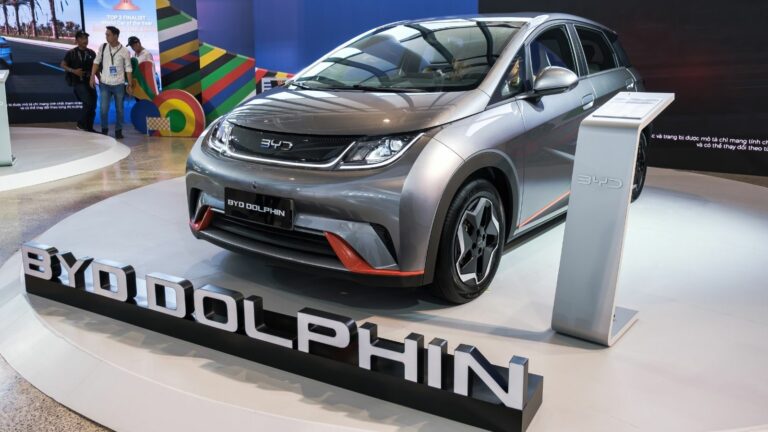
Price is where that concern becomes real. In Europe, some Chinese EVs are already selling below the kind of price points that get instant attention from mainstream buyers, while still offering features that make them feel modern rather than stripped down. In Washington, the fear is that U.S. automakers would be pushed into a lose-lose choice: cut prices and squeeze margins, or hold prices and lose share. Either path is painful. For Detroit, the threat is not just one cheap car model. It is a production system designed to overwhelm rivals through volume, speed, and lower cost.
Europe Has Become the Industry’s Warning Label
American executives keep pointing abroad because Europe offers a live example of what Chinese expansion can look like once the door is open. China-made cars now account for a meaningful share of EU sales, and that fact alone has helped sharpen the tone in Washington. European markets have become a demonstration zone for how quickly Chinese automakers can move from curiosity to serious competitive threat.
Europe’s response also tells its own story. Brussels imposed duties on Chinese EVs after concluding that unfair subsidies posed a threat to European producers. Yet even with those duties, the pressure has not vanished. That matters because it suggests tariffs alone may slow Chinese momentum without fully neutralizing it. For U.S. automakers, Europe is the cautionary tale they do not want replayed in America. Once Chinese brands build awareness, improve dealer networks, and establish consumer trust, the debate stops being theoretical. It becomes about how much market share can be defended, and at what cost.
Mexico Is the Route Everyone Is Watching
The industry’s worry does not stop at ships arriving directly from China. It extends to the possibility that Chinese automakers could use North America more strategically, especially through Mexico. Chinese brands have already expanded rapidly there, and that has intensified concern that manufacturing or assembly footprints in the region could eventually be used to press for broader access to the U.S. market.
That is why this debate overlaps with the USMCA review in such an important way. North American auto rules were designed around regional production, with high content requirements meant to keep supply chains rooted in the U.S., Canada, and Mexico. But if Chinese companies build scale in Mexico, the political argument over what counts as legitimate North American integration becomes much harder. For U.S. automakers, this is not just about border control. It is about preventing a back-door version of market entry that would exploit regional trade architecture while undercutting the original purpose of that architecture.
Trump’s Earlier Openness Triggered the Pushback
Much of the current alarm traces back to Trump’s own rhetoric. Earlier this year, he signaled openness to Chinese automakers building plants in the United States and hiring American workers. On the surface, that sounds like a classic investment-and-jobs pitch. In another industry, it might even have been welcomed. In autos, it landed like a siren.
The backlash came because critics see local production as only part of the picture. Their argument is that market distortion does not disappear just because assembly happens on U.S. soil. If the capital, control, software, supply chains, or strategic direction remain tied to China, opponents say the underlying risk remains. That explains why lawmakers from both parties reacted so sharply. They were not merely opposing imports. They were trying to close off the idea that Chinese firms could gain legitimacy through domestic manufacturing, then use that foothold to expand influence over pricing, technology, and future investment decisions across the American auto sector.
Cheap EVs Would Tempt Buyers and Trouble Washington
There is a reason this issue is politically awkward: many consumers would almost certainly be curious about lower-cost Chinese vehicles. New-car affordability remains a major problem in the United States, and buyers have spent years watching prices stay stubbornly high. In that environment, a well-equipped EV with a lower sticker price would not be dismissed automatically. It would get looked at.
That is what makes the industry’s lobbying effort more complicated than simple protectionism. Washington is being asked to keep out products that could appeal to cash-strapped shoppers at exactly the moment affordability remains a major barrier to higher sales. In places where Chinese EVs already compete, they are not winning attention only because they are cheap. They are often packed with the kind of technology that makes them feel like a bargain. For policymakers, that creates a difficult balance. The strategic case for exclusion may be strong, but the consumer case for access is not imaginary.
This Fight Has Created an Unusually Broad Alliance
Auto politics in the United States is often fragmented. Domestic automakers, foreign-brand manufacturers, dealers, parts makers, labor groups, and lawmakers do not always line up neatly. That is what makes the current coalition so notable. On this question, much of the industry has chosen to speak in one voice, and that gives the warning extra weight.
The alliance is also rooted in how much economic ground is at stake. U.S. motor vehicle and parts manufacturing still employs hundreds of thousands of workers directly, and the broader industry supports far more jobs through suppliers, logistics, retail, and service networks. Once that is understood, the tone of the lobbying makes more sense. This is not being framed as a narrow issue for a few executives in Detroit. It is being presented as a national industrial question with consequences stretching from assembly plants in the Midwest to supplier corridors in the South and border-linked production hubs across North America.
Canada Cannot Treat This as a Distant U.S. Story
For Canadians, this debate is not simply American political theater. Canada has already moved in the same general direction by imposing a 100 percent surtax on Chinese-made EVs, showing that Ottawa also views Chinese auto competition through an industrial and strategic lens. That decision reflected both domestic concerns and the reality that Canada’s auto sector remains deeply tied to U.S. policy and North American supply chains.
The summit matters north of the border for another reason as well. Any shift in U.S. policy would ripple quickly across the continent. If Washington stays hardline, Canada will face pressure to stay aligned. If Washington softens, Ottawa could be pulled into a more uncertain position between consumer affordability, domestic manufacturing interests, and continental trade politics. In other words, the stakes are not limited to whether Chinese cars appear in American showrooms. They also touch the future shape of North American production rules, cross-border investment, and how tightly Canada chooses to move with the United States on auto strategy.
What to Watch After Beijing
The most likely outcome may not be a dramatic headline announcing that Chinese cars are coming to America. Analysts are not expecting a giant breakthrough from the summit, and U.S. officials have tried to lower expectations around autos. But that does not mean the meeting is irrelevant. Sometimes the real signal comes from what is not said, what remains unchanged, and which policies are quietly reaffirmed afterward.
That is why the aftermath matters more than any single photo-op in Beijing. If the connected-vehicle restrictions stay intact, if Congress advances legislation to harden them, and if the administration keeps shutting down the idea of Chinese auto production in North America, the summit will look less like an opening and more like a line-drawing exercise. If the language softens, even slightly, the market will notice. So will Detroit. The central question is no longer whether Chinese automakers are globally competitive. It is whether the United States is prepared to keep that competition outside its own gates for as long as possible.
This Options Discord Chat is The Real Deal
While the internet is scoured with trading chat rooms, many of which even charge upwards of thousands of dollars to join, this smaller options trading discord chatroom is the real deal and actually providing valuable trade setups, education, and community without the noise and spam of the larger more expensive rooms. With a incredibly low-cost monthly fee, Options Trading Club (click here to see their reviews) requires an application to join ensuring that every member is dedicated and serious about taking their trading to the next level. If you are looking for a change in your trading strategies, then click here to apply for a membership.