35,000+ smart investors are already getting financial news, market signals, and macro shifts in the economy that could impact their money next with our FREE weekly newsletter. Get ahead of what the crowd finds out too late. Click Here to Subscribe for FREE.
Trade fights rarely stay at the border for long. In Canada, they moved quickly from government announcements into online carts, grocery aisles and household budgets. What began as a policy response to U.S. tariffs became something more personal: higher shelf prices on many affected goods, and a growing sense among shoppers that “tariff” was becoming part explanation, part warning label.
The Bank of Canada’s latest research suggests that this shift was not just anecdotal. It can be understood through 12 key parts, from how much of the tariff reached consumers to why some labels may have made price hikes easier to pass along. Taken together, they show how a trade dispute turned into a pricing story that landed directly in Canadian wallets.
The Price Jump Was Real, Not Just a Talking Point
Bank of Canada Says Tariff Labels Let Retailers Raise Prices — and Canadians Paid More
- The Price Jump Was Real, Not Just a Talking Point
- One Quarter of a Tariff Still Hurts
- March Is When the Pressure Started Building
- April 2 Changed the Mood of the Market
- A Small Label Can Change a Big Decision
- The Broad Price Grab Never Fully Materialized
- Relief Came, But Only After Months of Paying More
- Grocery Chains Made the Trade War Visible
- Households Were Already Primed to Feel the Squeeze
- Higher Sales Do Not Always Mean Healthier Consumers
- This Is Exactly the Kind of Thing a Central Bank Watches
- The Bigger Warning Is About How Prices Get Normalized
The Bank of Canada’s core finding is striking because it is concrete. Using daily online price data, researchers found that goods hit by Canada’s counter-tariffs ended up priced about 6% higher than comparable non-tariffed goods by mid-June 2025. That did not mean every item surged equally, but it did mean the average effect was large enough to stand out from normal pricing noise. In plain terms, the extra cost showed up where families actually spend money.
What gives the finding weight is the scale of the evidence behind it. The Bank examined more than 110,000 products sold by seven major Canadian retailers between February and December 2025. It also built a control group of domestic and non-tariffed goods to isolate the tariff effect. That makes the conclusion harder to dismiss as a one-store quirk or a single category problem. The price lift was broad enough, and consistent enough, to look real.
One Quarter of a Tariff Still Hurts
A 25% tariff did not translate into a 25% jump at the checkout. But the Bank’s estimate that about one-quarter of the counter-tariff was passed through to consumer prices is still meaningful. On paper, that sounds partial. In real life, it means retailers did not absorb most of the cost forever, and shoppers were left carrying part of the burden. When household budgets are already tight, even a partial pass-through can feel like a full problem.
The Bank estimated that this tariff pass-through added roughly 0.3 percentage points to consumer price inflation. That may sound modest beside bigger inflation shocks, but central banks care deeply about moves like that because they can spread expectations. Once consumers start assuming more price hikes are coming, and businesses begin planning around that assumption, the original shock can echo far beyond the specific products that were tariffed. That is one reason this research matters beyond a few marked-up items.
March Is When the Pressure Started Building
The pricing story did not begin when Canadians first noticed a label on a shelf. It started when Ottawa rolled out countermeasures against U.S. tariffs. Canada imposed 25% tariffs on $30 billion of U.S. goods effective March 4, 2025, then added another 25% tariff package on $29.8 billion of products effective March 13. Those lists touched familiar categories, including appliances, apparel, footwear, coffee, beer, cosmetics and more.
That matters because these were not obscure industrial inputs hidden deep in supply chains. Many were products shoppers could recognize immediately. The tariff fight moved straight into visible consumer categories, which made the later price changes easier to notice and easier to explain publicly. Once those categories were hit, retailers were no longer dealing only with behind-the-scenes cost pressure. They were managing a pricing story in plain sight, with everyday goods becoming reminders that a geopolitical dispute was now part of ordinary spending.
April 2 Changed the Mood of the Market
One of the Bank’s most revealing findings is that April 2, 2025 appears to have changed retailer behaviour even though no new Canadian counter-tariffs took effect that day. What changed was the signal. After the United States announced sweeping new global tariffs, some Canadian retailers seemed to conclude that the trade conflict would last longer and go deeper than expected. That changed the way they treated existing costs.
The Bank highlights one appliance retailer whose tariffed prices rose about 7% relative to the control group between April 1 and April 3, then peaked at around 10% less than a month later. That kind of move suggests expectations mattered almost as much as the tariff itself. When firms think a cost shock is temporary, they are more willing to wait it out. When they start to believe it will stick around, they become much more willing to pass it on. That is a powerful lesson, and not just for trade policy.
A Small Label Can Change a Big Decision
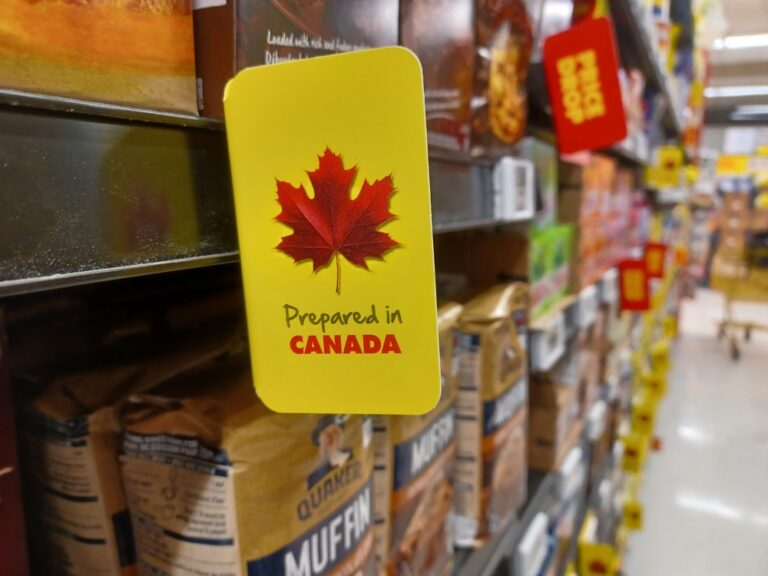
The headline claim in this story comes from one of the Bank’s more unusual findings: products with visible tariff banners saw larger and faster price increases than tariffed products without those labels. That does not prove a label alone caused every increase, but it strongly suggests transparency changed the pricing environment. In effect, a simple explanation on a product page may have made a higher price easier to defend.
The psychology is intuitive. Consumers often react badly to an unexplained increase because it feels arbitrary or opportunistic. A visible tariff label shifts the blame away from the retailer and toward the trade fight. The Bank’s interpretation is that this reduced the risk of customer backlash and gave firms more room to pass costs through. That is what makes the finding so interesting: the label was not merely informational. It may also have functioned as a kind of permission structure for higher prices.
The Broad Price Grab Never Fully Materialized
There is an important nuance in the Bank’s research that keeps this story from turning into a simple tale of every retailer cashing in. Researchers found no significant price increases, relative to the control group, among domestic substitute goods, foreign substitute goods from non-U.S. sources, or foreign non-substitute goods that were not subject to the Canadian counter-tariffs. In other words, the price pressure appears to have been concentrated rather than universal.
That distinction matters because it suggests the effect was not simply a blanket excuse to raise everything everywhere. Instead, the biggest changes showed up where the tariff shock was direct and visible. For Canadians, that is cold comfort, but it does add credibility to the broader finding. The research points to a targeted pass-through pattern rather than a full-scale opportunistic repricing of the entire retail landscape. The tariff story was real, but it was not identical across every aisle, category or seller.
Relief Came, But Only After Months of Paying More
Another revealing piece of the story is what happened when most of the counter-tariffs were removed. The Bank says prices on tariffed goods fell back quickly toward the control group after September 1, 2025, when Canada removed most of the countermeasures imposed earlier that year. For groceries and appliances, the reversal was nearly complete within about three months. That suggests at least some of the earlier price increases were closely tied to the tariff episode itself.
Still, a later reversal does not erase the earlier hit to household budgets. Canadians had already paid those higher prices through spring and summer, when many families were already juggling elevated food bills and general affordability stress. It also matters that not every tariff disappeared. Canada kept counter-tariffs in place on steel, aluminum and autos as negotiations continued. So while some consumer categories eased, the broader trade and inflation backdrop remained unsettled rather than fully resolved.
Grocery Chains Made the Trade War Visible
For many households, the trade conflict became real not through policy statements but through labels in stores. Loblaw said in 2025 that tariff-related price increases would affect more products and began marking impacted items with a “T” symbol. At the time Reuters reported on the move, nearly 1,000 items carried that symbol, with the company expecting the total to rise above 3,000 within weeks and exceed 6,000 within two months.
That rollout matters because it turned an abstract trade dispute into a daily shopping cue. Pantry staples, natural foods, and health and beauty products were among the categories expected to feel the impact. Even if shoppers did not track the details of Canada’s tariff lists, they could suddenly see which products had been caught in the crossfire. In that sense, the label did more than explain prices. It helped build consumer awareness that tariffs were no longer a headline on a news site; they were becoming part of ordinary spending decisions.
Households Were Already Primed to Feel the Squeeze
The Bank’s findings landed in a country that was already sensitive to food costs. Statistics Canada said consumer prices were up 2.4% year over year in March 2026, while food purchased from stores rose 4.4%. Fresh vegetables climbed 7.8%. Those are the kinds of figures that make Canadians notice even small changes faster, because grocery inflation tends to feel more personal than many other categories. People may not remember a precise CPI figure, but they remember the produce bill.
That broader backdrop is why tariff-related price increases had so much emotional force. Dalhousie University’s 2026 Food Price Report forecast overall food prices would rise 4% to 6% in 2026, with the average family of four expected to spend up to nearly $995 more on food than the year before. Against that kind of backdrop, a tariff label can land like confirmation of a fear shoppers already had: that everyday affordability keeps getting chipped away from multiple directions at once.
Higher Sales Do Not Always Mean Healthier Consumers
Retail spending data can sometimes hide more than it reveals. Reuters reported that Canadian retail sales rose 0.7% in February 2026, but sales volumes increased only 0.3%. That gap matters because it shows how nominal spending can rise faster than the actual quantity of goods changing hands. Put simply, part of the increase reflected higher prices, not necessarily stronger consumer buying power.
That is why tariff pass-through matters even when stores still look busy. A household can spend more while getting less. From the outside, that can look like resilience. Inside the budget, it feels more like compression. Families keep moving, but they cut elsewhere, downgrade brands, or postpone other purchases to absorb the difference. This is where the Bank’s research connects with the lived experience of inflation: the damage is not only in whether people stop buying, but in how much more they have to pay to keep buying roughly the same things.
This Is Exactly the Kind of Thing a Central Bank Watches
The Bank of Canada does not focus on tariff labels because it cares about retail signage. It cares because pricing behaviour can change inflation dynamics. In its April 2026 Monetary Policy Report, the Bank said the Canadian economy was still adjusting to U.S. tariffs and that inflation had moved up, in part because of higher oil prices. Around the same time, the Bank held its policy rate at 2.25% and signalled that if inflation pressures broadened, monetary policy might have more work to do.
That context makes the tariff-label finding especially important. Central bankers worry about temporary shocks becoming generalized inflation. If firms see room to pass through more costs, and consumers come to expect more price increases, the shock can spread beyond its original source. The Bank’s new research does not say tariffs were the only inflation problem in Canada. It says they were one channel through which higher prices reached households, and one that interacted with expectations in ways policymakers cannot ignore.
The Bigger Warning Is About How Prices Get Normalized
The most important takeaway may be less about one tariff episode and more about how quickly a public explanation can normalize a private price decision. Labels can be helpful. They can tell shoppers why a product costs more and signal that the increase did not come out of nowhere. But the Bank’s research suggests they may also make it easier for firms to move prices higher, faster, and with less resistance than they otherwise would.
That creates a harder question for Canadians than whether tariffs are good or bad policy. It raises the issue of how cost increases are communicated, and how much of that communication is truly neutral. The Bank is not accusing every retailer of abuse, and its own findings show the effect was partial, not universal. Still, the message is sharp: once a cost shock becomes publicly legible, it can become more commercially passable. And when that happens, shoppers often end up paying before the debate is even settled.
This Options Discord Chat is The Real Deal
While the internet is scoured with trading chat rooms, many of which even charge upwards of thousands of dollars to join, this smaller options trading discord chatroom is the real deal and actually providing valuable trade setups, education, and community without the noise and spam of the larger more expensive rooms. With a incredibly low-cost monthly fee, Options Trading Club (click here to see their reviews) requires an application to join ensuring that every member is dedicated and serious about taking their trading to the next level. If you are looking for a change in your trading strategies, then click here to apply for a membership.