35,000+ smart investors are already getting financial news, market signals, and macro shifts in the economy that could impact their money next with our FREE weekly newsletter. Get ahead of what the crowd finds out too late. Click Here to Subscribe for FREE.
A housing shortage usually sounds like a planning problem, but in Waterloo Region it has turned into something more physical and immediate: water. The issue is not that taps are running dry for current residents. It is that a key part of the region’s system no longer has the comfortable capacity buffer needed to keep approving growth at the pace many had expected.
This situation has pushed one of Ontario’s fastest-growing urban areas into a harder conversation about what growth really depends on. Below are 10 closely connected ways this water constraint is reshaping housing decisions, municipal priorities, and the region’s longer-term growth strategy.
A Supply Constraint, Not a Dry-Tap Crisis
Water Shortage Forces Ontario Region to Rethink Housing Growth
- A Supply Constraint, Not a Dry-Tap Crisis
- Why the Mannheim System Matters So Much
- The Region Is Not Frozen, But It Is No Longer Moving Normally
- Growth Is Shifting From Approvals to Conditional Approvals
- The Interim Fix Shows How Urgent the Situation Has Become
- Small Infrastructure Repairs Are Suddenly Big Housing Stories
- Conservation Matters, But It Will Not Build the Missing Capacity Alone
- Waterloo Region Is Now Rationing Growth More Openly
- Housing Targets Now Have to Answer to Water, Not Just Politics
- The Bigger Lesson Is That Ontario’s Growth Debate Is Changing
The first thing worth clarifying is that Waterloo Region’s problem is not a drinking-water safety emergency. Officials have repeatedly said the water remains safe. What changed is the region’s understanding of how much extra capacity the Mannheim Service Area can reliably provide for future development while still leaving room for repairs, maintenance, and unexpected shutdowns. That distinction matters because it turns the issue from a public-health scare into a planning shock.
In practical terms, the region discovered that growth assumptions were resting on a system with less breathing room than many believed. That is why the language coming from staff has focused on pumping, storing, treating, and distributing water rather than on contamination or drought. It is also why the story has become so important for housing: the constraint sits inside the infrastructure that decides whether new homes can actually connect.
Why the Mannheim System Matters So Much
This is not a niche issue affecting one small corner of the map. The Mannheim Service Area supplies water to Kitchener, Waterloo, and parts of Cambridge, Woolwich, and Wilmot, which means the constraint touches a large share of the region’s urban growth engine. When that service area tightens, the ripple spreads across municipal planning files, subdivision timelines, and local housing expectations.
The system itself is also more complex than many residents might assume. Waterloo Region says its broader drinking-water network relies on more than 100 wells and 50 treatment facilities. Its long-term water strategy notes that roughly 80 per cent of the region’s drinking water comes from groundwater, while about 20 per cent comes from the Grand River. That mix helps explain why officials are treating capacity cautiously: groundwater-based systems do not recharge as simply as turning to a massive lake source whenever growth pressures intensify.
The Region Is Not Frozen, But It Is No Longer Moving Normally
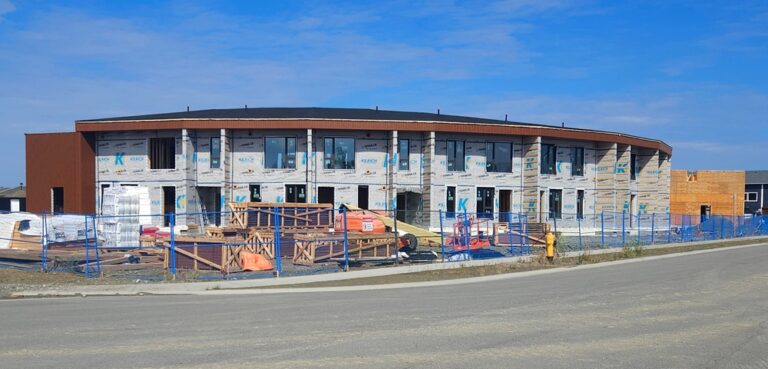
One of the most misunderstood parts of the story is the idea that development has stopped everywhere. It has not. Waterloo Region has said construction can continue for projects that already had building permits, including 7,742 units expected to house more than 14,000 residents. That means cranes, crews, and existing sites do not suddenly disappear just because a capacity limit was identified.
But beyond that already-approved pipeline, the mood changes quickly. The region has made clear it cannot support new commitments in the Mannheim Service Area the way it once did, at least not until more capacity is restored or safely allocated. Even some community-serving projects have had to be reviewed more carefully. Schools, child-care centres, and faith institutions have been allowed to move ahead because their water demand is already considered part of the existing population baseline, but that kind of exception only highlights how selective growth decisions have become.
Growth Is Shifting From Approvals to Conditional Approvals
This is where the story becomes especially real for builders and buyers. Instead of a simple yes-or-no development environment, Waterloo Region is now leaning on a more staged and conditional approach. Officials have supported the use of holding provisions, which let municipalities move certain planning approvals forward while delaying the point at which a project can fully proceed until water supply is confirmed.
That may sound technical, but it changes the feel of the housing pipeline. A project can look approved on paper and still sit in a kind of municipal waiting room. CityNews reported that two Waterloo developments totaling 310 units received zoning changes with a holding provision, meaning no actual construction could begin until the region gave the green light. For homebuyers, that creates uncertainty. For councils, it turns growth into sequencing. And for developers, it means planning risk now depends on infrastructure timing, not just land use.
The Interim Fix Shows How Urgent the Situation Has Become
Perhaps the clearest sign of urgency is the region’s “pivotal solution” at the Mannheim Water Treatment Plant. Staff began preparing the site for a temporary side-stream filtration system designed to bypass part of the current treatment process that requires upgrades. If the pilot works and additional units follow, the region says the measure could add 300 litres per second of new capacity by June 2027.
That is not a small tweak. Officials have described it as a bridge measure meant to get capacity online faster while larger long-term upgrades continue. In other words, the region is not waiting for a perfect permanent answer before acting. It is trying to buy time and restore confidence at the same time. When a municipality starts treating interim filtration units as a pivotal housing enabler, it says a great deal about how closely water engineering and homebuilding are now tied together.
Small Infrastructure Repairs Are Suddenly Big Housing Stories
Normally, a repaired reservoir, a rehabilitated well, or upgraded plant equipment would barely register outside municipal engineering circles. In Waterloo Region, those items have become headline material because every restored litre per second now affects how much growth can move. The Parkway system alone restored 60 litres per second after upgrades. Repairs at Greenbrook are expected to restore another 80 litres per second. Renewal work on Well K93 adds another 20 litres per second ahead of peak season.
There has also been a policy-driven shift that freed up about 30 litres per second for the Mannheim system while still protecting Wilmot’s long-term water needs. None of those numbers solve the problem on their own, but together they show why officials are treating maintenance as part of the housing response. A pump replacement or reservoir rehabilitation is no longer just asset management. It is part of the region’s growth calendar, and that changes how infrastructure projects are viewed by councils, builders, and residents.
Conservation Matters, But It Will Not Build the Missing Capacity Alone
Whenever water shortages enter the public conversation, conservation is the instinctive answer. Waterloo Region has been careful to say conservation still matters, especially because groundwater replenishes more slowly than systems tied to large lake sources. Lower day-to-day use helps protect the baseline, keep infrastructure costs lower, and improve long-term forecasting. The region has even brought in demand-management expertise as part of its response.
Still, officials have also been blunt about the limitation: conservation will not create the new capacity needed to solve this constraint by itself. That is an important political point as much as a technical one. It means the region cannot simply tell households to water lawns less and then declare the growth problem fixed. Behavioural change can support the system, but it cannot replace treatment upgrades, restored infrastructure, or a new allocation framework. That is why this has become a story about growth management, not just public awareness.
Waterloo Region Is Now Rationing Growth More Openly
The newest sign of that rethink is the Water Supply Capacity Allocation Policy approved by Regional Council. It creates what officials have described as a transparent way to allocate available water to area municipalities as new capacity comes online. Instead of a vague scramble behind closed doors, each municipality will receive a “bucket” of available capacity based on projected population and employment growth within the Mannheim Service Area.
Initially, those allocations are expected to happen quarterly as new capacity is identified through the interim risk framework. The region has also said it may reserve water for community projects with region-wide importance. That is a notable shift in tone. Growth is no longer being treated as something that can expand more or less evenly if councils approve enough housing files. It is being managed as a scarce resource that must be distributed, prioritized, and reviewed. For a fast-growing Ontario region, that is a major philosophical change.
Housing Targets Now Have to Answer to Water, Not Just Politics
The collision here is bigger than Waterloo Region alone. The City of Waterloo has said the province told it to plan for 16,000 new housing units by 2031. More broadly, Ontario assigned municipal housing targets as part of its 1.5 million-home goal. Meanwhile, CMHC has warned that Canada needs a much higher pace of homebuilding, estimating housing starts would need to rise to roughly 430,000 to 480,000 units annually through 2035 to restore affordability.
Those goals make political sense in a province and country desperate for more homes. But Waterloo Region’s situation shows how fragile those targets can become when physical systems are tighter than expected. A government can set a housing number quickly. It cannot rebuild treatment plants, restore wells, and re-engineer service capacity at the same speed. That is the deeper tension inside this story. The pressure to build is real, but the infrastructure that makes building possible is asserting its own timetable.
The Bigger Lesson Is That Ontario’s Growth Debate Is Changing
What is happening in Waterloo Region may be a preview of how other fast-growing communities will start talking about housing. For years, the loudest arguments focused on zoning, approvals, and political will. Those issues still matter. But this case shows that infrastructure constraints can become the harder limit, especially in systems that depend heavily on groundwater, aging assets, and careful operational buffers.
That is why the region’s longer-term water strategy now feels more central to housing than many people might have expected. Officials are planning for water needs through 2051, studying future sources, infrastructure needs, and demand patterns while trying to keep the region open for business in the near term. The result is a more sober model of growth: homes still matter, but so do pipelines, wells, reservoirs, treatment plants, and the boring but essential math underneath them. In Waterloo Region, that math is now shaping the housing conversation in public.
This Options Discord Chat is The Real Deal
While the internet is scoured with trading chat rooms, many of which even charge upwards of thousands of dollars to join, this smaller options trading discord chatroom is the real deal and actually providing valuable trade setups, education, and community without the noise and spam of the larger more expensive rooms. With a incredibly low-cost monthly fee, Options Trading Club (click here to see their reviews) requires an application to join ensuring that every member is dedicated and serious about taking their trading to the next level. If you are looking for a change in your trading strategies, then click here to apply for a membership.