35,000+ smart investors are already getting financial news, market signals, and macro shifts in the economy that could impact their money next with our FREE weekly newsletter. Get ahead of what the crowd finds out too late. Click Here to Subscribe for FREE.
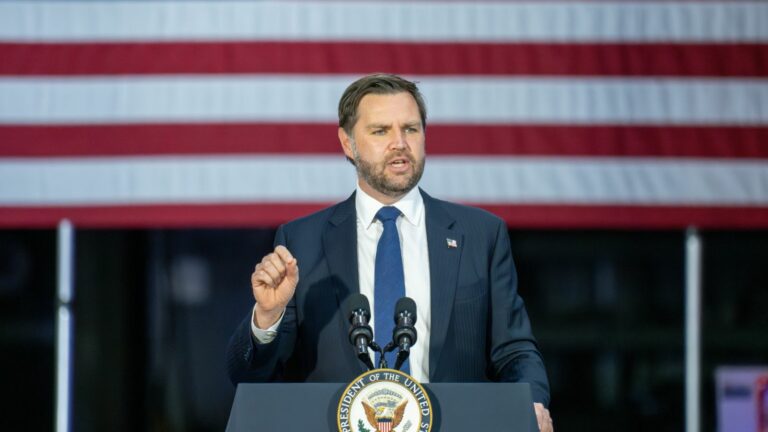
U.S. Vice-President JD Vance has injected an unusually personal note into one of Canada’s most consequential trade negotiations, mocking Prime Minister Mark Carney’s approach to Donald Trump while dismissing Conservative Leader Pierre Poilievre’s role in the talks. Speaking at a private fundraiser in Southampton, New York, Vance suggested Carney tried to “out-tough” Trump before Canada ultimately gave ground on several issues.
The remarks arrived at a sensitive moment. Canadian and American negotiators were still working toward an agreement capable of preventing a new 50% U.S. tariff from hitting roughly $20 billion in Canadian goods. Vance’s comments therefore amount to more than political trash talk: they expose competing narratives over who blinked, who influenced Washington and whether an emerging deal represents Canadian pragmatism or Canadian retreat.
Vance’s Version of the Negotiations Is Deliberately Unflattering
Vance Says Carney ‘Climbed Down’ to Trump and Calls Poilievre a ‘Non-Entity’ in Trade Talks
- Vance’s Version of the Negotiations Is Deliberately Unflattering
- The Timing Makes the Comments More Significant
- Canada Has Made Moves Washington Wanted — Especially on Alcohol
- The Potential Tariff Relief Complicates Vance’s Victory Narrative
- Calling Poilievre a ‘Non-Entity’ Was the Most Politically Explosive Line
- Jamil Jivani Is the Subtext Running Through Vance’s Remarks
- Poilievre Is Still Pressing Carney From the Sidelines
- Canadians Are Already Skeptical of Making More Concessions
- The Economic Imbalance Gives Washington Real Leverage
- The Real Verdict Depends on What Is Signed — Not What Vance Says
Vance’s account of Carney’s negotiating style came from audio of a private Republican fundraising event obtained by The Canadian Press. He described Carney personally as a “very sweet guy,” but portrayed the prime minister’s tougher public posture toward Trump as ineffective. According to Vance, Carney tried to “out-tough” the U.S. president before Canada ultimately had to “climb down on a lot of issues.”
That characterization should be treated as Vance’s assessment rather than an established description of the agreement. He did not provide a comprehensive list of Canadian concessions, and the final negotiating text had not been released when the comments became public. Ottawa, meanwhile, has described the negotiations in markedly different terms, arguing that substantial progress has been made toward preserving Canadian market access and reducing damaging sectoral tariffs. The result is an immediate political contest over the same events: Washington can portray concessions as proof Trump’s pressure worked, while Carney can point to avoided tariffs and potential reductions in existing duties as evidence that negotiation produced tangible gains.
The Timing Makes the Comments More Significant
The remarks emerged while the two governments were racing toward another tariff deadline. Trump had originally planned to impose an additional 50% duty on a range of Canadian products beginning August 19, using Section 338 of the U.S. Tariff Act of 1930. After speaking with Carney and citing progress toward an agreement, Trump postponed implementation until the end of August 21, giving negotiators three additional days.
That reprieve did not eliminate the threat. Canadian trade minister Dominic LeBlanc, chief negotiator Janice Charette and U.S. Trade Representative Jamieson Greer continued discussions in Washington as Friday’s deadline approached. Reuters reported that roughly $20 billion in Canadian goods could be affected if negotiations failed. That backdrop gives Vance’s rhetoric greater weight. He was not commenting on a settled, historical dispute; he was describing negotiations that were still unfolding. His suggestion that Canada had already changed its behaviour also offered an unmistakable glimpse into how senior members of the Trump administration wanted the emerging arrangement understood politically.
Canada Has Made Moves Washington Wanted — Especially on Alcohol
The clearest public example behind Vance’s claim involves American alcohol. Canadian provinces removed U.S. wine and spirits from government-controlled liquor-store shelves after the trade confrontation intensified. The policy became a particularly visible grievance in Washington, where American officials argued that provincial restrictions discriminated against U.S. producers. As negotiations advanced this week, Carney asked premiers to prepare to return American alcohol to shelves if a final agreement was reached.
Several premiers subsequently confirmed the request. Nova Scotia Premier Tim Houston described U.S. alcohol as a significant irritant in the negotiations, while Manitoba Premier Wab Kinew said Carney made clear to premiers that restoring sales was important to securing a deal. From Washington’s perspective, that creates an easy example of Canadian policy changing under tariff pressure. From Ottawa’s perspective, however, dropping a politically symbolic boycott may be a comparatively limited price if it helps secure relief for industries facing much larger economic costs. Whether that constitutes a “climb down” depends heavily on what Canada receives in return.
The Potential Tariff Relief Complicates Vance’s Victory Narrative
Available details suggest the negotiations are not simply about Canada abandoning retaliatory measures. Reuters reported that Washington was considering lowering its tariff on Canadian-made automobiles from 25% to 15%, while Canada continued pushing for a 10% rate. U.S. duties on Canadian steel and aluminum could also be reduced from 50% to 25%, although quotas and other conditions may limit how much relief producers ultimately receive.
Those numbers matter because the industries involved are deeply integrated across the border. A reduction from 50% to 25% is still a substantial tariff, and Canadian officials have repeatedly said their objective is relief from sectoral duties rather than merely preventing another round of them. Softwood lumber also remains an important unresolved concern. As a result, neither side’s political framing fully captures the trade-off. Trump officials can say pressure produced Canadian concessions. Carney can argue that avoiding fresh 50% tariffs while cutting existing duties is materially better than the alternative. Until the final text is public, declaring an unquestioned winner is premature.
Calling Poilievre a ‘Non-Entity’ Was the Most Politically Explosive Line
Vance’s description of Pierre Poilievre as a “non-entity” in the negotiations was striking because Poilievre is not a marginal Canadian politician. He remains leader of the Conservative Party and Leader of the Official Opposition, according to House of Commons records. He has also been one of Carney’s loudest critics on the U.S. file, repeatedly demanding that Ottawa stop making unilateral concessions and push for tariff-free trade.
There is, however, an important institutional distinction. Poilievre is not part of the Canadian government and therefore would not ordinarily sit at the formal negotiating table with Greer, LeBlanc and government officials. Being outside official negotiations is consequently unsurprising for an opposition leader. What gave Vance’s comment its sting was the comparison he immediately created with someone inside Poilievre’s own caucus. Rather than simply saying Poilievre was not involved, Vance portrayed another Conservative MP as having real influence in Washington. That transforms the remark from a procedural observation into a potentially awkward statement about relationships and access.
Jamil Jivani Is the Subtext Running Through Vance’s Remarks
The Conservative MP Vance singled out was Jamil Jivani, a longtime personal friend dating back to their time at Yale. Vance said Jivani had been quietly involving himself in discussions and had been an effective advocate on issues where American and Canadian interests could align, including energy and automobiles. He also indicated that his own involvement in the Canada file had been greater than normal partly because of that relationship.
Jivani’s Washington outreach did not begin this week. He travelled to the U.S. capital earlier in 2026, meeting Vance, Greer and other senior American figures. In April, he returned with Conservative colleagues for discussions involving Greer, Canadian business representatives and Canada’s ambassador. The outreach has occasionally produced tension inside the Conservative caucus. After Jivani earlier criticized what he considered excessive anti-American sentiment in Canada, Poilievre stressed publicly that Jivani spoke for himself rather than the party. Vance’s praise now gives those earlier episodes renewed significance by suggesting that Jivani’s personal channel into the administration became useful during actual trade discussions.
Poilievre Is Still Pressing Carney From the Sidelines
Vance’s characterization has not changed Poilievre’s substantive argument. As the deadline approached Friday, the Conservative leader continued warning that a deal leaving major Canadian industries subject to one-sided U.S. tariffs could accelerate investment and manufacturing shifts south of the border. Earlier in August, Poilievre and Conservative foreign-affairs critic Shuvaloy Majumdar accused Carney of making repeated concessions without securing enough in return.
Poilievre had also welcomed Trump’s three-day tariff pause while insisting that any final arrangement should not contain further unilateral Canadian concessions. That places him in an unusual political position. If Carney secures meaningful reductions on autos, metals and other sectors, Conservatives will need to explain why the agreement still falls short. If major duties remain, Poilievre can argue that his warnings were justified. Vance’s intervention complicates that strategy because a senior Trump administration figure has simultaneously belittled the Conservative leader and praised one of his MPs. Domestic criticism of Carney can therefore continue, but the idea that Poilievre himself possessed special leverage with Washington has become harder to sustain.
Canadians Are Already Skeptical of Making More Concessions
Carney is negotiating against a domestic political backdrop that gives him limited room to appear accommodating. A Léger poll released August 18 found that 56% of Canadians wanted the federal government to take a harder line and make no additional concessions to the United States, compared with 31% who favoured greater flexibility when necessary. Only 15% described Ottawa’s approach to that point as aggressive, while 38% considered it passive.
That helps explain why seemingly narrow issues such as U.S. alcohol have become politically charged. For premiers and consumers, removing American products from shelves became a visible way to register opposition to Trump’s trade policies. Asking provinces to reverse those measures carries symbolic costs even if the economic bargaining logic is straightforward. Some premiers have accepted the need for compromise while remaining wary of Trump’s reliability. Kinew, for example, has argued Canada should bargain harder even while supporting a broader Team Canada approach. Vance’s language therefore lands directly on an existing Canadian anxiety: that avoiding economic damage may require concessions voters increasingly dislike.
The Economic Imbalance Gives Washington Real Leverage
Canada’s exposure to the American market explains why Ottawa cannot treat the dispute as a simple test of political toughness. Statistics Canada reported that 71.7% of Canadian merchandise exports went to the United States in 2025, even after that share fell from 75.9% a year earlier. Government data also show that production connected to U.S.-bound exports accounted for more than 2.5 million Canadian jobs and 15.9% of national GDP in 2024.
The dependence is particularly intense in manufacturing. Statistics Canada estimates that U.S. demand supported roughly 694,000 Canadian manufacturing jobs in 2024. In automobile and light-duty vehicle manufacturing, about 76% of payroll jobs depended on U.S. demand; the equivalent figure for iron and steel mills was about 67%. Those figures put the rhetoric around “toughness” into perspective. A prime minister negotiating under those conditions is balancing political resistance against concentrated employment risks in communities where tariffs can quickly affect production schedules, investment and hiring. Washington understands that asymmetry, which is one reason tariff threats carry substantial bargaining power.
The Real Verdict Depends on What Is Signed — Not What Vance Says
For now, Vance has supplied Washington with a compelling political story: Trump applied pressure, Carney tested him, Canada adjusted its position and personal relationships helped identify areas of compromise. It is an effective narrative for a Republican audience, particularly with U.S. midterm politics approaching. But it remains a narrative, not a complete accounting of the bargain. The actual test will be the tariff rates, quotas, exemptions, market-access commitments and enforcement provisions contained in any signed agreement.
Even a successful agreement would not end the wider trade relationship’s uncertainty. CUSMA remains legally in force until 2036, but its joint-review process is underway, meaning the three North American partners are still debating how the framework should evolve. Canada and the United States exchanged nearly $3.5 billion in goods and services every day in 2025, making a prolonged rupture costly to both sides. Vance’s remarks may resonate politically for days. The more consequential question is whether the deal now being finished provides enough stability and tariff relief to survive long after the insults fade.
This Options Discord Chat is The Real Deal
While the internet is scoured with trading chat rooms, many of which even charge upwards of thousands of dollars to join, this smaller options trading discord chatroom is the real deal and actually providing valuable trade setups, education, and community without the noise and spam of the larger more expensive rooms. With a incredibly low-cost monthly fee, Options Trading Club (click here to see their reviews) requires an application to join ensuring that every member is dedicated and serious about taking their trading to the next level. If you are looking for a change in your trading strategies, then click here to apply for a membership.