35,000+ smart investors are already getting financial news, market signals, and macro shifts in the economy that could impact their money next with our FREE weekly newsletter. Get ahead of what the crowd finds out too late. Click Here to Subscribe for FREE.
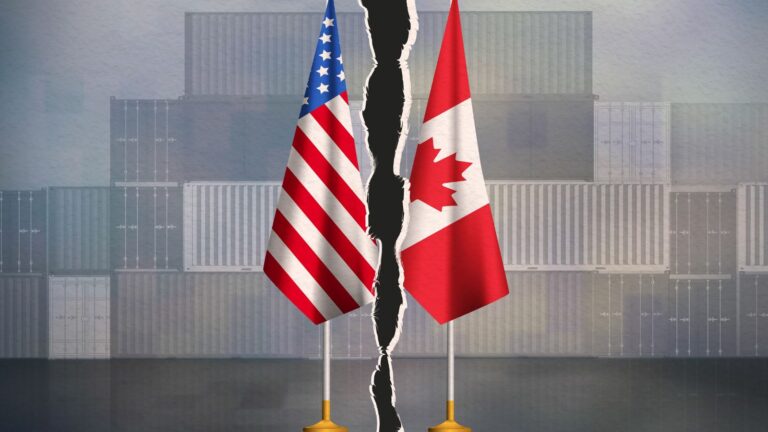
Canada’s economy entered the newest phase of its trade dispute with the United States on softer footing than Ottawa would have wanted. Real gross domestic product was unchanged in July, ending three straight months of growth, while manufacturing output fell and retail activity weakened. The timing matters: July came before a fresh round of U.S. tariffs took effect in late August, meaning the latest GDP reading does not yet capture their full impact.
The flat month has revived a long-running question that becomes more urgent whenever Washington changes the rules of cross-border commerce: how much risk comes from selling so much to one customer? Canada has made measurable progress in expanding non-U.S. trade, but the United States remains deeply embedded in the country’s factories, energy system and export-oriented jobs.
July’s Flat Reading Changes the Mood
Trump’s Trade Fight Puts Canada’s Reliance on U.S. Market Back Under Spotlight as Economy Goes Flat
- July’s Flat Reading Changes the Mood
- The U.S. Still Takes Most Canadian Goods
- August Tariffs Raised the Stakes Again
- Manufacturing Is Where the Fragility Shows
- Autos and Steel Reveal the Job Exposure
- Energy Is Both a Buffer and a Dependency
- Diversification Is Finally Showing in the Data
- Services Offer a Different Kind of Hedge
- Canada’s Internal Market Matters More Now
- The Bigger Risk Is Investment and Confidence
July’s GDP result was not a collapse, but it was a clear loss of momentum. Statistics Canada’s official data, reported on September 29, showed real output essentially unchanged after three consecutive monthly increases. Manufacturing contracted 0.9%, mining, quarrying and oil and gas extraction fell 0.5%, retail trade declined 1.0% and wholesale trade slipped 0.4%. Those losses were offset by stronger construction, up 1.3%, and utilities, up 1.7%.
That mix matters because it shows a very uneven economy rather than a broad-based contraction. Professional, scientific and technical services rose 0.3%, while real estate and rental and leasing advanced 0.2% for a sixth straight month. Statistics Canada’s preliminary estimate suggests GDP increased 0.2% in August. Still, July provides the cleanest snapshot of conditions immediately before the August tariff escalation, making it a useful baseline for judging what comes next. It also underscores how quickly the picture can change from one month to the next in a volatile trade environment.
The U.S. Still Takes Most Canadian Goods
Canada has reduced its dependence on the U.S. market at the margin, but the concentration remains striking. Statistics Canada reported that 71.7% of Canadian merchandise exports went to the United States in 2025, down from 75.9% in 2024. Exports to the U.S. fell 5.8% that year, while exports to countries outside the U.S. jumped 17.2%. That was a meaningful shift, not merely a rounding error.
Broader goods-and-services figures show the same direction. Global Affairs Canada says non-U.S. markets accounted for 32.8% of total Canadian exports in 2025, the highest share in roughly four decades. In the first quarter of 2026, the U.S. share of goods and services exports fell to 64.1%, the lowest in that series. Yet a market taking roughly two-thirds of exports still has enormous leverage over Canadian production decisions, hiring and investment. For export-heavy regions and industries, that concentration means changes in U.S. policy can still reach far beyond the border itself.
August Tariffs Raised the Stakes Again
The newest tariff round landed after the July GDP reference month. The U.S. imposed additional duties of up to 50% on specified Canadian products effective August 22, following a series of presidential actions under Section 338 and other trade authorities. Canada responded with counter-tariffs of 15%, 25% and 50% on $27.6 billion of U.S. imports, effective September 8, matching the new measures on a dollar-for-dollar basis, according to the federal government.
That sequencing is important when reading the latest economic data. July cannot show the full effect of measures that arrived weeks later. The Bank of Canada said in September that the newest U.S. tariffs directly cover roughly 5% of Canadian goods exports to the United States, limiting the immediate economy-wide hit. But policymakers also warned that renewed uncertainty can spread beyond the targeted products by delaying investment, hiring and spending decisions. In other words, the secondary confidence effect could prove broader than the direct tariff footprint.
Manufacturing Is Where the Fragility Shows
Manufacturing is one of the clearest places where softer domestic momentum and trade risk overlap. Industry GDP fell 0.9% in July, while Statistics Canada’s separate manufacturing survey showed sales slipping 0.4% to $78.7 billion. In constant dollars, manufacturing sales fell 1.4%, indicating that the decline was not simply a price effect. Chemical and food manufacturing were among the biggest drags on sales.
The July GDP weakness also reflected a sharp drop in petroleum refinery output, while factory inventories continued to rise. None of that proves tariffs caused July’s decline; in fact, some of the weakness was linked to refinery maintenance and other industry-specific factors. The more important point is that manufacturing entered the latest tariff phase without much room for error. When external demand is uncertain, even temporary plant disruptions or softer orders can produce a more visible hit to overall growth. That is especially relevant in provinces where manufacturing supply chains support large clusters of suppliers, transport firms and skilled trades.
Autos and Steel Reveal the Job Exposure
The dependence on the U.S. becomes more concrete when measured in jobs rather than trade totals. Statistics Canada estimates that 76.4% of payroll jobs in automobile and light-duty motor vehicle manufacturing in 2024 were supported by U.S. demand for Canadian exports. More than 93% of Canadian motor-vehicle exports went to the United States in 2025. In iron and steel mills and ferro-alloy manufacturing, U.S. demand supported about 67% of payroll jobs in 2024.
Those numbers help explain why sector-specific tariffs can have an outsized regional impact even when their national GDP effect looks modest. The Bank of Canada said in April that steel exports had fallen by roughly half under steep U.S. tariffs, while motor-vehicle exports were slightly below 2024 levels. More recently, Stelco said it would idle some Hamilton production, with up to 500 workers affected, citing trade-related pressures and market disruption. For affected communities, a national statistic that looks manageable can translate into a very concentrated employment shock.
Energy Is Both a Buffer and a Dependency
Energy gives Canada export strength, but it also demonstrates how difficult geographic diversification can be. The Canada Energy Regulator says 90.8% of Canadian hydrocarbon export volumes went to the United States in 2025. Crude oil alone generated $140 billion in export value, with 90.1% of that value tied to U.S. buyers. Energy exports therefore provide substantial export income while reinforcing the same concentration problem seen in other sectors.
The Trans Mountain expansion has begun changing that equation. Statistics Canada says crude oil exports to countries other than the U.S. jumped 132.6% in 2025, and non-U.S. destinations took 10.9% of total crude exports, more than triple the average share recorded from 2016 through 2024. That is meaningful progress, but pipelines, refineries and decades of integrated infrastructure cannot be reoriented quickly. Diversification in energy is a multi-year logistics project, not a short-term response to tariffs. The same infrastructure that made continental integration efficient also makes rapid separation expensive.
Diversification Is Finally Showing in the Data
There is stronger evidence of diversification than Canada had only a few years ago. Global Affairs Canada reported that total exports to non-U.S. markets rose 11.1% in 2025, increasing their share of Canadian exports to 32.8%. The European Union posted a 16.4% increase in Canadian goods and services exports, while Indo-Pacific growth was supported by crude oil shipments made possible by new transportation capacity.
The composition of that growth also shows both opportunity and limitation. Gold and energy accounted for a large part of the non-U.S. increase, meaning diversification is not yet evenly spread across the economy. The Bank of Canada has repeatedly noted that manufacturers face greater obstacles when trying to replace American customers because distant markets carry higher transportation costs and intense competition. Export diversification is happening, but for many factories it remains far harder than redirecting globally traded commodities. The next test is whether more value-added manufacturers can make the same transition.
Services Offer a Different Kind of Hedge
Canada’s services sector is considerably less dependent on a single market than its goods sector. Global Affairs Canada says services exports reached about $240 billion in 2025 and now represent nearly one-quarter of total Canadian exports. The United States took 53% of services exports, compared with about 72% of goods exports. That leaves a much larger share of services already distributed across Europe, Asia and other markets.
Digitally enabled and knowledge-intensive services also face fewer border frictions than physical goods. Commercial services exports grew 4.0% in 2025, while telecommunications, computer and information services were among the contributors. This does not make services immune to a North American slowdown, since U.S. clients remain important and weaker domestic conditions can still hurt demand. But it gives Canada a form of diversification that does not depend on building a new pipeline, rerouting a rail corridor or finding a foreign buyer for heavy industrial output.
Canada’s Internal Market Matters More Now
A stronger domestic market cannot replace the United States, but it can reduce some of the cost of external shocks. More than $527 billion in goods and services moves across provincial and territorial borders each year, equal to almost one-fifth of Canadian GDP, according to the federal government. Roughly one-third of businesses participate in internal trade by buying or selling across provincial lines.
That scale explains why internal trade reform has become part of the resilience discussion. Ottawa and the provinces have been working on mutual recognition, labour mobility and fewer regulatory barriers, while the Bank of Canada has argued that improving the movement of goods, workers and investment can strengthen productive capacity. The practical benefit is straightforward: a company that loses a U.S. customer has more options if Canadian markets are easier to reach. Internal trade will not replicate the scale of the U.S. economy, but fewer domestic frictions can make adjustment less painful.
The Bigger Risk Is Investment and Confidence
The immediate tariff math may understate the broader economic risk. In September, the Bank of Canada said the newest U.S. measures directly affect about 5% of Canadian goods exports to the United States and therefore may have only a modest direct impact on national output. The wider concern is uncertainty. Businesses facing repeatedly changing tariff rules may postpone a new production line, delay hiring or hold more cash instead of committing capital.
That is why July’s flat GDP should be read cautiously rather than dramatically. Canada had just posted annualized growth of 3.3% in the second quarter, and Statistics Canada’s advance estimate points to 0.2% growth in August. The Bank of Canada has been expecting roughly 1.5% annualized third-quarter growth. The economy is not simply moving in one direction. But the latest trade escalation has put Canada’s long-standing U.S. concentration back at the centre of the outlook—and made diversification a growth issue rather than only a trade-policy ambition.
This Options Discord Chat is The Real Deal
While the internet is scoured with trading chat rooms, many of which even charge upwards of thousands of dollars to join, this smaller options trading discord chatroom is the real deal and actually providing valuable trade setups, education, and community without the noise and spam of the larger more expensive rooms. With a incredibly low-cost monthly fee, Options Trading Club (click here to see their reviews) requires an application to join ensuring that every member is dedicated and serious about taking their trading to the next level. If you are looking for a change in your trading strategies, then click here to apply for a membership.