35,000+ smart investors are already getting financial news, market signals, and macro shifts in the economy that could impact their money next with our FREE weekly newsletter. Get ahead of what the crowd finds out too late. Click Here to Subscribe for FREE.
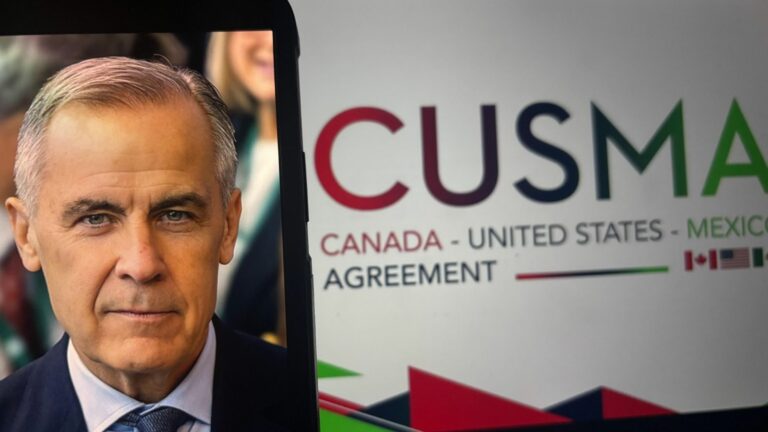
A trade deadline that might once have looked like another bargaining tactic is now pressing directly against the rules that have anchored North American commerce for years. President Donald Trump’s planned 50% tariffs on nearly US$20 billion of Canadian imports are scheduled to take effect on August 19, and unlike many earlier U.S. tariffs, the new duties are set to reach products that would otherwise qualify for preferential treatment under CUSMA. Canadian Trade Minister Dominic LeBlanc and chief negotiator Janice Charette have been in Washington as officials work through the weekend, trying to narrow a gap that remained substantial late Friday. The immediate question is whether an interim deal can stop the new tariffs. The larger one is whether CUSMA can still provide the certainty Canadian companies built their cross-border business around.
The Weekend Has Become Part of the Negotiating Calendar
Trump’s Tariff Deadline Puts CUSMA Itself on the Line as Canadian Officials Work Through the Weekend
- The Weekend Has Become Part of the Negotiating Calendar
- August 19 Is Different From Earlier Tariff Deadlines
- The Two Governments Are Bargaining Over a Stack of Disputes
- Some of Washington’s Demands Run Straight Into Canadian Politics
- Canada Has Diversified, but the U.S. Market Still Dominates
- Autos Show Why Repeated Uncertainty Can Be as Damaging as Tariffs
- An Interim Deal Would Solve the Deadline, Not the Bigger Problem
The weekend has become part of the negotiating calendar because there is little room left for leisurely diplomacy. LeBlanc has intensified his engagement with U.S. Trade Representative Jamieson Greer, meeting him four times in roughly three weeks, while Canadian and American officials have also been talking at the technical level on a near-continuous basis. LeBlanc’s office said he would remain in Washington through the weekend, and people briefed on the discussions said multiple meetings were planned. That pace reflects both the August 19 deadline and the growing list of issues that must be connected if either side is going to call the result a deal.
There is also a striking contrast in the public signals. A Canadian government source said on Thursday that Washington, too, wanted an agreement before August 19 and described positive movement. By Friday, however, LeBlanc had told a Canadian advisory committee that the two countries were still far apart on a draft acceptable to Ottawa. That does not necessarily mean the talks reversed in 24 hours. Trade negotiations often move unevenly, with progress on individual files while the overall package remains unresolved. The human reality is simpler: officials are spending a summer weekend in conference rooms because the gap between “constructive” discussions and a signable agreement is still large.
August 19 Is Different From Earlier Tariff Deadlines
The August 19 deadline matters because these tariffs are different from the broad U.S. measures Canadian exporters have spent much of the past year learning to navigate. The Trump administration invoked Section 338 of the Tariff Act of 1930, a rarely used authority that allows duties of up to 50% when the president finds that another country discriminates against U.S. commerce. USTR says the action will impose a 50% duty on nearly US$20 billion of Canadian imports. Reuters calculated that amount at about 5.2% of the roughly US$383 billion in goods the United States imported from Canada in 2025.
The product list is wide enough to make the dispute tangible. It includes categories such as wine, dairy products, cement, furniture, clothing, seeds, fishing rods and hockey-related goods. Energy, potash, fish and critical minerals are among the major exclusions, and products already subject to certain Section 232 tariffs are treated separately. The most important feature, however, is legal and commercial rather than visual: qualifying under CUSMA will not by itself shield covered goods from the new duties. For an exporter that spent years adjusting sourcing and paperwork to meet North American rules of origin, that changes the practical value of compliance overnight.
CUSMA Is Still Alive, but Its Long-Term Guarantee Is Gone
CUSMA is not disappearing on August 19, and it did not expire when the first six-year review arrived on July 1. The agreement entered into force on July 1, 2020, with a 16-year term and a review mechanism designed to encourage periodic renewal. At the 2026 joint review, the United States declined to extend the agreement in its current form. USTR explicitly said the pact remains in force while the three governments continue trying to resolve their differences. Under the review structure, the absence of a three-country extension means the parties move into annual reviews, with the agreement capable of continuing until 2036 unless it is extended earlier or otherwise terminated.
That distinction is essential because the current tariff fight is happening inside an agreement that is still legally alive but politically unsettled. The problem for business is therefore not simply whether a tariff line rises from zero to 50%. It is whether preferential treatment under CUSMA remains a durable organizing principle for investment. The Bank of Canada warned earlier this year that annual reviews without an extension would prolong uncertainty. Business groups and policy researchers have raised similar concerns because factories, warehouses and cross-border supply contracts are planned years ahead, not one review cycle at a time. August 19 is a tariff deadline, but July 1 had already put long-term certainty into question.
The Two Governments Are Bargaining Over a Stack of Disputes
The negotiations are difficult because the two sides are not arguing over one tariff. Washington has bundled several longstanding complaints with retaliation that emerged during the current trade conflict. U.S. officials have focused on Canadian treatment of American vehicles, access for U.S. dairy products and the refusal of a number of provinces to stock American alcohol. The Trump administration characterizes those policies as discriminatory. Ottawa disputes that framing in important areas and argues that some Canadian measures, particularly in autos, were responses to U.S. tariffs that Canada considers inconsistent with CUSMA.
Canada, meanwhile, is seeking relief from existing U.S. duties on major industrial sectors, especially steel and aluminum, while its own counter-tariffs on U.S. steel, aluminum and automobiles remain in place. Greer has made those Canadian retaliatory measures a central U.S. complaint and said they would need to be lifted to avoid the new tariffs. That creates a package-deal problem: Washington wants retaliation removed, while Ottawa wants meaningful tariff relief in return. Reuters reported that an American proposal to lower some tariffs did not go as far as Canadian officials wanted. By Friday, the near-term objective was increasingly being described as an interim agreement that could address some existing tariffs while stopping the looming 50% duties.
Some of Washington’s Demands Run Straight Into Canadian Politics
Even if negotiators identify a trade-off on paper, Ottawa cannot treat every U.S. demand as a switch controlled from one federal office. Alcohol is the clearest example. Provincial governments and their liquor agencies decide what is stocked in many Canadian markets, and several provinces removed U.S. products as retaliation for earlier American tariffs. The federal government has limited ability to simply order premiers to reverse those decisions. A concession Washington may view as straightforward can therefore require separate political choices across the federation, each with its own economic interests and domestic audience.
Dairy is equally sensitive for a different reason. Canada’s supply-management system and the allocation of dairy tariff-rate quotas have been persistent U.S. complaints under North American trade arrangements, yet Prime Minister Mark Carney has ruled out bargaining away supply management. Autos add another layer because Canada still maintains countermeasures tied to American vehicle tariffs while the industry itself depends heavily on continental production. The result is a negotiation where economic arithmetic collides with jurisdiction and politics. LeBlanc can bargain in Washington, but a package ultimately has to survive the prime minister’s scrutiny, provincial concerns, affected industries and a Canadian political environment in which retaliation has been defended as a response to unilateral U.S. trade actions.
Canada Has Diversified, but the U.S. Market Still Dominates
Canada has reduced its dependence on the U.S. market at the margin, but the numbers show why a disruption in preferential access still carries outsized weight. Statistics Canada reported that 71.7% of Canadian merchandise exports went to the United States in 2025, down from 75.9% in 2024. Exports to the U.S. fell 5.8% during the year, while Canada’s merchandise trade surplus with its southern neighbour narrowed to C$81.6 billion from C$101.3 billion. At the same time, exports to countries other than the United States rose 17.2%, evidence that Canadian trade flows have already begun shifting toward additional markets.
The broader goods-and-services picture tells a similar story. Global Affairs Canada’s 2026 State of Trade report found that Canadian goods and services exports to the United States fell 3.7%, or C$26.3 billion, in 2025, while the number of Canadian goods exporters selling into the U.S. declined by 542. Non-U.S. exports grew strongly, but diversification cannot instantly replace a neighbouring market connected by roads, rail lines, pipelines and decades of integrated production. For a midsized manufacturer in Ontario or an agricultural exporter on the Prairies, the difference between a tariff-free border and a 50% duty on a covered product is not abstract trade policy. It can determine whether an order still makes commercial sense.
Autos Show Why Repeated Uncertainty Can Be as Damaging as Tariffs
The automotive sector illustrates why CUSMA certainty matters even when a new tariff list does not simply cover every vehicle or part. Canada and the United States recorded about C$152 billion in automotive trade in 2024, including roughly C$75 billion of Canadian exports and C$77 billion of imports. Production on both sides of the border depends on common rules of origin and highly coordinated sourcing. Canada has already imposed counter-tariffs on certain U.S. vehicles in response to American auto duties, while Washington has used the wider CUSMA review to press for tighter production and content requirements within the North American vehicle industry.
For manufacturers, the concern is cumulative. A company can adapt to a known tariff, a known content rule or a known certification process. It is harder to commit billions of dollars to a plant when all three can be renegotiated repeatedly. The Bank of Canada has identified annual CUSMA reviews as a source of prolonged uncertainty, while research organizations have warned that trade-policy uncertainty raises the risks and costs surrounding long-term investment. That is why the weekend discussions matter beyond the products directly named in the August 19 action. If CUSMA-compliant trade can face new punitive duties while the agreement itself sits in yearly review, companies may increasingly price political risk into decisions that once rested primarily on efficiency and access to one continental market.
An Interim Deal Would Solve the Deadline, Not the Bigger Problem
The most plausible short-term breakthrough is not a grand rewrite of CUSMA before Wednesday. Canadian and U.S. officials have been working toward an interim understanding that could prevent the 50% tariffs and reduce at least some of the sectoral barriers already in place. That helps explain the intensity of the weekend schedule: negotiators are trying to isolate a package both governments can defend without pretending every dispute over dairy, autos, metals, alcohol and the future structure of CUSMA has been solved. Washington has signalled that it wants movement before the deadline; Canada has signalled that concessions must come with meaningful relief from U.S. tariffs.
If no agreement is reached and the Trump administration does not postpone or alter its action, the new duties are scheduled to take effect on August 19. Carney has said Canada is prepared to respond, while premiers have offered sharply different ideas about how aggressive that response should be. Even a last-minute tariff truce would settle only the immediate crisis. The United States’ July 1 refusal to extend CUSMA remains, annual reviews remain, and Washington has increasingly pursued separate negotiating tracks with Canada and Mexico. The weekend therefore is not just about avoiding another tariff increase. It is about whether a three-country trade framework can still provide dependable rules when bilateral pressure becomes one of Washington’s principal negotiating tools.
This Options Discord Chat is The Real Deal
While the internet is scoured with trading chat rooms, many of which even charge upwards of thousands of dollars to join, this smaller options trading discord chatroom is the real deal and actually providing valuable trade setups, education, and community without the noise and spam of the larger more expensive rooms. With a incredibly low-cost monthly fee, Options Trading Club (click here to see their reviews) requires an application to join ensuring that every member is dedicated and serious about taking their trading to the next level. If you are looking for a change in your trading strategies, then click here to apply for a membership.