35,000+ smart investors are already getting financial news, market signals, and macro shifts in the economy that could impact their money next with our FREE weekly newsletter. Get ahead of what the crowd finds out too late. Click Here to Subscribe for FREE.
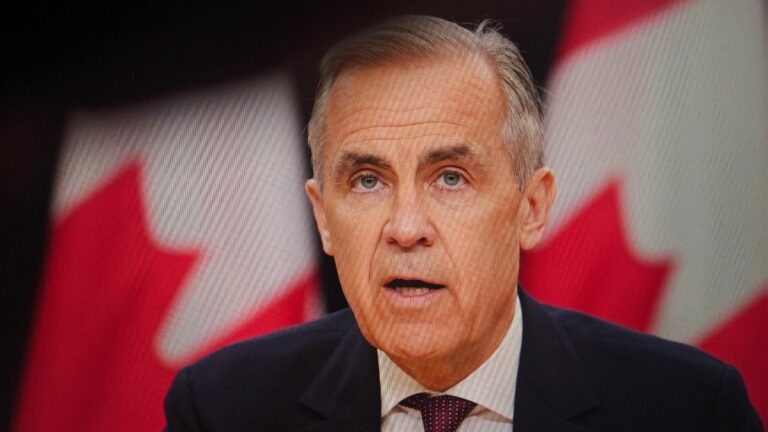
Canada and the United States have moved abruptly from near-deal optimism to another tariff confrontation. Early Saturday, August 22, Washington’s new 50% duties took effect on roughly US$20 billion, or about C$28 billion, of targeted Canadian goods after intensive negotiations failed to produce an agreement. Prime Minister Mark Carney suspended the talks, ordered Canadian negotiators home and said Ottawa would match the new tariffs “dollar for dollar.”
The escalation does not mean every Canadian product entering the United States suddenly faces a 50% charge. The measures cover a targeted group of goods representing just over 5% of Canadian exports to the U.S. But their significance reaches far beyond that share. The breakdown has reopened questions about business investment, consumer prices and the increasingly uncertain future of North America’s trading relationship.
A Deal That Looked Close Fell Apart at the Deadline
Trump’s 50% Tariffs Hit Canada After Deal Collapses — Carney Orders Dollar-for-Dollar Retaliation
- A Deal That Looked Close Fell Apart at the Deadline
- The 50% Rate Is Severe, but It Does Not Apply to Everything Canada Sells
- Carney’s “Dollar-for-Dollar” Response Marks a New Phase
- Small Exporters Could Feel the Damage Long Before the Broader Economy Does
- The Bigger Risk Comes From How Deeply the Two Economies Are Connected
- American Buyers Pay the Tariff First — and Costs Can Spread From There
- The Breakdown Makes the Future of CUSMA Even More Complicated
- Ottawa Is Preparing Support, but Diversification Cannot Happen Overnight
Only days before the tariffs took effect, Canadian and American officials were publicly signaling that meaningful progress had been made. President Donald Trump delayed the original implementation deadline by three days, while Canada-U.S. Trade Minister Dominic LeBlanc described negotiations as “very close” to producing an agreement. Reporting on the proposed framework indicated Washington could have reduced existing tariffs on Canadian steel and aluminum and lowered the rate facing Canadian-built vehicles. The talks also involved contentious issues including dairy market access, provincial restrictions on American alcohol and the treatment of automotive content. For exporters watching from factory floors and shipping offices, the short postponement raised the possibility that another costly round of tariffs might be avoided at the last moment.
That possibility disappeared late Friday. Carney said progress had not been sufficient to meet Canada’s objectives and accused Washington of making last-minute changes that were unfair and economically unacceptable. U.S. Trade Representative Jamieson Greer presented the breakdown differently, saying Canada had declined to finalize terms that Washington believed had already been agreed upon and had sought further concessions. With neither side willing to accept the other’s version of the emerging deal, Carney suspended negotiations and recalled the Canadian team. Reuters reported that no additional talks were immediately scheduled. The result was striking because negotiators had spent days discussing not merely how to prevent the new 50% duties, but how to reduce other tariffs already affecting strategically important Canadian sectors.
The 50% Rate Is Severe, but It Does Not Apply to Everything Canada Sells
The newest U.S. tariffs are unusually steep, yet their scope requires some clarification. Washington estimates that they cover nearly US$20 billion in Canadian imports, while Ottawa puts the Canadian-dollar value at roughly C$28 billion. Products identified by the U.S. government include categories ranging from alcohol and dairy products to cement, furniture and sporting goods. Hockey equipment has become one of the more symbolic examples because it illustrates how a trade dispute involving complicated legal provisions can reach familiar consumer products. Reuters estimates that the newly targeted trade represents slightly more than 5% of Canada’s exports to the United States, limiting the immediate economy-wide hit while creating potentially severe consequences for individual companies.
The duties were imposed under Section 338 of the U.S. Tariff Act of 1930, an authority that allows additional tariffs of as much as 50% when the president finds that another country discriminates against American commerce. The Trump administration invoked it over Canadian policies involving automobiles, alcoholic beverages and dairy. Washington’s proclamations say the new tariff applies to covered products even when they would otherwise qualify for preferential treatment under the U.S.-Mexico-Canada Agreement. Important categories are carved out, including energy, potash, certain critical minerals and products already facing particular Section 232 tariffs. That distinction matters: this is not a blanket 50% border tax on all Canadian exports, but for businesses whose products appear on the targeted lists, the increase can radically change whether a sale to an American customer remains profitable.
Carney’s “Dollar-for-Dollar” Response Marks a New Phase
Carney’s response was immediate in principle. Canada, he said, would match the new U.S. tariffs dollar for dollar to protect Canadian workers and businesses. At the time of the initial announcement, however, Ottawa had not yet released the complete product list or implementation details for the new countermeasures. That means “dollar for dollar” should not automatically be interpreted as a 50% tariff on exactly the same types of American products. Historically, Canada has calculated retaliation by targeting a comparable value of imports, selecting goods in ways designed to create economic and political pressure while limiting damage to Canadian supply chains. The precise composition of this round will therefore be as important as its headline value.
Canada has used that playbook before. In March 2025, Ottawa imposed 25% counter-tariffs on C$29.8 billion of American goods after U.S. steel and aluminum measures, including tariffs on C$12.6 billion of steel products and C$3 billion of aluminum products. Other targeted goods included computers, tools, sporting equipment and cast-iron products. Canada later removed some countermeasures while retaining duties connected with steel, aluminum and vehicles. That history demonstrates the challenge facing policymakers now: retaliation may strengthen negotiating leverage, but Canadian companies that rely on American machinery, components or materials can also face higher costs. Ottawa has previously used tariff-remission programs and exemptions to reduce those unintended consequences, and similar calibration will be closely watched this time.
Small Exporters Could Feel the Damage Long Before the Broader Economy Does
The new tariffs cover a modest portion of Canada’s total exports, but averages can hide intense pressure on individual businesses. Research released by the Canadian Federation of Independent Business before the tariffs took effect found that 40% of participating small firms that export to the United States sold products expected to be affected. Among those exposed exporters, 77% anticipated lower revenue if the 50% duties were implemented, while 35% expected revenue to fall by at least half. Machinery, forestry and building products, plastics, packaging, agriculture, food, beverages and creative products were among the categories represented. For companies operating on margins of only a few percentage points, absorbing anything close to a 50% border cost is rarely realistic.
The practical choices are uncomfortable. A Canadian manufacturer can lower its selling price and sacrifice margin, ask the American buyer to absorb a higher landed cost, move production, seek another market or simply stop serving some U.S. customers. CFIB illustrated the vulnerability with examples such as an Ontario creative business selling into New York or a British Columbia sawmill supplying an American builder. Those transactions may be tiny compared with continental auto production, yet they support employees, trucking companies and local suppliers. The Canadian Chamber of Commerce called the breakdown a major blow to North American competitiveness and warned that tariffs of this magnitude are difficult for businesses to absorb. That is why the first visible effects may appear not in national GDP figures, but in cancelled orders, shortened shifts and postponed investments.
The Bigger Risk Comes From How Deeply the Two Economies Are Connected
Canada has spent years trying to diversify its exports, and there is evidence of movement. Statistics Canada reported that the share of Canadian merchandise exports going to the United States fell from 75.9% in 2024 to 71.7% in 2025. Exports to countries other than the United States increased 17.2% during 2025. More recent data showed Canada exporting about C$53.9 billion in merchandise to the U.S. in June 2026 alone. Those numbers help explain both sides of Canada’s position: dependence on the American market has declined somewhat, but the U.S. remains overwhelmingly the country’s largest export destination.
The integration runs in both directions. U.S. Trade Representative data put total U.S.-Canada goods trade at about US$719.5 billion in 2025, with another US$150.2 billion in services trade. Global Affairs Canada estimates that the countries exchanged nearly C$3.5 billion in goods and services every day during 2025. A component can therefore cross the border as part of one production process before the finished product reaches a customer. This is particularly important in manufacturing, where supply chains were built around decades of relatively predictable continental trade rules. A tariff does not simply create a cost at an abstract national border; it can alter purchasing decisions, production schedules and investment calculations inside plants on both sides. Repeated policy reversals add another cost that is harder to quantify: companies become less willing to invest when they cannot confidently estimate future access to their largest market.
American Buyers Pay the Tariff First — and Costs Can Spread From There
Tariffs are sometimes described politically as bills sent to foreign countries, but their mechanics are different. U.S. Customs and Border Protection states that the importer of record is responsible for applicable duties, taxes and fees when merchandise enters the United States. A Canadian exporter may eventually bear some of the burden by lowering its price to preserve a customer, but the tariff itself is collected from the importing side. What happens next depends on competition, contracts, profit margins and the availability of substitute products. An American importer can absorb the cost, negotiate a discount from its Canadian supplier, switch sources or raise the price charged to customers.
Recent economic research suggests those price effects can be meaningful. A July 2026 National Bureau of Economic Research paper studying the 2025 U.S. tariffs estimated that roughly 26% of tariff increases passed through to consumer prices, including both direct effects on imported products and indirect effects through domestic supply chains and reduced competition. Federal Reserve research has likewise found significant pass-through, though the speed varies. That does not mean every product subject to the new Canadian tariff will become 50% more expensive at an American store. Businesses may absorb part of the cost, substitute suppliers or negotiate lower prices. But a sudden tariff of this size creates powerful pressure somewhere in the chain, which is why Canadian exporters and their American customers can both lose even when the tariff is formally aimed at Canada.
The Breakdown Makes the Future of CUSMA Even More Complicated
The timing is especially sensitive because the continental free-trade framework is already under strain. The United States declined on July 1 to extend the U.S.-Mexico-Canada Agreement for another 16-year term in its current form. That decision did not terminate CUSMA. Under the agreement’s review mechanism, it remains in force and is scheduled to continue until 2036 unless the three governments reach a different outcome. Because the countries did not jointly approve a long-term extension at the first six-year review, the agreement now enters a period of annual reviews during which the parties can continue negotiating changes and eventually agree to extend it.
The latest tariff confrontation makes that process harder. Canada and the United States were already arguing over automobiles, metals, dairy, alcohol and other market-access issues that overlap with broader discussions about the future of continental trade. Meanwhile, Washington has continued separate negotiations with Mexico on automotive rules, steel, aluminum, economic security and supply-chain policy. CUSMA was designed to create predictable rules for a continental market of more than 500 million consumers. Yet the current situation shows that qualifying under the agreement no longer guarantees protection from every U.S. trade action. For Canadian executives deciding whether to expand a plant or sign a long-term American supply contract, that uncertainty may eventually matter as much as the tariff rate itself.
Ottawa Is Preparing Support, but Diversification Cannot Happen Overnight
Carney said the federal government would announce additional assistance for Canadian workers and businesses in the coming days. Ottawa is not starting from scratch. The federal government says more than C$25 billion in support was set out through earlier measures responding to U.S. tariffs and trade disruption. Programs have included financing for large and small companies, worker retraining and income assistance, regional support funds and programs designed to help exporters enter new markets. Measures announced in 2026 included a C$1 billion Business Development Bank of Canada program for manufacturers and exporters using steel, aluminum or copper, plus additional money for the Regional Tariff Response Initiative.
Canada is simultaneously pursuing a longer-term strategy of reducing vulnerability to any single trading partner. Global Affairs Canada says the country has 15 active free-trade agreements covering 51 countries and providing preferential access to markets containing roughly 1.5 billion consumers. Statistics Canada’s 2025 figures already showed stronger growth in exports outside the U.S. Yet replacing the American market is not something most firms can accomplish in a few months. Geography, shared infrastructure, similar consumer markets and decades of integrated investment give U.S. trade advantages that distant markets cannot instantly reproduce. The immediate challenge for Carney is therefore twofold: protect businesses facing a sudden loss of competitiveness while keeping open the possibility of negotiations that could eventually restore more predictable access to Canada’s most important customer.
This Options Discord Chat is The Real Deal
While the internet is scoured with trading chat rooms, many of which even charge upwards of thousands of dollars to join, this smaller options trading discord chatroom is the real deal and actually providing valuable trade setups, education, and community without the noise and spam of the larger more expensive rooms. With a incredibly low-cost monthly fee, Options Trading Club (click here to see their reviews) requires an application to join ensuring that every member is dedicated and serious about taking their trading to the next level. If you are looking for a change in your trading strategies, then click here to apply for a membership.