35,000+ smart investors are already getting financial news, market signals, and macro shifts in the economy that could impact their money next with our FREE weekly newsletter. Get ahead of what the crowd finds out too late. Click Here to Subscribe for FREE.
For generations, the Arctic’s greatest defence was its own geography. Vast distances, punishing temperatures and thick sea ice made sustained military activity enormously difficult. That natural barrier is weakening just as relations among the world’s major powers are becoming more confrontational.
U.S. President Donald Trump has questioned whether America’s allies are doing enough to secure the region, while repeatedly treating Greenland as essential to U.S. security. Canada has answered with more than $35 billion in new northern investments, promising military infrastructure, support hubs, upgraded airports and stronger transportation links. Yet money alone cannot erase decades of limited northern capacity. Russia enters this competition with established bases, a dominant icebreaker fleet and critical military infrastructure already positioned above the Arctic Circle.
Trump Turns the Arctic Into a Test of Allied Credibility
Trump Questions Arctic Security as Canada’s $35-Billion Plan Confronts Russia’s Head Start
- Trump Turns the Arctic Into a Test of Allied Credibility
- The $35-Billion Figure Is Only the Front Door
- Russia’s Head Start Was Built Over Decades
- Canada Is Racing to Replace an Aging Set of Eyes
- Geography Makes Every Deployment an Expedition
- Equipment Matters, but Presence Matters More
- Canada Is Looking North to Its Nordic Allies
- The Real Test Will Be Delivery, Not Announcements
Trump’s focus on the Arctic has forced an uncomfortable debate within NATO. His pressure has centred on Greenland, allied defence spending and the ability of European countries and Canada to protect territory that Washington considers vital to North American security. NATO’s Arctic Sentry initiative, launched in February 2026, was partly intended to demonstrate that the alliance’s northern members could shoulder more of that responsibility.
The dispute is not simply about who controls a distant stretch of ice. The Arctic provides northern approaches to Canada, the United States and Europe, while the waters between Greenland, Iceland and Britain connect the Arctic to the North Atlantic. Trump’s confrontational approach has strained relationships, but it has also accelerated decisions that allies had postponed. Canada and the Nordic countries are expanding exercises, surveillance and infrastructure partly because they need to deter Russia—and partly because they want to prove that Arctic security does not require Washington to seize allied territory or dictate every regional decision.
The $35-Billion Figure Is Only the Front Door
Canada’s plan is commonly described as a $35-billion Arctic package, although Ottawa says it includes more than $35 billion in federal investments within a broader northern strategy backed by over $40 billion. The largest component is $32 billion for northern NORAD basing infrastructure at Yellowknife, Inuvik, Iqaluit and 5 Wing Goose Bay. Planned work includes airfield improvements, hangars, fuel facilities, warehousing, accommodations and communications infrastructure.
Another $2.67 billion is intended for operational support hubs in Whitehorse and Resolute and smaller support nodes in Cambridge Bay and Rankin Inlet. These locations are expected to store equipment and supplies that would otherwise have to be transported thousands of kilometres during an emergency. Ottawa has also allocated $294 million for Arctic airport improvements. The spending is substantial, but much of it is foundational. Canada is not merely adding new equipment; it is attempting to create the runways, fuel storage, maintenance capacity and supply network required to keep existing and future forces operating in the North.
Russia’s Head Start Was Built Over Decades
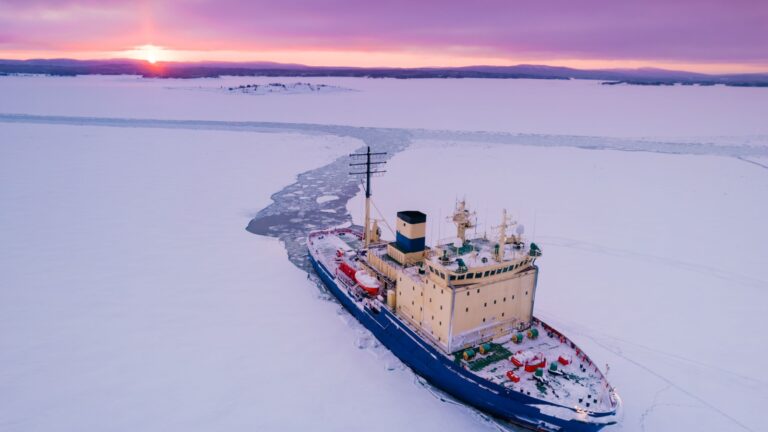
Russia begins with advantages that cannot be quickly purchased. It has reopened or modernized numerous Soviet-era Arctic facilities, including airfields, deepwater ports and military installations. It also operates 42 icebreakers, some nuclear-powered, compared with two operational American polar icebreakers. That fleet supports shipping, resupply, scientific work and a sustained government presence along Russia’s enormous northern coastline.
The Kola Peninsula makes that infrastructure strategically important far beyond the Arctic. It hosts Russia’s Northern Fleet and roughly two-thirds of the country’s second-strike nuclear capability, including six of its 12 nuclear-armed submarines. Russia’s Arctic land forces have reportedly been weakened by deployments and losses connected to the war in Ukraine, creating a potential window for NATO to improve its position. However, damaged units are easier to rebuild than ports, bases and icebreaking capacity are to create from scratch. Canada is therefore competing against an established system, not a collection of isolated Russian projects.
Canada Is Racing to Replace an Aging Set of Eyes
Defending the Arctic begins with knowing what is approaching it. Canada’s 47-site North Warning System stretches from Yukon to Labrador, but much of the network is roughly three decades old. Canadian officials acknowledge that it was not designed to identify newer long-range threats or provide the layered awareness demanded by modern continental defence.
The planned Arctic Over-the-Horizon Radar system is intended to extend surveillance far beyond the limits of conventional radar by using the ionosphere to detect objects around the Earth’s curvature. The system is anticipated to achieve an initial capability by the end of 2029, while a separate Polar Over-the-Horizon Radar is scheduled to follow in the early 2030s. Canada is also investing in space-based surveillance, communications and additional northern sensors. Those projects should eventually transform Arctic awareness, but their timelines reveal the immediate vulnerability: Russia’s infrastructure is operating now, while some of Canada’s most important detection systems remain years from completion.
Geography Makes Every Deployment an Expedition
Canada’s northern territory covers approximately four million square kilometres, representing about 40% of the country’s landmass and more than 70% of its coastline. More than 36,000 islands are scattered through the Canadian Arctic Archipelago. Yet only about 140,000 people live across Yukon, the Northwest Territories and Nunavut, leaving enormous areas without nearby roads, repair facilities, fuel supplies or permanent military units.
The human demands are just as severe. During exercises in early 2026, Canadian personnel completed a snowmobile patrol of more than 5,000 kilometres between Inuvik and Churchill while facing blizzards and temperatures approaching –60 C. Approximately 1,300 Armed Forces members participated in northern exercises involving ski patrols, sea-ice landings and the movement of equipment into remote communities. Such operations demonstrate determination, but they also reveal how difficult routine readiness can be. In southern Canada, a mechanical problem may delay a mission. In the Arctic, the same failure can strand personnel hundreds of kilometres from meaningful support.
Equipment Matters, but Presence Matters More
Canada is assembling a larger collection of assets capable of contributing to northern operations. Current plans include 88 F-35 fighters, up to 16 P-8A Poseidon patrol aircraft, 11 MQ-9B remotely piloted aircraft and six Arctic and Offshore Patrol Ships. The Coast Guard is also pursuing eight new icebreakers, including two polar vessels intended to improve year-round access. These programs should strengthen air, maritime and surveillance capabilities across the region.
Still, sovereignty is not established by owning equipment that spends most of its time in southern bases. Aircraft require suitable runways, ships need ports and maintenance, and personnel require dependable communications, shelter and resupply. The Canadian Rangers remain particularly valuable because they live in northern communities and bring experience that cannot be replicated through occasional deployments. Canada’s challenge is therefore to turn procurement into persistent activity. A smaller force that can arrive quickly, remain supplied and operate safely may provide more credible security than a larger force that cannot be sustained once weather or distance disrupts its southern logistics chain.
Canada Is Looking North to Its Nordic Allies
Canada is trying to reduce strategic dependence on the United States without abandoning the partnership that has defended the continent since NORAD was established in 1958. That distinction is important. Canadian and American warning systems, commanders and aircraft remain deeply integrated, and officials in both countries acknowledge that neither side can effectively monitor the entire North American Arctic alone.
At the same time, Canada is coordinating more closely with Denmark, Greenland, Finland, Iceland, Norway and Sweden. Seven of the eight Arctic states are now NATO members, giving the alliance a much stronger northern position than it held before Finland and Sweden joined. More than 32,000 personnel from 14 allied countries participated in the Cold Response 2026 exercise in Norway and Finland. NATO has also created Arctic Sentry, expanded its command structure and established new forces in Finland. These developments do not eliminate Russia’s advantage, but they allow Canada to draw on Nordic expertise in cold-weather operations, shipbuilding, surveillance and northern infrastructure.
The Real Test Will Be Delivery, Not Announcements
Canada’s northern strategy attempts to connect defence with everyday infrastructure. The proposed Mackenzie Valley Highway would shorten the road distance between Yellowknife and Inuvik by an estimated 1,200 kilometres and reduce the trip from approximately 38 hours to 23. The planned Grays Bay project would combine a roughly 230-kilometre road with a deepwater Arctic port and airstrip. Ottawa estimates that four major northern projects could generate more than 11,000 construction jobs while improving military mobility, community resupply and access to critical mineral deposits.
That dual-purpose approach may be Canada’s best response to Russia’s head start. Canada does not need to reproduce Russia’s militarized northern coastline installation by installation. It needs reliable surveillance, strategically located forces, functioning transportation links and communities capable of supporting a sustained national presence. Success will depend on completing projects on schedule, working meaningfully with Indigenous governments and preventing rising construction costs from consuming promised capabilities. The $35-billion commitment is large enough to change Canada’s Arctic position—but only if announcements become working runways, radar coverage, roads, ports and year-round operations.
This Options Discord Chat is The Real Deal
While the internet is scoured with trading chat rooms, many of which even charge upwards of thousands of dollars to join, this smaller options trading discord chatroom is the real deal and actually providing valuable trade setups, education, and community without the noise and spam of the larger more expensive rooms. With a incredibly low-cost monthly fee, Options Trading Club (click here to see their reviews) requires an application to join ensuring that every member is dedicated and serious about taking their trading to the next level. If you are looking for a change in your trading strategies, then click here to apply for a membership.