35,000+ smart investors are already getting financial news, market signals, and macro shifts in the economy that could impact their money next with our FREE weekly newsletter. Get ahead of what the crowd finds out too late. Click Here to Subscribe for FREE.
With a few words at a Kentucky campaign rally, U.S. President Donald Trump revived a naming dispute that has become a symbol of the increasingly strained relationship between Washington and Ottawa.
On October 17, 2026, Trump boasted about changing Lake Ontario to “Lake America,” presenting the decision as evidence of his growing presidential authority. His claim followed an executive order signed in August, although the change applies to U.S. federal usage rather than determining what Canadians must call the shared lake.
Prime Minister Mark Carney has rejected the new name, while the controversy has unfolded alongside escalating trade disputes affecting businesses and communities on both sides of the border.
What might appear to be a symbolic disagreement over geography has become part of a larger confrontation involving national identity, economic pressure and the future of Canada-U.S. relations.
Trump Boasts About His Power at a Kentucky Campaign Rally
Trump Brags About Renaming Lake Ontario ‘Lake America’ as Canada-U.S. Tensions Continue
- Trump Boasts About His Power at a Kentucky Campaign Rally
- How a Social Media Threat Became an Official Executive Order
- Why Trump’s Renaming Cannot Change What Canada Calls the Lake
- Carney, Doug Ford and U.S. Governors Reject the New Name
- The Indigenous History Behind the Name Makes the Dispute More Sensitive
- The Lake Dispute Is Unfolding Against a Costly Trade War
- Lake Ontario Is a Shared Economic and Environmental Resource
- Google and Apple Maps Turn the Name Change Into a Global Controversy
- Trump’s Latest Remarks Come Despite Widespread American Opposition
President Donald Trump brought the Lake Ontario controversy back into the spotlight during an October 17 campaign rally in Highland Heights, Kentucky. Speaking to supporters ahead of the November congressional midterm elections, Trump portrayed his second presidency as a period in which he could accomplish things that previously would have seemed impossible. He pointed to his administration’s decision to rename the Gulf of Mexico the Gulf of America before turning his attention to Canada’s best-known Great Lakes dispute.
Trump declared, “Well, I also changed the name of a lake in Canada to the Lake America,” referring to Lake Ontario. He framed the renaming as an accomplishment that demonstrated his influence over government institutions and even major technology companies.
The comments came during an event intended to energize Republican voters and support congressional candidate Ed Gallrein. Rather than focusing exclusively on domestic policy, Trump used geographic renaming to reinforce his political image as a leader willing to challenge established conventions. For Canadians, however, the remark revived an uncomfortable question: how far Washington intends to push symbolic disputes while the two countries remain locked in serious disagreements over trade and economic cooperation.
How a Social Media Threat Became an Official Executive Order
The controversy began on August 25, when Trump announced on Truth Social that his administration was seriously considering replacing the name Lake Ontario with Lake America. His explanation directly connected the proposal to deteriorating economic relations with Canada. He suggested that the United States expected to conduct much less business with Ontario, turning the proposed name change into another expression of frustration with the Canadian government.
Two days later, on August 27, Trump signed Executive Order 14422, formally directing the federal government to adopt the new designation. The document instructed the U.S. secretary of the interior to work with the U.S. Board on Geographic Names to update the government’s official geographic records.
The order established a 30-day period for the necessary administrative steps and directed federal agencies to reflect the change in maps, contracts, publications and other communications. It also called for references to Lake Ontario to be removed from the U.S. Geographic Names Information System. The decision gave Trump’s proposal practical consequences within the federal bureaucracy, even though it did not alter the international boundary or the authority of Canadian governments. What began as a provocative social media statement had become an official federal naming policy.
Why Trump’s Renaming Cannot Change What Canada Calls the Lake
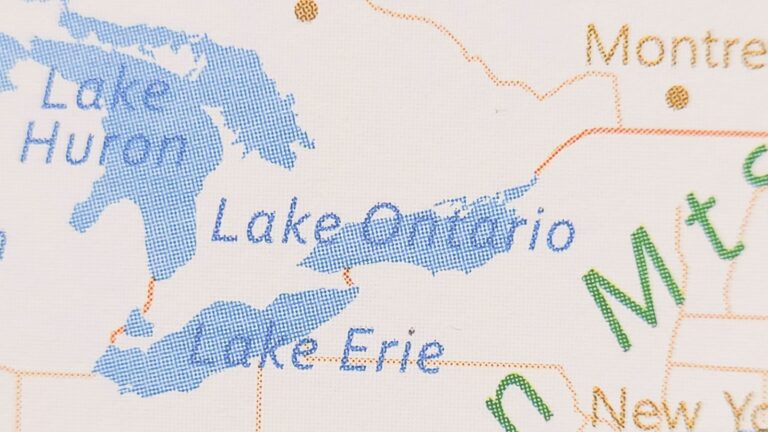
The distinction between a federal naming decision and international recognition is central to the dispute. Lake Ontario lies between the Canadian province of Ontario and New York State, with approximately 52% of its surface area within Canada. Although Trump can direct American federal departments to adopt a different designation, that authority does not extend to Canadian government agencies, international organizations or independently operated mapping services.
The U.S. Board on Geographic Names exists primarily to standardize geographic terminology across federal institutions. Its decisions influence official maps, government databases and publications, but they do not automatically determine the names recognized by other countries.
Consequently, Lake Ontario can appear as Lake America on American federal documents while retaining its historic name throughout Canada. Neither the international boundary nor Canada’s jurisdiction over its portion of the lake changes because of an executive order.
This distinction matters beyond political symbolism. Geographic names are used by navigators, researchers, educators and public agencies to communicate consistently about physical locations. Different official naming conventions can create confusion, particularly for landmarks shared by multiple countries. Trump’s order therefore carries administrative and political significance without granting the United States greater control over the lake itself.
Carney, Doug Ford and U.S. Governors Reject the New Name
Canadian Prime Minister Mark Carney responded to the August executive order by emphasizing the lake’s long-established identity. He pointed out that its name predates both Canadian Confederation and American independence, rejecting the suggestion that Washington could redefine a shared geographic landmark. His message was unmistakable: Canadians would continue calling it Lake Ontario.
Ontario Premier Doug Ford took the response a step further on August 29. Wearing a Team Canada jersey, Ford unveiled an enormous sign near Grimsby, Ontario, displaying the words “Lake Ontario. Now and Always.” Measuring approximately 24 feet wide and 12 feet high, the display transformed a diplomatic disagreement into a highly visible expression of Canadian identity.
Opposition to Trump’s decision also emerged within the United States. New York Governor Kathy Hochul, whose state borders the lake, publicly declared that New York would not adopt the new designation. Vermont’s Republican Governor Phil Scott also criticized the move, describing it as petty and disappointing.
The reactions demonstrated that opposition was not limited to one political party or one side of the border. Although these officials differed on many other issues, they challenged the idea that changing a familiar geographic name was an appropriate response to international disagreements.
The Indigenous History Behind the Name Makes the Dispute More Sensitive
The controversy extends beyond modern Canadian nationalism because the name Ontario has deep Indigenous roots. Carney identified its origin as the Wendat word Ontari’io, commonly interpreted as describing a beautiful or great lake. Canadian government historical sources also connect Ontario to related Iroquoian words associated with sparkling water. Although historical spellings and translations vary, the name’s Indigenous origins are well established.
Government records identify the use of Ontario as a geographic name as early as 1641, centuries before the province formally entered Confederation in 1867. The name therefore carries a history that cannot be explained simply through the modern political boundaries of Canada and the United States.
Wendat Nation Grand Chief Pierre Picard strongly condemned Trump’s decision, describing it as an attempt to erase his people’s history and identity. The Wendat have longstanding historical connections to the Great Lakes and St. Lawrence region, including important trading routes that existed before European colonization.
For Indigenous communities, geographic names can preserve language, cultural memory and relationships with ancestral territories. Replacing an established Indigenous-derived name with a modern nationalist label raises questions about whose history receives recognition. What Trump portrayed as an assertion of American pride was experienced by some Indigenous leaders as another challenge to their cultural heritage.
The Lake Dispute Is Unfolding Against a Costly Trade War
Trump’s campaign remarks arrived during a period of significant economic friction between Canada and the United States. Trade negotiations broke down in August after disagreements over proposed American demands, including conditions affecting Canadian vehicle production and future trade arrangements. Washington subsequently imposed 50% tariffs on C$27.6 billion worth of Canadian goods, prompting Ottawa to introduce retaliatory measures covering an equivalent value of American imports.
Canada’s counter-tariffs, which took effect September 8, included rates of 15%, 25% and 50% across selected products. Steel, dairy, appliances, agricultural equipment and electronics were among the affected sectors. The dispute has created uncertainty for businesses accustomed to operating within an integrated North American marketplace.
The economic consequences are particularly visible in Canadian manufacturing. Reuters reported on October 16 that Canadian steel shipments to the United States had fallen 60% in 2025, according to industry data, following the introduction of steep American trade barriers. Some producers have responded by concentrating more heavily on domestic customers, while others continue to face difficult conditions.
Against this backdrop, the Lake America controversy is more than an isolated political argument. It reflects a deteriorating diplomatic atmosphere in which disagreements over trade rules increasingly overlap with disputes involving sovereignty, national identity and political messaging.
Beyond its name, Lake Ontario plays an important role in the daily lives and economies of communities on both sides of the border. As the easternmost of North America’s five Great Lakes, it forms a critical link between the upper Great Lakes and the St. Lawrence River system. Its waters support commercial navigation, municipal drinking-water supplies, electricity generation, fisheries and recreational activities.
The lake also requires careful international management. The International Joint Commission, a binational organization established by Canada and the United States, oversees important aspects of shared water regulation. In June 2026, the commission reported that a six-year review of Lake Ontario outflow management was nearing completion, following damaging floods in 2017 and 2019.
The scientific community has also responded directly to the naming controversy. On August 28, the International Association for Great Lakes Research announced that it would continue using Lake Ontario in its publications, conferences and scientific communications regardless of the American federal designation.
Its position highlights an important contrast. Governments may disagree over names, but protecting shared freshwater resources still depends on cooperation, dependable research and communication between countries. Environmental challenges do not stop at international borders, making the practical relationship between Canadian and American institutions far more consequential than the wording on a political map.
Google and Apple Maps Turn the Name Change Into a Global Controversy
The dispute quickly spread from government documents to the digital maps used by millions of people. Google Maps began displaying Lake America for users in the United States in late August, following updates to the American government’s geographic names database. Apple Maps adopted the new designation for American users in early September.
However, both companies maintained a geographic distinction in how they displayed the lake. Canadian users continued seeing Lake Ontario, while users in other countries could see both names. As a result, the same body of water could carry different labels depending on where someone opened the mapping application.
Trump celebrated the technology companies’ decisions and suggested that their adoption of Lake America made the change binding. Legally, however, decisions by private mapping companies do not establish international recognition or require Canada to follow the American government’s naming policy.
Not every mapping provider agreed with the change. MapQuest publicly maintained the Lake Ontario designation, attracting attention from users seeking alternatives to Google and Apple. The Associated Press reported that MapQuest downloads surged in early September, reaching the top of free-app charts in the United States and Canada.
The episode revealed how geopolitical disputes can spread into everyday technology, transforming digital maps into unexpected battlegrounds over identity and political influence.
Trump’s Latest Remarks Come Despite Widespread American Opposition
Trump’s renewed boast reflects a broader effort to reshape familiar geographic names around themes of American identity and presidential authority. In January 2025, he directed the U.S. government to adopt the name Gulf of America for the Gulf of Mexico. More recently, during an October 10 rally in Tennessee, he floated the possibility of renaming either the Atlantic or Pacific Ocean as “Trump Ocean” or “Ocean of the Americas.”
These suggestions demonstrate how geographical naming has become part of Trump’s political messaging. Supporters may regard such gestures as expressions of national pride, while critics see them as unnecessary provocations that complicate relationships with neighboring countries.
Public opinion suggests the Lake Ontario decision has not received widespread support among Americans. An Ipsos survey conducted from August 28 to 30 found that 63% of U.S. adults opposed the renaming, compared with just 14% who supported it. Even among Republicans, opposition exceeded support, at 43% versus 33%.
The same survey found that 68% of Americans believed the United States should be willing to make compromises with Canada in trade negotiations, while 57% opposed additional tariffs on Canadian goods.
Although the polling predates Trump’s latest Kentucky remarks, it illustrates the gap between the president’s enthusiasm for symbolic victories and the concerns of many Americans about relations with Canada.
Ultimately, changing the wording on federal maps cannot resolve disputes over tariffs, manufacturing jobs or international cooperation. The larger challenge for Washington and Ottawa remains rebuilding a functional economic relationship while respecting the sovereignty, history and established identities of both countries.
This Options Discord Chat is The Real Deal
While the internet is scoured with trading chat rooms, many of which even charge upwards of thousands of dollars to join, this smaller options trading discord chatroom is the real deal and actually providing valuable trade setups, education, and community without the noise and spam of the larger more expensive rooms. With a incredibly low-cost monthly fee, Options Trading Club (click here to see their reviews) requires an application to join ensuring that every member is dedicated and serious about taking their trading to the next level. If you are looking for a change in your trading strategies, then click here to apply for a membership.