35,000+ smart investors are already getting financial news, market signals, and macro shifts in the economy that could impact their money next with our FREE weekly newsletter. Get ahead of what the crowd finds out too late. Click Here to Subscribe for FREE.
Quebec’s election campaign has entered its final two weeks with an unusually crowded contest behind the front-running Parti Québécois. A new Segma Recherche poll conducted for Radio-Canada and Les Coops de l’information places the Quebec Liberals at 19% and Éric Duhaime’s Conservative Party of Quebec at 18%, leaving the two formations statistically tied while the PQ leads at 29% and the governing Coalition Avenir Québec sits at 22%. The numbers arrive as parties struggle to balance everyday concerns over prices and health care with an unpredictable Canada-U.S. trade confrontation that is already affecting businesses and workers. Quebec’s approximately 6.4 million registered electors are scheduled to choose representatives in 127 ridings on October 5.
A One-Point Race for Third Place Has Emerged
Quebec Liberals and Conservatives Are Statistically Tied at 19%–18% as U.S. Tariff War Hangs Over Campaign
- A One-Point Race for Third Place Has Emerged
- A Large Poll Comes With an Important Timing Caveat
- Tariffs Loom Over the Campaign, but Affordability Looms Even Larger
- Liberals Are Selling Diversification and Targeted Business Relief
- Conservatives Are Betting on Lower Taxes and Fewer Barriers
- The CAQ Is Leaning on the Powers of Incumbency
- The PQ Wants a More Targeted Trade Response
- Age and Language Are Splitting the Electorate in Different Ways
- The Final Two Weeks Remain Open
The latest provincial picture puts Paul St-Pierre Plamondon’s Parti Québécois at 29%, followed by Christine Fréchette’s CAQ at 22%. Charles Milliard’s Quebec Liberal Party stands at 19%, Éric Duhaime’s Quebec Conservatives at 18%, and Québec solidaire at 12%. The one-point Liberal-Conservative gap is reported as a statistical tie, making the competition between the PLQ and PCQ one of the more notable features of the poll rather than evidence that either party has secured third place.
That matters because the two parties are drawing support from electorates with substantially different profiles. The Conservatives have established stronger support among younger voters and around the Quebec City region, while the Liberals remain a different political proposition with historically stronger appeal in parts of Montreal and among non-francophone voters. The province-wide percentages therefore conceal several distinct regional and demographic contests. A one-point provincial difference does not mean individual ridings will resemble one another, particularly under Quebec’s first-past-the-post electoral system, where geographically concentrated support can matter as much as the province-wide popular vote.
A Large Poll Comes With an Important Timing Caveat
Segma Recherche conducted the poll from September 8 through September 17 among 5,572 Quebec respondents using online and telephone interviews. An entirely probabilistic sample of that size would carry an indicative margin of error of roughly plus or minus 1.3 percentage points at the 95% confidence level. The unusually large provincial sample also makes it possible to examine regional and demographic subgroups with more depth than a typical Quebec-wide poll of roughly 1,000 people.
There is nevertheless an important timing qualification. Poll analyst Philippe J. Fournier noted that roughly two-thirds of responses were collected before the TVA and Noovo debates, meaning the results should not be treated as a clean measurement of voter opinion after those events. Segma also found that 41% of respondents considered their vote still potentially changeable before October 5, rising to about half among voters aged 18 to 34. That figure does not mean all of those voters will switch parties, but it does underline how much of the electorate remained persuadable when interviews were conducted.
Tariffs Loom Over the Campaign, but Affordability Looms Even Larger
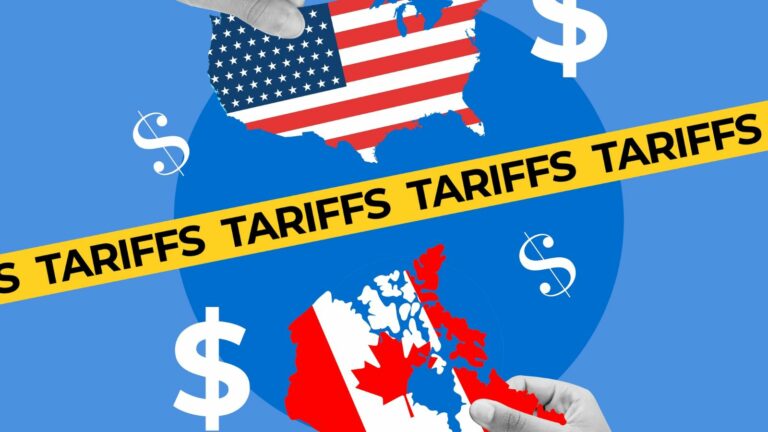
The Canada-U.S. trade dispute has repeatedly forced itself onto the campaign agenda. Washington imposed a 50% tariff on $27.6 billion worth of Canadian goods effective August 22, according to the federal government. Ottawa responded with counter-tariffs of 15%, 25% and 50% on $27.6 billion worth of U.S. imports beginning September 8, targeting products including steel, aluminum, appliances, agricultural equipment, dairy products, pulp and paper, and electronics. Quebec is particularly exposed because the United States remains by far its largest international customer.
Yet the Segma findings indicate that trade is not operating in isolation from domestic concerns. Thirty-eight per cent identified the cost of living as their leading issue and 25% pointed to access to health care, compared with 9% who selected the tariff war. That distinction helps explain why party responses have quickly expanded from trade retaliation into taxes, wages, government purchasing, energy, business regulation and household affordability. Quebec shipped $84.8 billion in merchandise to the United States in 2025, representing 69.8% of its international merchandise exports, although that share had declined from 73.3% in 2024.
Liberals Are Selling Diversification and Targeted Business Relief
Charles Milliard has positioned the Liberal response around reducing Quebec’s dependence on the American market while helping firms survive the immediate disruption. The PLQ has pledged to reduce by at least 15% the share of Quebec exports going to the United States during a first mandate by pursuing additional opportunities elsewhere in Canada, Europe and the Francophonie. The proposal is notable because official provincial statistics already show some diversification: exports to the United States fell 6.9% in 2025 while Quebec exports to destinations outside the U.S. increased.
For companies facing immediate tariff pressure, the Liberals have also proposed temporarily suspending Health Services Fund contributions for directly affected businesses, with relief varying according to exposure. Another Liberal proposal would convert 25% of assistance received by eligible small and medium-sized companies with annual revenue between $1 million and $2 million into non-repayable support. These remain campaign proposals rather than implemented programs, and their fiscal and economic effects would ultimately depend on their design and uptake. For a manufacturer dealing with lost American orders or more expensive imported inputs, however, the underlying Liberal pitch is straightforward: provide short-term liquidity while gradually finding customers outside the United States.
Conservatives Are Betting on Lower Taxes and Fewer Barriers
Éric Duhaime’s Conservatives have offered a substantially different economic prescription. Their anti-tariff plan includes progressively reducing Quebec’s general corporate income-tax rate from 11.5% to 4.7%. The PCQ says that would take the combined federal-provincial rate from 26.5% to 19.7%. It has also proposed cutting Quebec’s regulatory burden on businesses by 30% during a first mandate. Any claims about the number of jobs or amount of economic growth those policies would produce are projections made by the party rather than established outcomes.
The Conservatives have paired those tax and regulatory proposals with a call to reduce barriers to interprovincial commerce. Their plan would seek greater mutual recognition of goods, services and professional credentials across Canada while removing Quebec exceptions under the Canadian Free Trade Agreement. Duhaime has argued that Canadian markets become more important when American barriers increase. The PCQ has also advocated developing Quebec natural gas as part of its energy strategy. Taken together, the proposals reflect a competitiveness-focused response to tariffs: lower business costs, loosen regulatory constraints and make it easier for Quebec firms to sell elsewhere in Canada.
The CAQ Is Leaning on the Powers of Incumbency
Christine Fréchette occupies a different position because she is campaigning while serving as premier. When Canadian counter-tariffs were approaching implementation in early September, she temporarily stepped away from campaign activities to chair a cabinet meeting. The Quebec government subsequently moved to strengthen local purchasing rules, giving public buyers tools to restrict certain competitions to businesses with establishments in Quebec or elsewhere in Canada, require domestic production or processing in designated categories, and apply a preferential margin of up to 15% based on Quebec or Canadian value added.
The CAQ has also presented measures aimed at workers and industries facing economic transition, including additional training and diversification support for businesses affected by tariffs. That governing record forms part of Fréchette’s campaign argument, while opposition leaders have challenged both the adequacy of the measures and the overlap between her government and campaign roles. In the Segma poll, 23% chose Fréchette as the leader best suited to manage the economy during the tariff conflict, ahead of St-Pierre Plamondon at 19%. At the same time, 26% selected no leader or said they did not know, illustrating the absence of a dominant public verdict on economic crisis management.
The PQ Wants a More Targeted Trade Response
The leading Parti Québécois has criticized the structure of Ottawa’s counter-tariffs rather than arguing that Canada should simply avoid responding. Paul St-Pierre Plamondon has called for retaliation to be more tightly directed at finished American goods instead of inputs used by Quebec companies. His party argues that taxing necessary inputs can add costs for manufacturers already dealing with American tariffs. Ottawa, for its part, maintains a remission process that allows companies to request exceptional relief when affected goods cannot reasonably be sourced in Canada or from non-U.S. suppliers.
The PQ has coupled its tariff position with a broader business-tax proposal. It promises to reduce Quebec’s corporate income-tax rate from 11.5% to 9.5% over a mandate while scaling back its reliance on business subsidies, although the party says it would retain the ability to intervene when strategic Quebec companies face exceptional circumstances such as U.S. tariffs. The proposal is less aggressive than the PCQ’s planned reduction to 4.7%, illustrating a concrete policy difference between the two parties even when both use competitiveness and lower business costs as part of their economic message.
Age and Language Are Splitting the Electorate in Different Ways
One of the clearest findings in Segma’s results is a pronounced generational divide. Among voters aged 18 to 34, Québec solidaire registered 27%, the PQ 26% and the PCQ 23%. The CAQ, despite sitting second province-wide, ranked fifth among the five major parties within that younger group. Its position changes dramatically among older voters, where the governing party performs considerably better and leads among those aged 65 and over. Half of 18-to-34-year-olds also said their vote could still change before election day.
Language produces another divide relevant to the Liberal-Conservative tie. Among francophone respondents, the PQ stood at 34%, followed by the CAQ at 25%, PCQ at 17%, PLQ at 12% and QS at 11%. That puts the Conservatives ahead of the Liberals among francophones even though the Liberals remain one point ahead province-wide. The implication is not that either coalition is inherently stronger; rather, their support is distributed differently across Quebec’s electorate. Those differences can become especially consequential in a 127-seat contest because provincial vote shares do not translate mechanically into an equal share of seats.
The Final Two Weeks Remain Open
The 19%-18% result offers a snapshot of an electorate measured mainly between September 8 and 17, not a forecast of what Quebecers will do on October 5. The poll’s large sample provides useful evidence that the Liberals and Conservatives were essentially level province-wide during that period, but the 41% who remained open to changing their choice and the timing of interviews around campaign debates both limit how far the findings can reasonably be projected forward.
There are also several opportunities for voters to cast ballots before election day. Élections Québec has scheduled advance voting for September 27 and 28, with additional voting at returning officers’ offices on September 25 and 26 and from September 29 through October 1. The broader contest therefore moves quickly from campaigning into actual voting. What is firmly established as of September 21 is narrower but significant: the PQ remains first in this poll, the CAQ is second, and neither the Liberals nor Conservatives has a statistically clear advantage over the other. Meanwhile, the tariff confrontation remains an important economic backdrop even as affordability and health care rank higher among voters’ immediate concerns.
This Options Discord Chat is The Real Deal
While the internet is scoured with trading chat rooms, many of which even charge upwards of thousands of dollars to join, this smaller options trading discord chatroom is the real deal and actually providing valuable trade setups, education, and community without the noise and spam of the larger more expensive rooms. With a incredibly low-cost monthly fee, Options Trading Club (click here to see their reviews) requires an application to join ensuring that every member is dedicated and serious about taking their trading to the next level. If you are looking for a change in your trading strategies, then click here to apply for a membership.