35,000+ smart investors are already getting financial news, market signals, and macro shifts in the economy that could impact their money next with our FREE weekly newsletter. Get ahead of what the crowd finds out too late. Click Here to Subscribe for FREE.
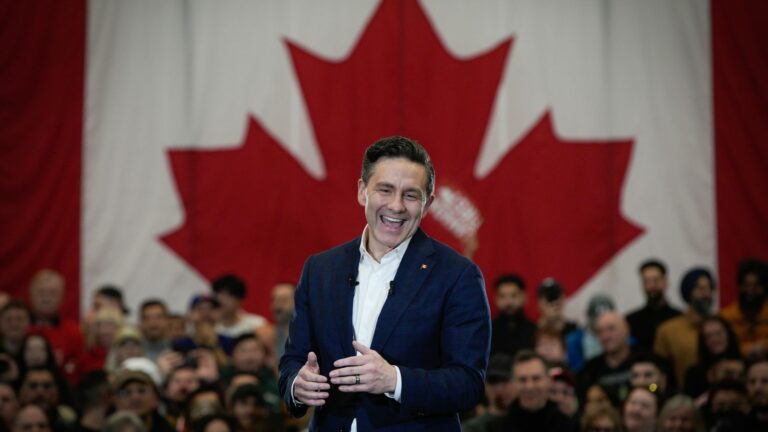
Pierre Poilievre used a gathering of Conservative MPs in Penticton, British Columbia, to make a two-track argument for the fall political season: Conservatives should back Canada when the country faces pressure from abroad while aggressively challenging the government over economic conditions at home. His declaration that the party’s duty is “country before party” came as Canada confronts an escalating tariff dispute with the United States and households continue to wrestle with elevated prices.
The message offered a revealing preview of how the Official Opposition intends to navigate an unusual political environment. Poilievre presented cooperation on tariff relief as compatible with sharp criticism of Prime Minister Mark Carney on affordability, housing, spending and economic policy. With Parliament preparing to resume, the Conservatives are trying to keep household finances at the centre of their domestic pitch without appearing divided when Canada faces pressure from Washington.
“Country Before Party” Reframes the Opposition’s Role
Poilievre Tells Tories ‘Country Before Party’ as Affordability and U.S. Tariffs Drive Caucus Pitch
- “Country Before Party” Reframes the Opposition’s Role
- Affordability Returns to the Centre of the Conservative Message
- U.S. Tariffs Turn the Pitch Into an Economic-Sovereignty Argument
- Poilievre Has Taken His Free-Trade Argument Directly to Americans
- The Latest Economic Numbers Are More Mixed Than the Political Rhetoric
- Housing Gives the Affordability Message a Human Face
- Forestry and Small Business Show the Regional Stakes
- Conservatives Pair Tax Relief With a Major Spending-Cut Claim
- The Fall Strategy Is Cooperation Abroad and Confrontation at Home
Poilievre opened the central political argument of his caucus address by saying Conservatives had an obligation to put the national interest ahead of partisan advantage. He described the party as a “Loyal Opposition” that should support the government when it believes Ottawa is acting correctly and oppose it when it disagrees. The distinction matters during the current Canada-U.S. confrontation. Rather than arguing that every federal move should be resisted, Poilievre portrayed opposition as having two responsibilities at once: defending Canadian interests abroad and scrutinizing federal decisions at home. That framing also allowed him to connect patriotism with political criticism, arguing that challenging policies affecting household finances is not inconsistent with presenting a united Canadian front internationally.
The formulation was especially notable because Poilievre explicitly connected it to President Donald Trump’s tariffs and rhetoric toward Canada. He told MPs that Canadians want their government to succeed when confronting what he called unfair U.S. tariffs and provocations. At the same time, he argued that international tensions should not push domestic concerns such as grocery bills, mortgages, rents and jobs out of political debate. The result was a deliberately balanced caucus message: Conservatives would not treat disagreement with the Liberal government as disagreement with Canada, but neither would the trade fight provide Ottawa with insulation from opposition scrutiny. Canadian Press reporting from the retreat similarly characterized the speech as an appeal for Conservatives to put the national interest first while speaking for financially strained Canadians.
Affordability Returns to the Centre of the Conservative Message
Poilievre repeatedly brought the speech back to household finances, depicting affordability as the Conservatives’ top priority when MPs return to Ottawa. Recent inflation figures help explain why the issue remains politically potent, although the data are more nuanced than partisan descriptions suggest. Statistics Canada reported that consumer prices were 3.0% higher in August 2026 than a year earlier, unchanged from July’s annual pace. Food purchased from stores was up 2.8%, while shelter costs increased 1.5%. Transportation prices were up a much larger 7.5%, driven partly by gasoline, which was 22.8% more expensive than in August 2025.
Those figures put headline inflation at the upper boundary of the Bank of Canada’s 1% to 3% control range and above its 2% midpoint target. That gives Conservatives an opening to emphasize the continued strain caused by prices, particularly because lower inflation does not mean earlier price increases have been reversed. Yet the picture is not one of uniformly accelerating costs. Inflation excluding gasoline was 2.4% in August, and the Bank’s preferred core measures have been much closer to its target. The Bank has said it expects inflation to move gradually toward 2%, while warning that energy prices, global disruptions and U.S. trade policy continue to create uncertainty. Poilievre’s caucus pitch therefore rests on a real affordability pressure point, but one occurring within a mixed inflation environment rather than a broad-based price surge across every category.
U.S. Tariffs Turn the Pitch Into an Economic-Sovereignty Argument
The trade confrontation gives Poilievre’s economic message a second dimension. The Trump administration has used Section 338 of the U.S. Tariff Act to impose additional duties of as much as 50% on specified Canadian products, with measures targeting areas that include vehicles, dairy and alcoholic beverages. Duties that had briefly been suspended took effect on August 22. Washington has also announced additional restrictions affecting certain Canadian products, including import bans scheduled to take effect September 29 in specified categories. The U.S. administration says its measures respond to Canadian practices it regards as discriminatory; Ottawa disputes the broader U.S. approach and has answered with countermeasures of its own.
Canada’s Department of Finance says the latest U.S. measures applied 50% tariffs to C$27.6 billion worth of Canadian goods. Ottawa responded with counter-tariffs covering the same value of U.S. imports, applying rates of 15%, 25% or 50% depending on the product. The Canadian measures took effect September 8 and include goods in sectors such as steel and aluminum, agricultural equipment, appliances, pulp and paper, plastics and electronics. Against that backdrop, Poilievre argued that Canada should respond not only through trade negotiations but by making domestic businesses more competitive. His proposition was essentially that tariff pressure should trigger lower Canadian costs, faster approvals and more domestic investment. Whether individual Conservative measures would achieve those outcomes is a policy question separate from the documented existence and scale of the tariff dispute.
Poilievre Has Taken His Free-Trade Argument Directly to Americans
The Penticton remarks did not emerge in isolation. Days earlier, Poilievre travelled to New York as part of an effort to make the Canadian case directly to American audiences. His office said the trip was focused on pushing for tariff-free Canada-U.S. trade, and he appeared on American business television while meeting representatives from the investment and business communities. In a CNBC appearance reported by Canadian Press, Poilievre argued that a stronger North American economic relationship could help both countries respond to strategic competitors elsewhere in the world. He also acknowledged that Canada is already pursuing broader international trade relationships.
That trip helps explain one of the more unusual passages in his caucus address. Poilievre said American interviewers appeared surprised that he declined to attack his Canadian political opponents while appearing in the United States. Back in British Columbia, however, he made clear that the restraint would not extend to domestic political debate. The approach provides the Conservatives with a way to advocate a common Canadian position abroad while retaining a conventional opposition role in Ottawa. Poilievre has also argued in U.S. interviews that trade with Canada can help lower American costs by giving the United States access to Canadian energy and minerals. That is his economic case to Washington rather than an independently established outcome, but it demonstrates how closely his tariff strategy is being tied to affordability on both sides of the border.
The Latest Economic Numbers Are More Mixed Than the Political Rhetoric
Poilievre told Conservatives that the economy was “flat” and that Canadians were losing jobs. The employment concern has support in the latest labour data: Statistics Canada reported that employment declined by 42,000 positions in August, while the unemployment rate remained at 6.4%. Roughly 1.5 million Canadians were unemployed, and 24% of them had been searching for work continuously for at least 27 weeks. Employment fell in natural resources, utilities, public administration and business-support services. However, manufacturing moved in the opposite direction, adding approximately 22,000 jobs during the month.
The description of the overall economy as flat is more political shorthand than a literal description of the most recent national-accounts figures. Statistics Canada reported that real GDP increased 0.8% in the second quarter of 2026 after first-quarter growth was revised to 0.1%. The second-quarter expansion was supported by exports, household spending and business capital investment. That does not eliminate concerns about weak sectors, job losses or per-capita economic pressure, but it illustrates why economic claims in a caucus speech need to be separated from the underlying statistics. The Bank of Canada has likewise described the economy as recovering while emphasizing substantial uncertainty around trade policy and global conditions. For the Conservatives, the political challenge will be translating uneven economic performance into an affordability argument without overstating what the headline growth numbers actually show.
Housing Gives the Affordability Message a Human Face
Housing featured heavily in Poilievre’s attempt to move the discussion from national statistics to individual experience. He recounted meeting a young articling student in the Lower Mainland who described buying a home and starting a family as a “pipe dream.” The anecdote cannot establish the condition of the housing market by itself, but the latest construction figures show why housing supply remains a significant policy concern. CMHC reported that the six-month trend in housing starts fell 1.3% in August to an annualized 244,149 units. Actual starts in population centres of at least 10,000 people were down 2% compared with August 2025.
Year-to-date starts in those centres stood at 149,542 units, 4% lower than during the equivalent period of 2025, while completions dropped 11.2% from July. Poilievre used housing to argue for removing taxes from new construction, releasing land and pushing municipalities to issue permits more rapidly. Those are Conservative proposals, not implemented federal policy, and the effect would depend on details including which taxes were removed, how provincial and municipal governments responded and whether labour, financing and infrastructure constraints eased alongside regulatory changes. Politically, though, housing allows the party to link several themes from the speech—affordability, younger Canadians’ expectations, taxes and government approvals—into one highly visible issue. A potential homeowner does not experience the housing shortage as an abstract national ratio; it appears in the monthly payment attached to an ordinary listing.
Forestry and Small Business Show the Regional Stakes
Holding the caucus retreat in British Columbia gave Poilievre a local example of the economic insecurity he wanted MPs to carry back to Ottawa. He spoke about loggers, mill communities and small businesses, portraying forestry losses as evidence of the human consequences behind economic statistics. The precise causes of British Columbia’s forestry contraction are contested politically, but the contraction itself is well documented. The BC Council of Forest Industries said in August that at least 21 lumber mills had closed permanently or indefinitely since 2023, four pulp mills had closed or curtailed operations during the preceding nine months, and more than 15,000 forestry jobs had been lost since 2022.
Trade pressure is only one factor. Industry and government accounts also point to weak global markets, declining or costly wood supply, fibre constraints and operating costs. Canfor’s planned closure of the Northwood pulp mill in Prince George, for example, was expected to affect roughly 300 employees, while the company cited market conditions and difficulty securing economically viable fibre. Similar combinations of soft demand, timber constraints and U.S. trade measures have affected other facilities. That broader context matters because it prevents the current tariff fight from becoming a catch-all explanation for problems that began earlier. Poilievre nevertheless used these communities effectively as the practical backdrop to his caucus message: a 50% duty or a mill closure is not simply a trade statistic when contractors, families and surrounding businesses depend on the same industrial base.
Conservatives Pair Tax Relief With a Major Spending-Cut Claim
The domestic policy portion of Poilievre’s address included several concrete promises. He said Conservatives want to remove GST from Canadian-made vehicles, eliminate taxes they say raise housing-construction costs, reduce fuel-related taxes and make permitting faster. He also proposed eliminating capital-gains tax in certain circumstances when money is reinvested in Canada. The objective, according to his speech, is to respond to U.S. tariffs by lowering the cost of doing business domestically rather than matching American protectionism solely with higher Canadian barriers. These remain opposition proposals and would require legislation, detailed eligibility rules and fiscal costing before their full budgetary effects could be assessed.
The largest headline number was Poilievre’s statement that the Conservative team had identified $150 billion in potential federal savings from areas including bureaucracy, consulting, foreign aid and corporate support. The speech did not provide an independently audited line-by-line costing establishing that total, so it should be treated as a Conservative estimate rather than a verified saving. For comparison, the federal government’s Spring Economic Update projected a $65.3-billion deficit for 2026-27 and a federal debt-to-GDP ratio of 41.5%. Finance Canada’s latest available Fiscal Monitor showed a $0.4-billion deficit for the first three months of the fiscal year, compared with $6.3 billion during the same period a year earlier. Those official numbers provide useful scale, but they do not independently validate the Conservatives’ proposed $150-billion reduction.
The Fall Strategy Is Cooperation Abroad and Confrontation at Home
The political logic running through the Penticton speech is that the Conservatives do not want Trump’s trade confrontation to erase the issues on which they have built their domestic message. Poilievre offered cooperation with the government when Canadian interests are challenged from abroad but simultaneously laid out an opposition agenda focused on household costs, jobs, housing, immigration, public safety, taxes and economic development. He also emphasized Canadian sovereignty in relationships beyond the United States, saying major decisions should be made in Canada while supporting trade and cooperation with European allies. His caucus remarks drew a distinction between deeper trade and defence cooperation with Europe and arrangements that Conservatives believe could transfer taxation, legal or immigration authority.
That positioning is likely to shape the Conservatives’ return to parliamentary debate. The House of Commons calendar has regular sittings scheduled beginning September 21, giving MPs an immediate forum to test the strategy. The challenge is built into Poilievre’s own formulation: an opposition promising to put “country before party” must demonstrate where bipartisan cooperation ends and legitimate political disagreement begins. Tariffs give the Conservatives a reason to present national unity abroad; affordability gives them a reason to resume partisan combat at home. The Penticton speech attempted to make those positions complementary rather than contradictory. Whether the distinction resonates politically cannot be established from the speech itself, but it offers a clear map of the issues Conservative MPs have been told to emphasize as the fall sitting begins.
This Options Discord Chat is The Real Deal
While the internet is scoured with trading chat rooms, many of which even charge upwards of thousands of dollars to join, this smaller options trading discord chatroom is the real deal and actually providing valuable trade setups, education, and community without the noise and spam of the larger more expensive rooms. With a incredibly low-cost monthly fee, Options Trading Club (click here to see their reviews) requires an application to join ensuring that every member is dedicated and serious about taking their trading to the next level. If you are looking for a change in your trading strategies, then click here to apply for a membership.