35,000+ smart investors are already getting financial news, market signals, and macro shifts in the economy that could impact their money next with our FREE weekly newsletter. Get ahead of what the crowd finds out too late. Click Here to Subscribe for FREE.
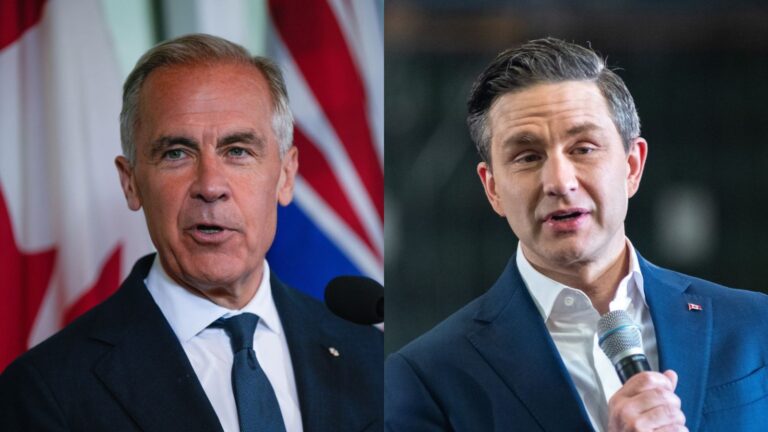
Canada’s growing trade confrontation with the United States is becoming a central issue in the battle over Ottawa’s next federal budget. Conservative Leader Pierre Poilievre is pressing Prime Minister Mark Carney to deliver a trade agreement with President Donald Trump while demanding additional diesel tax relief and tighter government spending.
The demands come just days before Finance Minister François-Philippe Champagne is scheduled to present the federal budget on November 5, 2026. Meanwhile, Carney and Trump have signalled renewed progress toward a possible agreement, although significant details remain unresolved.
With diesel prices squeezing farmers and trucking companies, American tariffs threatening Canadian industries, and federal borrowing under scrutiny, the government faces difficult decisions about affordability, economic growth, and Canada’s financial future.
Poilievre Puts Carney Under Pressure Ahead of November 5 Budget
Poilievre Tells Carney to Deliver Trump Trade Deal as He Demands Diesel Tax Relief Before Federal Budget
- Poilievre Puts Carney Under Pressure Ahead of November 5 Budget
- Conservatives Want Diesel Taxes Suspended Until Canada Day 2027
- Rising Diesel Prices Are Squeezing Farmers, Truckers, and Grocery Supply Chains
- Poilievre Wants More Canadian Diesel Production and Fewer Fuel Regulations
- Trump and Carney Signal Progress, but a Trade Agreement Remains Unfinished
- American Tariffs Continue to Threaten Canada’s Economic Outlook
- Federal Deficit Projections Add Another Challenge to Poilievre’s Tax Demands
- November 5 Budget Will Test Two Competing Plans for Canada’s Economy
Poilievre intensified his criticism of the Liberal government on November 1, outlining several demands that he believes should shape the upcoming federal budget. In a letter to Carney, the Conservative leader called for additional fuel tax reductions, tighter spending controls, and greater accountability over Ottawa’s fiscal commitments. His message was that the government needed to deliver measurable economic improvements rather than rely on promises about future prosperity. Speaking at a Sunday news conference, Poilievre argued that excessive government spending was contributing to affordability pressures and increasing the financial burden on Canadians. His intervention came as the government was preparing a budget intended to strengthen Canada’s economic independence and respond to growing uncertainty surrounding international trade.
The Conservative leader also linked Ottawa’s domestic economic decisions to its difficulties negotiating with Washington. Poilievre has repeatedly criticized Carney’s inability to secure lasting relief from American tariffs, particularly those affecting Canadian manufacturing and resource industries. On November 1, he urged the prime minister to turn negotiations into tangible results, arguing that Canadian workers and businesses could not afford indefinite uncertainty. The timing is politically significant. Carney’s government has portrayed the upcoming budget as an opportunity to strengthen investment, infrastructure, and economic resilience. Poilievre, however, is attempting to establish a different measure of success: whether Canadians see lower costs, whether the government controls borrowing, and whether businesses receive meaningful relief from Trump’s trade measures.
Conservatives Want Diesel Taxes Suspended Until Canada Day 2027
One of Poilievre’s most prominent demands involves extending federal diesel tax relief until at least July 1, 2027. His proposal would eliminate federal sales taxes on diesel during that period, including the GST, while keeping the federal fuel excise tax suspended for longer than currently scheduled. There is an important distinction between his proposal and existing government policy. Ottawa already suspended the federal diesel excise tax on April 20, 2026, temporarily removing its regular four-cent-per-litre charge. Parliament subsequently approved legislation extending that suspension through January 31, 2027. Under the existing schedule, the excise tax will return at two cents per litre in February and March before increasing to its regular four-cent rate on April 1, 2027.
Poilievre wants the full suspension extended through Canada Day while also removing the federal GST on fuel purchases until the summer. That would go beyond the relief Ottawa has already enacted. However, the financial benefit would not be identical for every fuel purchaser. Businesses registered for GST/HST can generally recover eligible sales taxes paid on commercial purchases, including fuel, through input tax credits. Removing those taxes could therefore affect businesses differently depending on their tax arrangements and eligibility. Provincial fuel taxes would also remain unless provincial governments independently changed their policies. The disagreement is consequently about the duration and scope of federal relief, rather than whether Ottawa has provided any relief at all. It also raises questions about how much additional revenue the government would forgo.
Rising Diesel Prices Are Squeezing Farmers, Truckers, and Grocery Supply Chains
Diesel costs have become particularly important because the fuel supports much of Canada’s agricultural production and goods transportation. According to a September analysis reported by agricultural publication AgCanada, Grain Growers of Canada calculated that operating a single large combine during harvest could cost approximately $15,120 more in diesel in 2026 than in 2025. The calculation assumed a machine consuming 70 litres per hour over eight hours a day for 30 days, with bulk diesel rising from $1.10 to $2 per litre. Although this was an illustrative calculation rather than an average for every farm, it demonstrates how quickly higher fuel costs can affect agricultural operations. Farms operating multiple combines, tractors, grain carts, and transport vehicles can face substantially greater exposure.
The pressure extends well beyond farming. The Canada Truck Operators Association reported that Canada’s volume-weighted average retail diesel price reached approximately $2.49 per litre on September 10, 2026. Kalibrate Canada subsequently reported a national retail diesel price of 260.7 cents per litre at the end of September. Higher prices are particularly difficult for smaller trucking businesses because fuel expenses rise immediately, while freight contracts and fuel surcharges may take longer to adjust. Farm Credit Canada’s October economic analysis also found that fuel surcharges had climbed to nearly 45% of base trucking freight charges in the data it examined. These pressures can eventually affect grocery prices, although the extent and timing depend on transportation contracts, competition, and how much of the additional cost businesses absorb.
Poilievre Wants More Canadian Diesel Production and Fewer Fuel Regulations
Poilievre’s diesel proposal extends beyond temporary tax reductions. In September, the Conservatives introduced an Emergency Fuel Relief Plan that called for expanding Canadian refining capacity, improving domestic fuel transportation, and reducing reliance on imported refined products. The party proposed increasing Canadian diesel and other refined-fuel production to one million barrels per day within five years. Its proposals included faster approvals for refineries and fuel infrastructure, accelerated tax deductions for new investment, and strategic reserves of gasoline and diesel. Poilievre also called for eliminating federal industrial carbon pricing and the Clean Fuel Regulations, arguing that these policies increase production costs and discourage refinery investment. These are Conservative policy objectives rather than measures approved by the federal government.
The proposals reveal a fundamental disagreement over energy policy. Canada’s consumer-facing federal carbon charge ended in April 2025, but industrial carbon pricing and the Clean Fuel Regulations are separate mechanisms. The Clean Fuel Regulations require gasoline and diesel suppliers to reduce the carbon intensity of their products through cleaner production methods, lower-emission fuels, or compliance credits. Unlike an excise tax, the system does not impose a fixed per-litre federal sales tax. On October 27, Ottawa proposed amendments intended to support Canadian low-carbon fuel producers and make compliance more flexible. The government argues that the regulations encourage investment and emissions reductions, while Conservatives maintain that eliminating them would improve affordability and refining competitiveness. The economic and environmental consequences of either approach remain central to the debate.
Trump and Carney Signal Progress, but a Trade Agreement Remains Unfinished
The pressure surrounding the federal budget intensified after Carney and Trump held another conversation about Canada–U.S. trade on October 31. Carney publicly described the exchange on November 1 as constructive and said negotiating teams would continue working toward an agreement over the coming weeks. The prime minister characterized the intended outcome as one that would create employment opportunities, improve household affordability, and protect Canada’s languages, culture, and sovereignty. Trump also offered an optimistic assessment, telling reporters that the countries had developed the concept of a potentially beneficial agreement. He discussed American agricultural interests and the possibility of reviving the Keystone XL pipeline. However, no completed agreement or binding set of trade concessions was announced.
Recent negotiations have focused heavily on tariffs affecting Canadian steel and automobiles. Reuters reported on October 26 that officials from both countries were discussing potential relief from American duties, including tariffs of up to 50% on Canadian steel and 25% on automobiles. Canada’s Dominic LeBlanc and U.S. Commerce Secretary Howard Lutnick were among the officials involved in those discussions. The renewed engagement represents a change from August, when Canada suspended negotiations after rejecting American proposals that Carney characterized as economically unacceptable and harmful to Canadian interests. Poilievre argues that Ottawa must deliver an agreement capable of protecting jobs and reducing uncertainty. Carney’s challenge is to secure meaningful tariff relief without accepting concessions that his government considers damaging to Canadian sovereignty or major industries.
American Tariffs Continue to Threaten Canada’s Economic Outlook
The economic consequences of the trade confrontation are becoming clearer in official Canadian forecasts. The Bank of Canada’s October 28 Monetary Policy Report estimated that the average American tariff rate on Canadian goods had increased to 7.5%, compared with 5% in July. Although approximately 80% of Canadian merchandise exports to the United States remained tariff-free, the restrictions affecting particular industries were substantially more severe. The central bank identified new American tariffs of 50% on several categories of Canadian goods, including machinery, plastics, furniture, and certain wood and paper products. Canada also responded with counter-tariffs on approximately $28 billion in American goods. These measures create additional costs for businesses operating across the border and complicate decisions about production, investment, and employment.
The trade relationship remains essential despite Canada’s efforts to diversify exports. Statistics Canada reported that merchandise exports to the United States increased 8.1% in August, although it warned that companies may have accelerated shipments before new tariffs took effect. The agency also reported that destinations outside the United States accounted for 30.2% of Canadian merchandise exports that month. The Parliamentary Budget Officer has estimated that trade measures introduced since early 2025, if maintained permanently, could reduce Canada’s real economic output by approximately 1.4% over the medium term compared with a scenario without those measures. For manufacturers, the uncertainty is particularly difficult because investment decisions often involve factories, equipment, and supply agreements that must remain commercially viable for years. A stable agreement could therefore matter well beyond the immediate impact of tariff reductions.
Federal Deficit Projections Add Another Challenge to Poilievre’s Tax Demands
Poilievre’s calls for tax relief are arriving alongside increasingly difficult questions about federal borrowing. In its October 20 economic and fiscal outlook, the Parliamentary Budget Office projected a $63.3-billion federal deficit for 2026–27, followed by a $70.2-billion deficit in 2027–28. It also forecast that the federal debt-to-GDP ratio would rise from 40.8% in 2026–27 to 42.6% by 2030–31. These are projections based on policies and economic conditions included in the watchdog’s October assessment, not final budget results. Poilievre has used the figures to argue that Ottawa needs to reduce spending more aggressively. His recommendations include cutting bureaucracy, reducing spending he considers unnecessary, and cancelling the proposed Alto high-speed rail project connecting Toronto and Quebec City.
The fiscal discussion requires distinguishing borrowing from annual budget deficits. The Parliamentary Budget Office projects approximately $732.9 billion in additional federal borrowing over five years, but its cumulative deficit forecast for that period is approximately $333.3 billion. The difference largely reflects borrowing to finance loans, financial assets, and other transactions that do not count as ordinary budget expenses. The watchdog also expects the government to achieve its objective of balancing day-to-day operating spending with revenue in 2028–29, while failing to maintain a consistently declining deficit-to-GDP ratio under its existing projections. Additional fuel tax relief would reduce federal revenue unless offset elsewhere. That creates a difficult balance between helping households and businesses manage immediate costs and preventing longer-term fiscal pressures from becoming more severe.
November 5 Budget Will Test Two Competing Plans for Canada’s Economy
Finance Minister François-Philippe Champagne is expected to present the government’s economic priorities when the federal budget is tabled on November 5. Ottawa has indicated that the document will focus on attracting investment, strengthening economic security, moving major infrastructure projects forward, and making everyday life more affordable. The government can also point to measures already implemented, including the extended fuel excise tax suspension. Finance Canada estimates that the fuel tax relief measures will provide approximately $5.3 billion in savings during the 2026–27 fiscal year. The Conservatives are demanding a different combination of policies, emphasizing additional fuel tax cuts, reduced regulatory costs, lower federal spending, and stronger results in negotiations with Washington. Both approaches claim to support affordability, but they prioritize different economic tools.
Several questions will determine how the budget is received. Will Ottawa extend diesel excise relief beyond March 2027 or consider suspending the GST on fuel? Will spending plans produce a credible path toward meeting the government’s fiscal commitments? And will new investments help Canadian businesses respond to American tariffs without creating unsustainable costs? The separate trade negotiations with Trump remain another major test, particularly for workers in industries exposed to American import restrictions. For farmers filling expensive diesel tanks, trucking operators managing rising freight costs, and manufacturers uncertain about future orders, the immediate concern is whether government decisions will improve economic conditions. The November 5 budget will provide important answers about Ottawa’s domestic strategy, even as the outcome of negotiations with Washington remains unresolved.
This Options Discord Chat is The Real Deal
While the internet is scoured with trading chat rooms, many of which even charge upwards of thousands of dollars to join, this smaller options trading discord chatroom is the real deal and actually providing valuable trade setups, education, and community without the noise and spam of the larger more expensive rooms. With a incredibly low-cost monthly fee, Options Trading Club (click here to see their reviews) requires an application to join ensuring that every member is dedicated and serious about taking their trading to the next level. If you are looking for a change in your trading strategies, then click here to apply for a membership.