35,000+ smart investors are already getting financial news, market signals, and macro shifts in the economy that could impact their money next with our FREE weekly newsletter. Get ahead of what the crowd finds out too late. Click Here to Subscribe for FREE.
Canada’s economic warning lights are flashing at a politically dangerous moment. Fresh GDP figures have pushed the country into recession territory by a benchmark some economists use, giving Conservative Leader Pierre Poilievre a new opening to blame Prime Minister Mark Carney for a slowing economy, strained households, and weakening business confidence. The numbers are not simple: Statistics Canada reported flat quarterly growth in the first quarter, while annualized figures showed a slight contraction after a sharper decline late last year. That distinction matters. Still, for families watching grocery bills, mortgage renewals, and job prospects, the debate over definitions may feel less important than the pressure building around them.
Recession Territory Gives Ottawa a Political Shock
Poilievre Blames Carney as Canada Falls Into Recession Territory
- Recession Territory Gives Ottawa a Political Shock
- Poilievre Turns the GDP Report Into a Blame Game
- What the GDP Numbers Actually Showed
- Tariffs Hit Canada Where It Is Most Exposed
- Business Investment Is the Deeper Warning Sign
- Households Kept Spending, But the Cushion Got Thinner
- The Job Market Adds Another Layer of Pressure
- Inflation Limits the Easy Fix
- Mortgage Stress and Food Bank Demand Make the Downturn Feel Real
- Carney’s Defence Will Likely Centre on Global Shocks
- The Real Fight Is Over Who Owns the Economy Now
The phrase “recession territory” is powerful because it turns a complicated GDP report into something voters immediately understand: the economy is no longer clearly moving forward. Reuters reported that Canada’s first-quarter GDP declined at a 0.1% annualized rate after a 1% annualized contraction in the fourth quarter of 2025, creating two straight quarters of annualized decline. Statistics Canada’s own quarterly measure was less dramatic, showing real GDP unchanged in the first quarter after a 0.2% decline in the previous quarter.
That nuance gives both sides room to argue. Poilievre can point to two weak quarters and say the economy has tipped into a technical recession. Carney’s defenders can argue the official picture is closer to stagnation than collapse, especially with an early estimate showing a possible April rebound. But politics often moves faster than economic definitions. Once the word “recession” enters the national conversation, it shapes how people interpret everything else: hiring freezes, delayed purchases, rent pressure, and conversations around the kitchen table.
Poilievre Turns the GDP Report Into a Blame Game
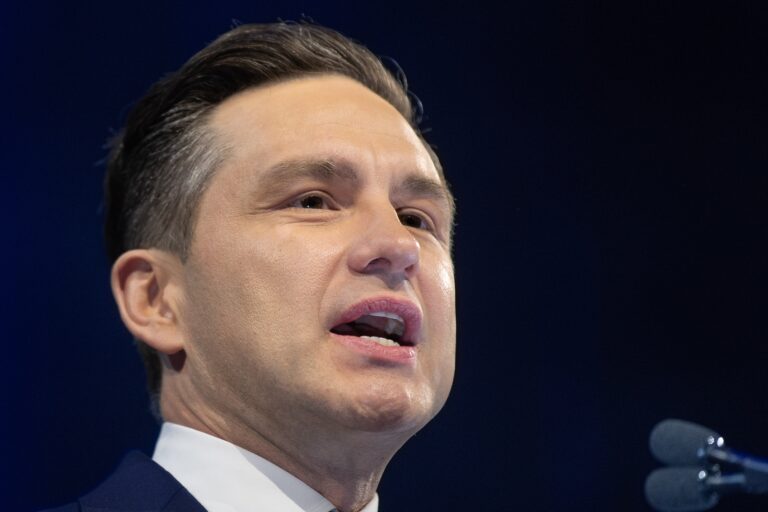
Poilievre’s response was direct: he blamed Carney’s policies for Canada slipping into recession territory. The Conservative leader tied the GDP figures to broader affordability concerns, arguing that the weakness is not merely technical when Canadians are dealing with rising mortgage delinquency, heavier food bank use, and falling business investment. That framing is designed to make the economic release feel personal, not abstract.
The political strategy is clear. GDP numbers can sound distant, but missed mortgage payments and food bank lineups do not. By connecting the recession debate to everyday pressure points, Poilievre is trying to make Carney own the downturn before the government can define it as a global trade shock. The risk for Carney is that voters may not separate inherited economic weakness from current leadership. When a government is in power during bad data, opposition parties rarely wait for a clean causal chain before assigning blame.
What the GDP Numbers Actually Showed
Statistics Canada’s report did not show an economy in free fall. It showed an economy stuck. Real GDP was unchanged in the first quarter, with higher imports offset by business inventory accumulation. Final domestic demand edged lower, which is often the more worrying part because it reflects underlying spending by households, businesses, and governments. Exports slipped slightly, and imports rose sharply, particularly because of gold-related trade flows.
The details matter because they reveal a mixed economy rather than a uniform collapse. Household spending rose 0.4%, helped by spending on financial services and food. Corporate incomes increased, boosted by the energy sector as global oil prices rose. But the positives were not strong enough to overcome weaker capital investment and trade pressure. For readers trying to understand the headline, the simplest explanation is this: Canada did not suddenly crash, but it lost momentum in enough key places to make the recession argument politically credible.
Tariffs Hit Canada Where It Is Most Exposed
Trade is one of the biggest reasons the downturn is difficult to pin entirely on domestic policy. Statistics Canada said exports edged down in the first quarter, led by fewer exports of passenger cars and light trucks affected by U.S. tariffs. That matters because autos are not just another export category. They are tied to factories, parts suppliers, transport networks, and thousands of middle-class jobs across Ontario and beyond.
The Bank of Canada has also warned that tariffs and trade uncertainty are weighing on exports and business investment. This gives Carney a potential defence: Canada is being hit by external shocks, including U.S. trade policy and global energy disruption. But Poilievre’s counterargument is that strong leadership should reduce vulnerability and restore confidence. The tariff story may explain part of the weakness, but it does not automatically absolve Ottawa. Voters tend to judge governments by whether they can shield the country from shocks, not simply whether the shocks began elsewhere.
Business Investment Is the Deeper Warning Sign
One of the most politically damaging parts of the GDP report is the decline in business capital investment. Statistics Canada said business capital investment fell 0.7% in the first quarter, marking the fifth consecutive quarterly decline. That is the kind of number economists watch closely because investment today often determines productivity, hiring, and wage growth tomorrow.
For a small manufacturer, a weak investment climate might mean delaying a new machine. For a construction firm, it could mean holding back on equipment. For a tech company, it could mean slowing hiring or waiting before expanding into another city. Those decisions rarely make national headlines one by one, but collectively they can weigh down the economy for years. This is where Poilievre’s attack may resonate most with business-minded voters. A country can survive a bad quarter. A long investment slump is more worrying because it suggests companies are unsure Canada is the right place to expand.
Households Kept Spending, But the Cushion Got Thinner
Canadian households helped keep the economy from looking worse. Statistics Canada reported that household spending rose in the first quarter, led by financial services and food. That sounds encouraging at first glance. But the same report also showed the household saving rate fell to 3.5%, its lowest level in two years. In plain terms, households were still spending, but they had less room to absorb more pressure.
That is a fragile kind of resilience. A family may still buy groceries, pay for insurance, and keep up with basic bills, but that does not mean it feels secure. Spending on food can rise because prices are higher, not because households feel wealthier. Financial-service spending can increase in a stressful environment. The consumer has not disappeared, but the buffer is shrinking. That gives the recession debate more emotional force because many Canadians already feel they have been stretching every paycheque for years.
The Job Market Adds Another Layer of Pressure
The labour market is not collapsing, but it is soft enough to deepen concern. Statistics Canada reported that Canada’s unemployment rate rose to 6.9% in April, up 0.2 percentage points from March. Youth unemployment reached 14.3%, well above the pre-pandemic average cited by the agency. Long-term unemployment also remained higher than its pre-pandemic norm, showing that some job seekers are having a harder time getting back into work.
Those numbers matter because recessions are not only about output. They are about confidence. A worker who sees fewer postings, a student struggling to land summer work, or a parent worried about layoffs may pull back on spending even before losing income. This is where “technical recession” becomes a real-world story. If GDP is weak but jobs are strong, the public may shrug. If GDP is weak and hiring feels uncertain, the political consequences grow quickly.
Inflation Limits the Easy Fix
In a normal slowdown, voters often expect interest-rate relief. But inflation complicates that path. Statistics Canada reported that CPI inflation rose to 2.8% in April, up from 2.4% in March, with energy and gasoline prices driving much of the acceleration. The Bank of Canada held its policy rate at 2.25% in April and said it was watching the impact of the Middle East conflict, U.S. tariffs, and energy prices.
That leaves policymakers in a tight spot. If rates are cut too aggressively while energy-driven inflation is rising, the Bank risks letting price pressure broaden. If rates stay higher for longer, households and businesses face more strain. Carney’s government may prefer to talk about stability, but stability can sound unsatisfying to people renewing mortgages or running small businesses. Poilievre’s argument gains power when there is no obvious quick fix. The economy is weak enough to worry about growth, but inflation is still present enough to limit easy relief.
Mortgage Stress and Food Bank Demand Make the Downturn Feel Real
Poilievre’s strongest political ground may be the evidence of household strain outside the GDP tables. CMHC reported that national 90-plus-day mortgage delinquencies increased in 2025, with the rise concentrated in Ontario, especially Toronto. The national rate remained low by historical standards, but CMHC also said borrower stress is increasing because of softer labour-market conditions and exposure to higher interest rates. That is a careful institutional way of saying more households are under pressure.
Food bank data adds another layer. Food Banks Canada reported nearly 2.2 million food bank visits in March 2025, the highest level in its history, and said usage had doubled since March 2019. Those numbers make the recession debate more than a fight over GDP methodology. A country can have positive pockets of growth while many people still feel poorer. That tension is politically explosive because it allows Poilievre to argue that official reassurance is disconnected from daily life.
Carney’s Defence Will Likely Centre on Global Shocks
Carney’s best defence is that Canada is being hit by a cluster of external shocks: U.S. tariffs, energy volatility, trade uncertainty, and the delayed effects of higher interest rates. The Bank of Canada’s April statement supports part of that argument, noting that tariffs and trade uncertainty are weighing on exports and investment while energy prices are lifting inflation. Statistics Canada’s GDP report also pointed directly to tariff-affected passenger car and light truck exports.
But that defence has limits. Voters may accept that external shocks are real and still conclude that the government’s job is to manage them better. The longer business investment falls and household stress rises, the harder it becomes to rely on global explanations. Carney’s challenge is to show a credible growth plan that feels immediate without looking reckless. Poilievre’s challenge is to prove that his criticism is more than a political slogan. The recession-territory debate is now a test of economic credibility for both leaders.
The Real Fight Is Over Who Owns the Economy Now
Economic downturns are rarely caused by one person or one policy. Canada’s current weakness appears to be the result of trade disruption, cautious investment, household strain, energy-price pressure, and soft labour-market conditions. Still, politics is not an economics seminar. The leader in power usually wears the numbers, while the opposition turns them into a story about competence.
That is why this GDP report matters beyond the decimal points. If April’s rebound holds and investment begins to recover, Carney can argue the recession scare was shallow and temporary. If weak growth continues, Poilievre will likely frame the downturn as proof that the government has failed to protect Canadian workers, consumers, and businesses. For now, Canada is not facing a simple economic collapse. It is facing something politically more dangerous: stagnation that many households already feel, paired with a blame fight that is only getting started.
This Options Discord Chat is The Real Deal
While the internet is scoured with trading chat rooms, many of which even charge upwards of thousands of dollars to join, this smaller options trading discord chatroom is the real deal and actually providing valuable trade setups, education, and community without the noise and spam of the larger more expensive rooms. With a incredibly low-cost monthly fee, Options Trading Club (click here to see their reviews) requires an application to join ensuring that every member is dedicated and serious about taking their trading to the next level. If you are looking for a change in your trading strategies, then click here to apply for a membership.