35,000+ smart investors are already getting financial news, market signals, and macro shifts in the economy that could impact their money next with our FREE weekly newsletter. Get ahead of what the crowd finds out too late. Click Here to Subscribe for FREE.
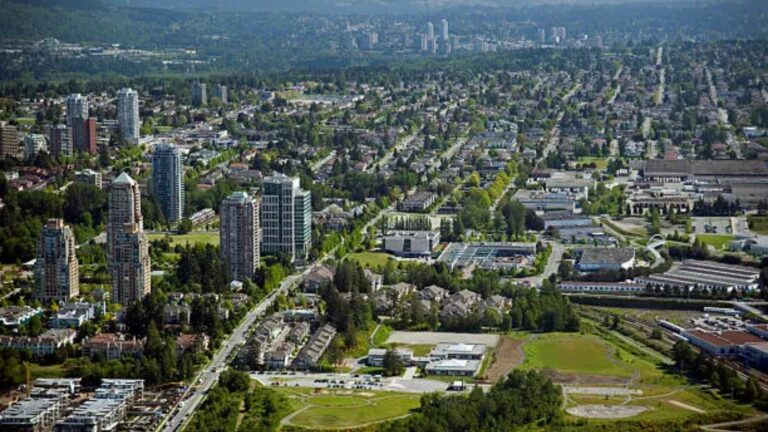
Ottawa is putting substantial financing behind a Burnaby rental development aimed squarely at a part of the housing market that can be difficult for families to find: ground-oriented homes with multiple bedrooms. The federal government, the City of Burnaby and the Burnaby Housing Authority have announced nearly $92 million in combined support for 183 purpose-built rental townhomes at 6203 Marine Drive.
The largest piece is an $84.5-million federal low-interest loan through the Apartment Construction Loan Program. Construction is already underway, with completion expected in September 2028. The development arrives as Burnaby’s rental market becomes somewhat less tight but remains expensive, particularly for households needing two or three bedrooms. It also represents an early test of Burnaby’s new municipal housing authority and its strategy of combining public land, government financing and private-sector development expertise.
Ottawa’s $84.5 Million Is a Loan, Not a Grant
Ottawa Puts $84.5 Million Into 183 Burnaby Rental Townhomes as Housing Costs Stay Under Pressure
- Ottawa’s $84.5 Million Is a Loan, Not a Grant
- The Project Is Built Around Two- and Three-Bedroom Homes
- Affordability Is Concentrated in 37 Non-Market Units
- Family-Sized Rentals Remain a Thin Part of Burnaby’s Stock
- Burnaby Has More Vacancy, but Rent Levels Are Still High
- Public Land and a Municipal Housing Authority Change the Model
- The Federal Program Is Designed to Make Rental Projects Financeable
- Construction Economics Explain Why Cheap Capital Matters
- Burnaby’s Housing Need Is Much Larger Than One Development
- The First Real Test Comes at Lease-Up in 2028
The federal contribution is by far the largest component of the financing package, but an important distinction sits behind the headline number. Ottawa is providing $84.5 million through the Apartment Construction Loan Program, which offers fully repayable, low-interest financing intended to make new purpose-built rental projects easier to build. The overall support package is valued at nearly $92 million when contributions and development-charge relief from other partners are included.
Burnaby Housing Authority is contributing $3.9 million. The City of Burnaby is providing $833,000 in development cost charge credits, while TransLink is contributing another $511,525 in development cost charge credits. Metro Vancouver is also providing development cost charge waivers. Those pieces matter because rental construction economics depend on more than the cost of lumber and concrete. Financing costs, municipal charges, infrastructure expenses and the length of the development process all affect whether a project can ultimately move from planning documents to occupied homes.
The Project Is Built Around Two- and Three-Bedroom Homes
Unlike many recent rental developments dominated by studios and one-bedroom apartments, the Marine Drive project is entirely focused on larger homes. Plans call for 58 two-bedroom townhomes and 125 three-bedroom townhomes, giving the development a distinctly family-oriented profile. The project is being built at 6203 Marine Drive in Burnaby’s South Slope area and is being delivered in collaboration with Mosaic Homes.
That unit mix may be as important as the headline total. Families looking for enough space for children, home working or multigenerational living often face a narrower range of rental choices than single renters. Burnaby says the homes will be close to schools, child care, parks, shopping and the Rosemary Brown Recreation Centre. The ground-oriented townhouse format also provides a different option from the high-rise apartments that have become increasingly familiar around Burnaby’s major transit-oriented centres. Municipal officials describe the development as one of British Columbia’s largest new purpose-built rental townhouse projects, underscoring how unusual projects of this size and housing type remain.
Affordability Is Concentrated in 37 Non-Market Units
The development will contain both market and non-market rentals, rather than offering all 183 townhomes at subsidized or below-market rents. Burnaby’s housing agreement identifies 37 homes as non-market rental units. All 37 are designated as two-bedroom homes, meaning the remaining 146 townhomes will operate as market rentals under the current project structure. That distinction is significant when assessing how directly the development will affect affordability.
For the designated non-market homes, the agreement establishes an income-linked affordability framework. Eligible households must have annual household income that does not exceed the applicable median total income benchmark for families in the Vancouver census metropolitan area. Initial non-market rents cannot exceed the equivalent of 30% of that median income divided across 12 months, subject to permitted increases afterward. Burnaby’s agreement also states that the non-market rental conditions apply in perpetuity. The result is therefore a mixed model: most homes expand general rental supply, while a smaller protected portion is intended to remain accessible at regulated non-market rates over the long term.
Family-Sized Rentals Remain a Thin Part of Burnaby’s Stock
CMHC’s 2025 rental-market data illustrate why the bedroom mix stands out. Burnaby had 11,771 units in its primary rental universe, but only 606 were classified as having three bedrooms or more. Another 3,343 were two-bedroom units, while the largest category by far consisted of 7,080 one-bedroom homes. Against that backdrop, adding 125 three-bedroom townhouses represents a sizeable new cluster of family-oriented rental housing, even though Burnaby’s overall stock will continue changing before the project opens.
The pricing data also show why additional bedrooms can become a substantial household expense. CMHC reported an average monthly rent of $2,147 for a two-bedroom purpose-built rental in Burnaby in 2025 and $2,403 for units with three bedrooms or more. Vacancy rates differed by bedroom size: the estimated vacancy rate was 4.2% for two-bedroom units and 3.3% for units with at least three bedrooms. Those figures suggest that a citywide increase in vacancies does not necessarily translate into abundant choices for every household type.
Burnaby Has More Vacancy, but Rent Levels Are Still High
Burnaby’s rental market has softened compared with the extreme tightness seen earlier in the decade. CMHC estimated the city’s overall purpose-built rental vacancy rate at 5.9% in 2025, above the 3.7% rate for the Vancouver census metropolitan area. CMHC linked some of Burnaby’s increased vacancy to new apartment construction and competition from recently completed condominium units, particularly around Brentwood, Edmonds and Metrotown.
That improvement in availability is welcome for renters, but vacancy and affordability are not the same measure. Burnaby’s average purpose-built rent across unit types was still $1,856 in 2025. Average rents reached $2,147 for two-bedroom homes and $2,403 for units with three or more bedrooms. Across the Vancouver region, the average two-bedroom purpose-built rent stood at $2,363. CMHC also found that although rent growth was slowing as supply expanded and demand softened, rents paid by tenants continued to increase. The market therefore presents a more complicated picture than either “housing shortage” or “rental glut” alone would suggest.
Public Land and a Municipal Housing Authority Change the Model
The 183 townhomes are among the first major projects being advanced by the Burnaby Housing Authority, an arm’s-length municipal corporation created by the City. The authority was incorporated in June 2024 and formally launched later that year, with a mandate to develop both market and non-market housing while operating more like a developer than a traditional city department. Its stated purpose is to fill gaps in the local housing system while keeping public benefit at the centre of development decisions.
For the Marine Drive project, Burnaby Housing Authority will own the homes while the underlying municipal land is leased to it on a long-term basis. That arrangement keeps the property connected to public ownership rather than requiring the authority to acquire high-priced Burnaby land on the open market. The authority’s first two major projects were planned to create a combined 387 rental homes, including the 183 townhouses and a separate 204-unit development. The model illustrates how municipalities are increasingly experimenting with direct participation rather than relying solely on zoning approvals and private construction.
The Federal Program Is Designed to Make Rental Projects Financeable
Ottawa’s Apartment Construction Loan Program is now a major component of federal rental-housing policy. The program has roughly $55 billion available in low-cost financing and is intended to support more than 131,000 new rental homes across Canada by 2031-32. As of March 2026, CMHC reported that $30.82 billion in loans had been committed toward more than 78,200 rental homes.
The structure is deliberately different from a conventional housing grant. Developers or housing organizations receive financing that must be repaid, but the borrowing terms are intended to be more favourable than financing that might otherwise be available for qualifying rental construction. Ottawa has expanded and modified the program over time, including extending loan terms and broadening eligibility. That approach reflects a central challenge in rental development: a project can have long-term demand and still struggle to proceed when borrowing costs, construction expenses and projected rents do not produce acceptable financial results. The Burnaby townhouses offer a concrete local example of federal financing being used to narrow that gap.
Construction Economics Explain Why Cheap Capital Matters
The timing of the federal loan is significant because purpose-built rental developers have been facing a difficult financial environment. CMHC’s 2026 housing-supply analysis for the Vancouver region pointed to higher labour, material and regulatory expenses as continuing pressures on construction. At the same time, slower rent growth, higher vacancies and longer periods required to lease new buildings were reducing expected revenues and making some prospective rental developments harder to justify financially.
Lower-cost government financing cannot eliminate those pressures, but it can change the equation. Borrowing expenses are a major component of a project carried through several years of planning and construction before rent begins flowing in. Burnaby is also lowering other costs through development-charge credits and waivers, while the housing authority contributes capital and the City supplies land through a long-term lease. The Marine Drive development therefore demonstrates a layered approach: rather than relying on a single subsidy, several organizations are reducing different costs that collectively determine whether construction remains viable.
Burnaby’s Housing Need Is Much Larger Than One Development
The 183 townhomes are substantial for a single family-oriented rental development, but Burnaby’s long-term housing requirements are far larger. Using the provincial Housing Needs Report methodology, the City has estimated that 74,051 additional homes of all tenures could be needed between 2021 and 2041. Anticipated household growth represents the largest portion of that estimate. Burnaby also notes that rental housing accommodates close to 40% of households in the city.
Affordability pressures predate the latest construction cycle. Statistics Canada’s 2021 Census found that 38.7% of Burnaby tenant households were spending at least 30% of household income on shelter costs, the commonly used affordability threshold. Nearly 28% of tenant households were identified as being in core housing need. Those figures should be understood as 2021 conditions rather than current rent measurements, but they illustrate why simply increasing the raw unit count is only part of the challenge. New housing must also include sizes and price points that match the households expected to live in it.
The First Real Test Comes at Lease-Up in 2028
Construction on the Marine Drive townhomes began in March 2026 and is expected to finish in September 2028. By then, Burnaby’s rental environment could look different again. New supply currently under construction may have opened, vacancy rates could move in either direction and market rents will reflect nearly two additional years of economic conditions. That means the project’s ultimate impact cannot be measured only from the financing announcement.
Several elements will be worth watching as completion approaches: the rents ultimately charged for the 146 market homes, demand for the larger three-bedroom units and the operation of the 37 protected non-market rentals. What is already clear is that the project combines several policies governments increasingly rely on—public land, municipal development participation, permanent affordability requirements on part of the site and federal low-cost financing. For Burnaby families, the most tangible outcome will come when those policy mechanisms turn into actual keys, leases and 183 occupied homes.
This Options Discord Chat is The Real Deal
While the internet is scoured with trading chat rooms, many of which even charge upwards of thousands of dollars to join, this smaller options trading discord chatroom is the real deal and actually providing valuable trade setups, education, and community without the noise and spam of the larger more expensive rooms. With a incredibly low-cost monthly fee, Options Trading Club (click here to see their reviews) requires an application to join ensuring that every member is dedicated and serious about taking their trading to the next level. If you are looking for a change in your trading strategies, then click here to apply for a membership.