35,000+ smart investors are already getting financial news, market signals, and macro shifts in the economy that could impact their money next with our FREE weekly newsletter. Get ahead of what the crowd finds out too late. Click Here to Subscribe for FREE.
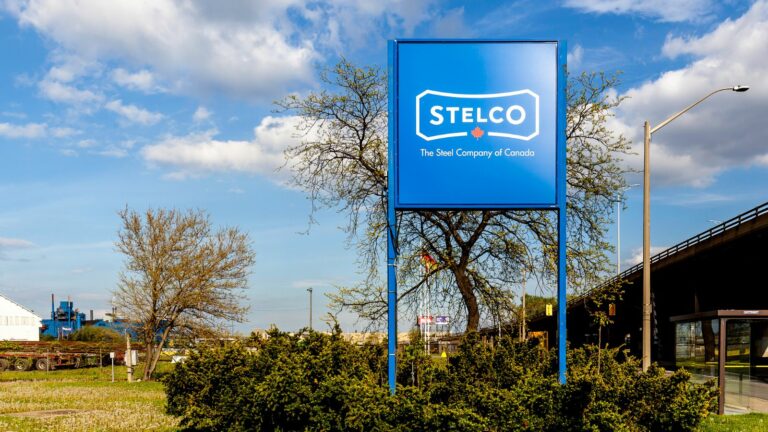
For generations, Stelco has represented more than a steel plant in Hamilton. Its jobs have supported households, apprenticeships and businesses throughout southern Ontario. Now, as layoffs begin at its U.S.-owned operations, Ontario NDP Leader Marit Stiles wants governments to consider something far more dramatic than financial assistance: buying the company and bringing it into public ownership.
Stiles made the appeal on October 13, urging Premier Doug Ford and Prime Minister Mark Carney to act together. Roughly 350 Hamilton jobs are at the centre of the dispute, while company restructuring could affect as many as 500 workers across its operations. Cleveland-Cliffs, Stelco’s American parent, blames a severely weakened market and U.S. steel tariffs. Ottawa says employment promises made during the company’s 2024 takeover cannot simply be ignored. The argument now extends from factory floors to the question of who should control a strategic Canadian industry.
Stiles Wants a Public Buyer, Not Another Temporary Fix
Ontario NDP Wants Ford and Carney to Buy U.S.-Owned Stelco as 350 Canadian Steel Jobs Come Under Threat
- Stiles Wants a Public Buyer, Not Another Temporary Fix
- The Job Cuts Are Already Moving From Plans to Reality
- A 2024 U.S. Takeover Came With Promises to Canada
- Ottawa Threatens Enforcement, While Stelco Denies a Breach
- Trump’s Steel Tariffs Have Altered the Company’s Market
- Ford’s Earlier Talk of Buying Stelco Is Back in Focus
- Workers Question Whether Transfers Can Replace Lost Jobs
- Federal New Democrats Point to a British Precedent
- A Government Purchase Would Raise Difficult Financial Questions
- The Real Test Is Whether Canadian Steel Finds More Buyers
Ontario’s Official Opposition leader has made a direct proposal. In an October 13 letter to Ford, Stiles urged Ontario to work with Ottawa on a plan to bring Stelco under public ownership and Canadian management. She also called for using legal mechanisms to push Cleveland-Cliffs to give up its ownership interest. Her central argument is that industrial capacity can disappear long before politicians finish debating another relief package, leaving communities without the skilled people needed to restart production when markets recover.
This remains an opposition demand, not a government-approved purchase agreement. Stiles has not announced a price, a financing structure or a detailed operating plan. She wants Ontario to accelerate projects such as hospitals, schools, homes, highways and public transit while prioritizing Canadian steel. That combines two ideas, public control and greater domestic demand, but neither would automatically reverse layoffs or restore lost export orders. Both demand more than speeches.
The Job Cuts Are Already Moving From Plans to Reality
On September 28, Stelco said it would indefinitely idle cold-rolled and coated steel operations at Hamilton Works, near the city’s waterfront, with layoffs beginning in October. Those processes finish steel for industrial customers. Reports identified approximately 350 Hamilton workers, while broader announcements warned that up to 500 positions could be affected. These are overlapping estimates, not separate totals.
Union officials said notices started arriving ahead of Thanksgiving weekend. Ron Wells, president of United Steelworkers Local 1005, reported that about 90 employees were expected to receive notices during the first week, with the first layoffs taking effect that Sunday, as equipment was taken out of service. The company says steelmaking itself will remain concentrated at Lake Erie Works in Nanticoke. But maintaining tonnes of output does not mean keeping the same workers or the same higher-value finishing operations. For affected households, a production shift can still mean losing a dependable paycheque.
A 2024 U.S. Takeover Came With Promises to Canada
Cleveland-Cliffs agreed to acquire Stelco in July 2024 in a deal worth approximately C$3.4 billion in enterprise value. The American steelmaker described the purchase as an expansion of its North American footprint, bringing 1,800 union workers into its organization. Its Ontario sites perform different jobs: Lake Erie Works produces steel in Nanticoke, while Hamilton Works has specialized in downstream finishing and coke production. Both matter to manufacturers buying Canadian-made steel.
Ottawa approved the transaction that October under the Investment Canada Act, subject to binding commitments lasting five years. The conditions included maintaining at least the existing number of unionized employees and the vast majority of non-union jobs, keeping the company’s headquarters in Hamilton, respecting collective agreements, and investing in the business. They also addressed pensions and environmental performance. These were not casual statements of goodwill; they formed part of government approval. Their interpretation is now central to a heated dispute.
Ottawa Threatens Enforcement, While Stelco Denies a Breach
Industry Minister Mélanie Joly has demanded an explanation from Stelco about how it intends to honour the takeover commitments while cutting jobs. Her October 5 letter demanded a compliance plan within five days, warning of possible legal action. Carney has also condemned the job losses and said federal assistance was available to help preserve employment. Its terms remain undisclosed.
Stelco has rejected the allegation that layoffs automatically break its agreement. In an October 9 response that emerged publicly days later, company president Paul Simon argued that its undertakings did not amount to an outright ban on layoffs. Stelco said it remained compliant and had previously informed officials about deteriorating market conditions. Ottawa maintains that changing business circumstances do not erase binding promises. These are competing, contested legal interpretations, not a settled court finding. As of October 13, a threatened enforcement action was not the same thing as a successful lawsuit.
Trump’s Steel Tariffs Have Altered the Company’s Market
Trump imposed 50% tariffs on Canadian steel entering the United States, disrupting cross-border sales. Stelco says demand for its cold-rolled and galvanized products fell sharply, especially because Canadian sales cannot replace all of its former U.S. business. A company memo estimated traditional-market demand fell nearly 25% in the second quarter against its 2024 average, including 10% in Canada.
A contradiction complicates the dispute. Cleveland-Cliffs chief executive Lourenco Goncalves has publicly supported U.S. steel tariffs, even as his Canadian subsidiary points to those tariffs as a reason for the layoffs. Goncalves argues that insufficient orders make the Hamilton finishing lines uneconomic and says workers could be recalled if a Canada–U.S. steel deal restores demand, although no deal has been reached. Those claims explain the company’s position; they do not prove that every proposed job cut is unavoidable. They also show why government ownership alone would not solve the underlying export problem.
Ford’s Earlier Talk of Buying Stelco Is Back in Focus
Stiles is reminding Ford of something he said himself. In Hamilton in August 2025, the premier criticized Cleveland-Cliffs for supporting U.S. tariffs while employing Canadians. He publicly floated the possibility of finding Stelco a new owner, even suggesting that Ontario might buy it, although no formal plan followed. At the time, the comments came during a defence of Ontario workers and a tariff-relief announcement.
A year later, the casual possibility has become an opposition demand for a serious public acquisition plan. Reporting on October 13 said people within Ford’s government regarded his earlier words as off-the-cuff, and one senior source described a wait-and-see approach while emphasizing Ottawa’s potential leadership role. That is not an endorsement of Stiles’s proposal. It also leaves a politically difficult question for the premier: if public ownership was worth mentioning when tariffs first escalated, what would have to change before it became worth formally evaluating now?
Workers Question Whether Transfers Can Replace Lost Jobs
Cleveland-Cliffs says a significant number of Hamilton employees could find work at Stelco’s Lake Erie Works in Nanticoke. A transfer could preserve incomes, especially where comparable local jobs are scarce. But the union at Nanticoke has questioned whether enough positions actually exist. Its president, John McElroy of United Steelworkers Local 8782, said there were only about 20 steel-production vacancies available when the restructuring was announced.
The larger Nanticoke operation faces changes of its own, including the closure of two pickling lines and reduced hours at another. Its union anticipated additional layoffs, complicating the company’s assurances about transfers. McElroy, a fourth-generation Stelco worker, described colleagues worried about mortgages and losing jobs that can pay around $40 an hour. Those concerns turn an industrial strategy debate into a personal calculation: whether a family can remain in its community and whether decades of specialized experience will still have a place in Ontario’s economy.
Federal New Democrats Point to a British Precedent
The call extends beyond Ontario. On October 13, federal NDP Leader Avi Lewis urged Carney to nationalize Stelco, arguing lawsuits could move too slowly to save jobs. He accused the U.S. owner of breaking its commitments, a claim Stelco disputes. Lewis also pointed to Britain’s decision to bring British Steel into public ownership as evidence that governments can intervene when a strategically important industry is threatened.
That comparison has a factual basis: Britain transferred British Steel into public ownership on July 16, 2026, following passage of a nationalization law. The British government said it was protecting domestic steelmaking capacity, critical supply chains and thousands of British jobs. Yet Canadian laws and circumstances differ. Public ownership required legislation, operating support and a plan for commercial sustainability. A British precedent can show what intervention might look like, but it cannot establish that an Ontario takeover would be inexpensive, swift or legally straightforward.
A Government Purchase Would Raise Difficult Financial Questions
The NDP has not offered a proposed purchase price for Stelco. Cleveland-Cliffs valued the company at roughly C$3.4 billion on an enterprise basis when it announced the 2024 acquisition, but that historical figure is not a current appraisal. Tariffs may have changed asset values, debts and projected earnings. Any public transaction would need an agreed valuation or another legally authorized route, alongside decisions about management and government liabilities.
Supporters of a takeover argue that essential industrial capability should not depend exclusively on the priorities of an American parent. Critics can reasonably ask whether taxpayers would inherit years of operating losses or large bills for modernizing equipment. Preserving jobs matters, but a purchase does not create customers by itself. A credible plan would need to show where Stelco’s products could be sold, which investments keep the mills competitive and how governments would protect the public’s financial interest while workers are protected.
The Real Test Is Whether Canadian Steel Finds More Buyers
Stiles wants Ontario to fast-track hospitals, housing, transit and northern roads using Canadian steel. There is already a federal model. Since December 2025, federal procurement rules have required Canadian-made steel in eligible construction and defence contracts worth at least C$25 million, with C$250,000 in qualifying materials and available domestic supply. That policy can support demand, but it does not guarantee an order for every product Stelco makes.
Decisions remain separate: whether Ford will enter talks about ownership, whether Ottawa will pursue enforcement of the 2024 commitments, and how many workers can actually transfer or be recalled. A steel trade deal could boost demand, but remains uncertain. For Hamilton families, the measure of success will not be which government gives the strongest speech. It will be whether a viable Canadian steel business keeps producing, investing and providing the kinds of jobs that once made Stelco a foundation of the local economy.
This Options Discord Chat is The Real Deal
While the internet is scoured with trading chat rooms, many of which even charge upwards of thousands of dollars to join, this smaller options trading discord chatroom is the real deal and actually providing valuable trade setups, education, and community without the noise and spam of the larger more expensive rooms. With a incredibly low-cost monthly fee, Options Trading Club (click here to see their reviews) requires an application to join ensuring that every member is dedicated and serious about taking their trading to the next level. If you are looking for a change in your trading strategies, then click here to apply for a membership.