35,000+ smart investors are already getting financial news, market signals, and macro shifts in the economy that could impact their money next with our FREE weekly newsletter. Get ahead of what the crowd finds out too late. Click Here to Subscribe for FREE.
A diplomatic standoff thousands of kilometres away is once again threatening to show up on Canadian gas-station signs. Talks involving Iran, the United States, nuclear limits, sanctions relief, and the Strait of Hormuz have shifted from reported progress to renewed uncertainty, leaving energy markets on edge.
For Canadian households, the issue is not abstract. The Strait of Hormuz is one of the world’s most important oil chokepoints, and gasoline prices in Canada are still shaped by global crude markets, refining costs, taxes, seasonal demand, and currency swings. Even a rumour of disruption can move oil prices. A delayed or fragile deal could keep pressure on commuters, truckers, farmers, and families heading into the summer driving season.
The Talks Look Close — Until They Don’t
Iran Deal Drama Could Hit Canadians at the Pumps as Hormuz Talks Turn Murky Again
- The Talks Look Close — Until They Don’t
- Why Hormuz Has So Much Power Over Oil Prices
- Canadian Gas Prices Have Already Felt the Shock
- Canada Produces Oil, But Drivers Are Not Fully Protected
- The Route From Hormuz To A Canadian Gas Pump
- A Deal Could Calm Markets, But Not Overnight
- A Partial Deal Could Keep Prices Volatile
- The Inflation Problem Goes Beyond Gasoline
- Ottawa’s Tax Relief Helps, But It Has Limits
- What Canadians Should Watch Next
The latest round of Iran deal drama has been defined by mixed signals. Reports suggested the United States and Iran were nearing a framework that could extend a ceasefire, reopen the Strait of Hormuz, allow Iranian oil sales, and create space for talks over Iran’s nuclear program. That kind of development would normally calm oil traders because it points toward more supply and fewer shipping risks.
But the optimism faded quickly. President Donald Trump said there was “no rush” and that the U.S. blockade on Iranian ships would remain until an agreement was reached, certified, and signed. Iranian officials also signalled that unresolved clauses remained. That uncertainty matters because oil markets do not wait for formal signatures. Traders react to risk, and when the risk involves a waterway tied to a major share of global energy flows, Canadian pump prices can respond before diplomacy is settled.
Why Hormuz Has So Much Power Over Oil Prices
The Strait of Hormuz is small on a map but enormous in the energy system. It connects the Persian Gulf to the Gulf of Oman and the Arabian Sea, giving Gulf producers access to global shipping routes. The U.S. Energy Information Administration has described it as one of the world’s most important oil chokepoints because few practical alternatives exist if flows are blocked or restricted.
Before the latest crisis, the strait handled roughly 20 million barrels per day of oil and petroleum liquids, equal to about one-fifth of global consumption. It also carried a major share of liquefied natural gas trade, especially cargoes from Qatar. That is why a dispute over who controls passage, which vessels can move, or whether shipping is safe becomes more than a regional issue. It becomes a global pricing event, affecting crude oil, diesel, jet fuel, fertilizers, freight, and eventually grocery and delivery costs.
Canadian Gas Prices Have Already Felt the Shock
Canadian consumers have already seen how quickly Middle East turmoil can reach the pump. Statistics Canada reported that gasoline prices rose sharply year over year in April 2026, helping push national inflation higher. Transportation costs also accelerated, showing how a fuel shock can move beyond individual drivers and into broader household budgets.
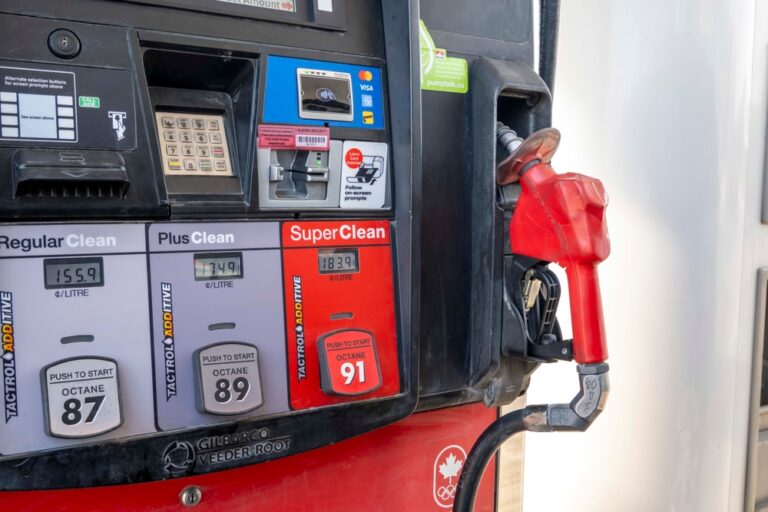
The pain is visible in real-world price boards. CAA’s national gas-price tracker showed the Canadian daily average at 180.0 cents per litre on May 24, 2026, compared with 138.2 cents per litre a year earlier. The same tracker showed a one-year high of 190.4 cents per litre earlier in May. For a 50-litre fill-up, the difference between those two yearly figures is more than $20. That is the kind of increase that changes weekend plans, delivery costs, and small-business margins.
Canada Produces Oil, But Drivers Are Not Fully Protected
Canada is a major oil producer and exporter, which can make the pump-price story feel confusing. If the country produces so much crude, many Canadians reasonably wonder why global conflict still matters at local gas stations. The answer is that crude oil is traded in global markets, and Canadian gasoline prices are influenced by international benchmarks, wholesale gasoline prices, refining capacity, transportation costs, competition, taxes, and the Canadian dollar.
Canada’s energy system is also deeply connected with the United States. The Canada Energy Regulator has reported that most Canadian crude exports go to the U.S., while Canada also imports refined petroleum products and crude through integrated North American supply chains. That means a global crude spike can still filter through wholesale prices, even in an oil-producing country. Alberta may benefit from stronger crude prices, but a family filling up in Ontario, British Columbia, Nova Scotia, or Quebec can still pay more.
The Route From Hormuz To A Canadian Gas Pump
The path from Hormuz uncertainty to Canadian gas prices is not always instant, but it is direct enough to matter. First, oil traders price in risk when supply appears threatened. Then crude benchmarks influence wholesale gasoline markets. Refineries, distributors, and retailers adjust to the cost of supply, expected demand, taxes, and local competition. By the time the price appears on a sign outside a station, several layers of the energy chain have already moved.
There are also seasonal pressures. Spring and summer often bring more driving, and gasoline markets can face added costs from summer-blend fuel requirements. Statistics Canada specifically noted that more expensive summer blends contributed to higher gasoline prices in April 2026. That makes the timing especially sensitive. If Hormuz talks remain murky while Canadians enter peak road-trip, cottage, construction, and farming season, global risk could collide with domestic demand.
A Deal Could Calm Markets, But Not Overnight
A credible agreement could still ease pressure. If a signed deal reopens the strait, reduces shipping risks, and allows more oil to move freely, markets could remove some of the fear premium built into crude and refined fuel prices. That would be good news for drivers, airlines, trucking companies, and businesses that rely on diesel or gasoline.
But even a diplomatic breakthrough may not mean instant relief. The International Energy Agency said in May that restricted Hormuz tanker traffic had already contributed to cumulative Gulf supply losses exceeding 1 billion barrels, with more than 14 million barrels per day shut in. Reuters also reported warnings that full flows through the strait may not return quickly even if the fighting ends. In practical terms, reopening a chokepoint is not like flipping a switch. Shipping schedules, insurance, port operations, sanctions, and confidence all have to normalize.
A Partial Deal Could Keep Prices Volatile
The biggest risk for Canadians may be a partial deal that creates hope without certainty. A ceasefire extension, limited sanctions waivers, or verbal commitments on nuclear issues might lower prices temporarily. But if enforcement details remain unclear, or if either side says key terms are unresolved, oil markets could swing sharply from one headline to the next.
That volatility can be frustrating at the pump. Prices may drop one week on optimism, then climb again after a political statement, shipping incident, sanctions dispute, or breakdown in talks. This is especially true when inventories are tight and traders are already nervous. For households, the result can feel random: a station that was cheaper on Monday suddenly jumps before the weekend. For businesses, it becomes harder to quote delivery, construction, landscaping, and service-call costs with confidence.
The Inflation Problem Goes Beyond Gasoline
Fuel prices matter because they feed into more than personal driving. Diesel powers trucks, farm equipment, construction machinery, and parts of the logistics network. Higher fuel costs can raise the price of moving food, building materials, consumer goods, and online orders. Even when companies do not pass on every extra cent immediately, higher energy costs squeeze margins and can influence future pricing.
The Bank of Canada has already connected higher oil prices linked to the Middle East conflict with stronger inflation pressure. Statistics Canada’s April CPI data showed gasoline was a major driver of headline inflation, while CPI excluding gasoline rose more slowly. That distinction is important. It means underlying inflation may be calmer than the pump makes it feel, but fuel is visible, frequent, and psychologically powerful. Canadians do not need an economics report to notice a $90 fill-up.
Ottawa’s Tax Relief Helps, But It Has Limits
The federal government has tried to blunt the impact. Ottawa temporarily suspended the federal fuel excise tax on gasoline and diesel from April 20 to September 7, 2026. The measure was expected to reduce regular gasoline bills by 10 cents per litre and diesel by 4 cents per litre. For drivers and businesses, that is meaningful relief, especially during a period of unusually high prices.
Still, tax relief cannot fully offset a global oil shock. If crude prices or wholesale gasoline costs rise sharply enough, the savings can be swallowed by market moves. It also does not solve regional differences. Pump prices vary by province and city because of taxes, competition, refinery access, transportation costs, and local supply conditions. A driver in Vancouver, Toronto, Halifax, or rural Northern Ontario may experience the same global crisis very differently.
What Canadians Should Watch Next
The key signal is whether the Iran framework becomes a signed, enforceable agreement. Markets will look for clear terms on the Strait of Hormuz, shipping access, sanctions relief, Iranian oil exports, and nuclear negotiations. Vague progress may not be enough. Traders tend to reward certainty and punish ambiguity, especially when the stakes involve a chokepoint tied to millions of barrels per day.
Canadians should also watch daily gas-price averages, crude benchmarks, inventory reports, and statements from the IEA, EIA, Ottawa, and major oil producers. The Canadian dollar matters too, because oil and refined fuels are generally priced in U.S. dollars. A weaker loonie can make imported or benchmark-priced energy more expensive in Canadian terms. The simple version is this: if Hormuz headlines stay messy, Canadian pump prices may stay jumpy.
This Options Discord Chat is The Real Deal
While the internet is scoured with trading chat rooms, many of which even charge upwards of thousands of dollars to join, this smaller options trading discord chatroom is the real deal and actually providing valuable trade setups, education, and community without the noise and spam of the larger more expensive rooms. With a incredibly low-cost monthly fee, Options Trading Club (click here to see their reviews) requires an application to join ensuring that every member is dedicated and serious about taking their trading to the next level. If you are looking for a change in your trading strategies, then click here to apply for a membership.