35,000+ smart investors are already getting financial news, market signals, and macro shifts in the economy that could impact their money next with our FREE weekly newsletter. Get ahead of what the crowd finds out too late. Click Here to Subscribe for FREE.
A political boast about having “zero expenses” has collided with Ontario’s own disclosure system. Records show taxpayers covered $11,709.85 in airfare and accommodation for Premier Doug Ford, Labour Minister David Piccini and two staff members to attend a LiUNA leadership gathering in the Orlando area in July 2025.
The trip may have involved legitimate government work: Ford was invited to speak to a major construction union with deep ties to Ontario’s infrastructure and skilled-trades agenda. Yet the public description of the visit, its Disney resort setting and Ford’s sweeping claim about his expenses have created a sharper question. The issue is no longer simply whether officials travelled for work, but whether the government has explained the purpose, cost and public value of that travel with enough clarity.
Records Put a Price on the Florida Trip
Ford Claimed He Had ‘Zero Expenses’—Records Show Taxpayers Paid $11,700 for Disney-Area Union Trip
- Records Put a Price on the Florida Trip
- The “Zero Expenses” Claim Meets the Disclosure Database
- What Happened at the Disney-Area Conference
- How the $11,709.85 Bill Breaks Down
- The Government’s Case for Sending Ford and Piccini
- Why LiUNA’s Political Relationship Matters
- Commercial Flights Do Not End the Spending Debate
- The Rules Focus on Purpose, Reasonableness and Documentation
- The Missing Answers Now Matter Most
Ontario’s travel, meal and hospitality disclosure records identify four government travellers connected to the three-day Florida visit from July 14 to July 16, 2025. Ford, Piccini, the premier’s executive assistant and a Ministry of Labour staff member claimed a combined $11,709.85 for commercial airfare and accommodation. The publicly reported entries describe Orlando as the destination and characterize the trip as a ministry-related international mission. That wording matters because it presents the travel as official government business rather than party activity or a private visit.
The records do not show that Ford personally took a vacation or visited a theme park, and the conference location alone is not proof of improper spending. What they do establish is that public funds paid for the delegation’s transportation and lodging. That distinction is important. Criticism should focus on what can be demonstrated: four travellers, a defined three-day window, a union event and a five-figure bill. The controversy begins with the gap between those documented costs and the premier’s later description of his own expense record.
The “Zero Expenses” Claim Meets the Disclosure Database
Ford’s statement was unusually broad. While responding to scrutiny over expenses claimed by members of his caucus, he told reporters to examine his record and said he had “zero expenses,” adding that he was unique among Ontario premiers. Taken literally, that claim is difficult to square with disclosures showing $1,464.10 in airfare and $1,498.09 in accommodation associated with his Orlando trip. Together, the two entries total $2,962.19 for the premier’s travel and stay.
There may be a narrower interpretation Ford intended—perhaps that he does not routinely claim meals, incidentals or personal reimbursements—but that qualification was not included in the remark reported publicly. The timing intensified the contradiction. His government was already dealing with anger over Toronto-area Progressive Conservative MPPs billing local hotel stays to taxpayers, including more than $16,000 attributed to former tourism minister Stan Cho. Against that backdrop, “zero expenses” sounded less like a technical accounting distinction and more like a sweeping claim of personal frugality.
What Happened at the Disney-Area Conference
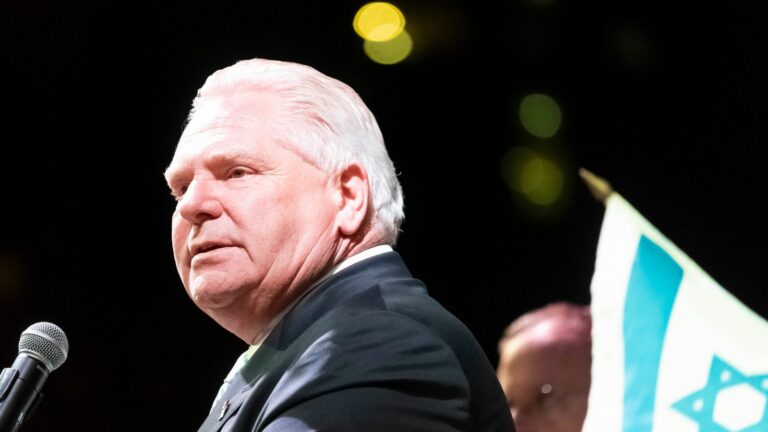
The gathering was the LiUNA International Leadership Conference, held at Disney’s Beach Club Resort in the Orlando area. Ford and Piccini attended during the same July 14-to-16 period listed in their disclosures. Social media footage reviewed by Global News showed Ford receiving an enthusiastic welcome from delegates and delivering a keynote address. He praised LiUNA as a private-sector union aligned with his government’s approach and framed its Canadian-American membership as an example of cross-border cooperation.
That setting helps explain both the government’s defence and the public reaction. LiUNA represents construction, industrial and health-care workers, and its members build roads, transit, housing, energy systems and other infrastructure shaped by provincial policy. A premier speaking to that audience can reasonably be performing government work. At the same time, holding the conference at a Disney resort creates an unmistakable visual that officials needed to address directly. The key question is not whether Disney was nearby, but what official meetings, policy discussions or measurable outcomes justified sending four people at public expense.
How the $11,709.85 Bill Breaks Down
The cost was spread across the four travellers rather than appearing as one large claim. Ford’s airfare was $1,464.10 and his accommodation was $1,498.09, producing a total of $2,962.19. His executive assistant claimed another $2,962.19 for the same three-day trip. Piccini’s flight and hotel costs came to $2,662.18, while a Ministry of Labour staff member recorded $3,123.29. Added together, the four amounts equal $11,709.85.
The individual totals also show why a simple headline figure can obscure the real accountability question. None of the four claims, considered alone, necessarily appears unusual for international business travel involving flights and multiple hotel nights. The concern is cumulative and contextual: why four attendees were required, whether the chosen accommodation met government standards, and whether the trip produced benefits proportionate to the cost. Public-sector travel is often defensible when senior officials are carrying out time-sensitive work. It becomes harder to assess when the published purpose is generic and the government declines to provide a detailed itinerary or outcome summary.
The Government’s Case for Sending Ford and Piccini
The premier’s office said Ford was invited to address LiUNA and emphasized the union’s large Ontario membership. Government and party statements have placed LiUNA’s Ontario membership above 120,000, while the union’s own national material says it represents more than 140,000 members across Canada. Those workers occupy sectors directly affected by decisions on highways, housing, transit, nuclear projects, apprenticeships and workplace training. From that perspective, a premier and labour minister engaging union leaders is not inherently unusual.
There is also a substantial policy relationship behind the invitation. In September 2024, Ontario announced more than $26 million for a new training centre at LiUNA Local 183’s Vaughan campus, intended to support training for tens of thousands of construction workers. The PC Party later said its government had invested more than $60 million in LiUNA and its local chapters. Those figures strengthen the argument that the conference audience was relevant to Ford’s official responsibilities. They also raise the standard for disclosure: the closer the institutional relationship, the more clearly government should distinguish public business from political alliance-building.
Why LiUNA’s Political Relationship Matters
LiUNA formally endorsed Ford and the Ontario Progressive Conservatives before the 2025 provincial election. The party announced the endorsement on January 30, highlighting infrastructure spending, worker training and skilled-trades policies. Union leaders praised Ford’s record, while Ford described LiUNA members as essential to building Ontario. The endorsement was politically significant because construction unions have become an important part of the coalition Ford has cultivated beyond the Conservative Party’s traditional base.
That history does not prove the Florida trip was partisan, nor does government funding for training establish that the union received special treatment. Public investments in apprenticeship capacity can serve a clear workforce need, and unions routinely communicate with governments of different political stripes. Still, the combination of endorsement, funding and a taxpayer-paid appearance makes precise documentation especially important. The public should be able to see whether Ford attended as premier to advance defined policy objectives, as party leader to reinforce a political relationship, or in a blended role. Ontario’s expense framework depends on separating official duties from political and constituency functions, not merely asserting that a trip was work-related.
Commercial Flights Do Not End the Spending Debate
LiUNA representatives stressed that Ford flew commercially and was seen greeting families at Toronto Pearson, rather than travelling on a private aircraft. That is relevant because commercial airfare can be less expensive and easier to defend than a charter. The Orlando records also show that the delegation did not use one of the private flights that became a separate source of criticism during Ford’s third term.
Still, choosing a scheduled airline does not make the expense disappear. Separate records examined by Global News showed $143,498.16 in charter costs for five private-flight trips involving Ford and staff over roughly a year, with individual costs ranging from about $1,800 to nearly $9,000 per passenger. The Florida trip therefore sits inside a broader debate about how the premier travels, how many aides accompany him and what level of detail is released afterward. Commercial travel may answer the question of transportation mode, but it does not answer why the trip required four publicly funded travellers or what Ontario received in return.
The Rules Focus on Purpose, Reasonableness and Documentation
Ontario’s expense rules do not prohibit ministers from travelling outside the province or attending conferences. They require expenses to be legitimate, reasonable and appropriate, and transportation is expected to reflect practical and economical choices given the destination, timing and circumstances. The Office of the Integrity Commissioner explains that ministerial duties can include attending an event connected to a portfolio. That means a labour conference may qualify when the participation is genuinely related to government responsibilities.
The review process is more than a receipt check. Expense claims are submitted with supporting documentation, assessed against the applicable rules and can trigger requests for clarification when information is missing or an item appears non-compliant. The commissioner can require repayment and proof that repayment occurred. Personal entertainment and other costs unrelated to official duties are not reimbursable. Nothing publicly reported so far establishes that Ford or Piccini claimed prohibited Disney entertainment. The live question is whether the approved purpose and documentation adequately explain the trip as official business—and whether the public description provides enough information to judge that conclusion.
The Missing Answers Now Matter Most
The government confirmed the conference attendance but did not fully answer several questions posed in the original reporting. Among them were why the trip was labelled an international mission, whether Ford and Piccini stayed at the conference resort, why four travellers were necessary and what made the expense a proper use of public money. Those are practical questions, not accusations. A short itinerary listing speeches, meetings, participants and outcomes could resolve much of the uncertainty.
Until that information is released, the strongest criticism concerns transparency and consistency rather than proven illegality. The disclosure records show a taxpayer-funded trip; they do not show a family holiday, theme-park admission or personal entertainment billed to Ontario. They also do not support the literal impression created by Ford’s “zero expenses” boast. For a premier who has built part of his political identity around watching public dollars, the credibility cost may exceed the $11,709.85 itself. Clear records made the trip visible. A clear explanation is now needed to show why it was worthwhile.
This Options Discord Chat is The Real Deal
While the internet is scoured with trading chat rooms, many of which even charge upwards of thousands of dollars to join, this smaller options trading discord chatroom is the real deal and actually providing valuable trade setups, education, and community without the noise and spam of the larger more expensive rooms. With a incredibly low-cost monthly fee, Options Trading Club (click here to see their reviews) requires an application to join ensuring that every member is dedicated and serious about taking their trading to the next level. If you are looking for a change in your trading strategies, then click here to apply for a membership.