35,000+ smart investors are already getting financial news, market signals, and macro shifts in the economy that could impact their money next with our FREE weekly newsletter. Get ahead of what the crowd finds out too late. Click Here to Subscribe for FREE.
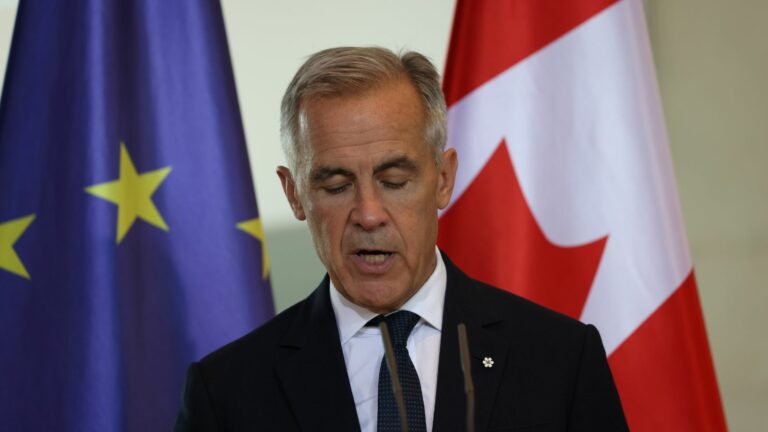
Canada’s push for a deeper economic relationship with the European Union is moving toward a major test in Montréal, but one politically sensitive idea is being ruled out before leaders sit down. Jonathan Wilkinson, Canada’s ambassador to the EU, says the negotiations are not about creating full free movement of workers between Canada and the 27-country bloc. Instead, officials are examining targeted ways to make it easier for certain workers and students to cross the Atlantic where both sides see a clear benefit.
That distinction matters because Prime Minister Mark Carney has described the emerging relationship in sweeping terms, including closer trade, defence, energy, technology and people-to-people ties. Conservatives have warned against any arrangement that could import EU-style open-border immigration rules or weaken Canadian control over laws and borders. The Montréal summit on October 29 and 30 is expected to show how far the partnership will actually go.
What Wilkinson Says Is Actually on the Table
Carney’s EU Trade Push Won’t Include Free Movement of Workers, Ambassador Says Amid Conservative Immigration Warnings
- What Wilkinson Says Is Actually on the Table
- Why Conservatives Are Warning About Immigration and Sovereignty
- CETA Already Provides a Model for Limited Worker Mobility
- The New Partnership Is Much Bigger Than Labour
- CETA’s Unfinished Ratification Still Matters
- Student Mobility Could Expand Without Creating Open Borders
- Europe Is Central to Carney’s Trade-Diversification Strategy
- What the Montréal Summit Could Clarify
Wilkinson’s message is narrower than the language surrounding the Canada-EU talks. In an interview with The Canadian Press before the Montréal summit, he said the two sides are not discussing unrestricted labour mobility. Instead, officials are looking at “specialized areas” where employers in Canada and Europe could benefit from a broader talent pool. He did not name specific occupations, though the wider partnership has emphasized critical minerals, technology, defence and clean energy.
The ambassador said any easier movement for workers or students would need to be designed thoughtfully and around mutual benefit. His example was architecture, where Canada and the EU already recognize qualifications through a professional agreement. That model reduces a practical barrier to working abroad without removing immigration controls. The direction therefore looks more like targeted access for selected skills than an EU-style right for millions of people to live and work freely across borders. That is an important distinction as negotiations move forward.
Why Conservatives Are Warning About Immigration and Sovereignty
Conservative Leader Pierre Poilievre has framed the still-undefined partnership as a sovereignty issue as much as a trade issue. After European Commission President Ursula von der Leyen floated Canada becoming the EU’s first “associate member,” Poilievre said Conservatives support free trade and NATO cooperation with Europe but oppose EU taxes, EU laws or EU open-border immigration policies being imposed on Canadians. His party has also demanded clearer disclosure of what Ottawa is seeking.
The warning gained traction because the terminology has been unusually ambitious. Von der Leyen used “associate member,” while Carney has spoken of an “alliance for the future” and a more integrated relationship. Yet the proposed status is not defined as a normal EU membership category, and officials say the framework is still being developed. Wilkinson’s statement therefore addresses one of the opposition’s concerns: unrestricted movement of workers is not currently part of the talks, even if narrower mobility measures are.
CETA Already Provides a Model for Limited Worker Mobility
Canada and the EU are not starting from zero. The Comprehensive Economic and Trade Agreement, or CETA, already facilitates temporary entry for defined categories of business people, including intra-corporate transferees, investors, contractual service suppliers, independent professionals and short-term business visitors. The rules can reduce administrative barriers and make temporary assignments easier, but CETA explicitly excludes general access to the labour market, permanent employment, citizenship and residence.
A 2026 agreement for architects shows what this can look like. Canada and the EU created a mutual-recognition process that makes professional qualifications easier to recognize across the Atlantic while preserving local licensing and registration requirements. Canada called it the first mutual-recognition agreement for professional services under one of its free trade agreements. For an architecture firm staffing a cross-border project, that can remove uncertainty. It does not, however, create an automatic right for any Canadian or European worker to relocate there permanently today.
The New Partnership Is Much Bigger Than Labour
Worker mobility is only one element of Carney’s European strategy. The official summit agenda includes trade, digital policy, critical raw materials, defence and security, education, research, innovation and youth. Canada is also building on the security and defence partnership launched in 2025 and became the first non-European country to participate in the EU’s Security Action for Europe initiative, opening opportunities for Canadian defence companies in European procurement.
Critical minerals and energy are another major pillar. Canadian and European officials have discussed cooperation on liquefied natural gas, nuclear energy, hydrogen, clean technology and mineral supply chains. In March 2026, the European Investment Bank and Canada signed a letter of intent to explore cooperation on critical raw materials and arrangements that could allow the bank to operate in Canada. For Ottawa, that can mean new capital and customers. For Europe, it offers another route to diversify strategically important global mineral supply chains.
CETA’s Unfinished Ratification Still Matters
The new political ambition rests on an older agreement that is still not fully ratified. CETA was signed on October 30, 2016, and has been provisionally applied since September 21, 2017. Most commercially important provisions are already operating, including broad tariff reductions. The European Commission says 18 of the EU’s 27 member states have completed national ratification, leaving nine — Belgium, Bulgaria, Cyprus, France, Greece, Hungary, Ireland, Italy and Poland — still to finish domestic processes.
Even with that unfinished legal work, trade has expanded significantly. Canada says two-way trade in goods and services with the EU reached about $178 billion in 2025, making the bloc Canada’s second-largest trading partner. Global Affairs Canada also reported that bilateral merchandise trade has grown by more than 78% since CETA, while Canadian merchandise exports to the EU rose almost 21% from January through August 2026. Those numbers give Ottawa a concrete case for going deeper.
Student Mobility Could Expand Without Creating Open Borders
Students may see some of the most visible changes from a deeper Canada-EU relationship. Carney has proposed Canadian participation in Erasmus+, the EU’s mobility program, and Wilkinson has confirmed that student movement is part of the broader discussion. That is different from granting a general right to settle or work permanently: Erasmus+ is structured around education, training and exchanges governed by program rules and participating institutions.
The idea is moving beyond rhetoric. In October, European Parliament discussions about the next Erasmus+ framework identified Canada as a prospective partner, with officials saying an association arrangement is being negotiated. Canada already participates in Horizon Europe, the EU’s major research and innovation program, showing that deep participation in an EU program does not require EU membership. For a student in Halifax or Montréal, the result could be an easier path to a semester in Paris, Berlin or Madrid. Politically, however, education mobility remains separate from unrestricted immigration.
Europe Is Central to Carney’s Trade-Diversification Strategy
The EU push also reflects Canada’s changing relationship with the United States. Carney’s government has made diversification an economic objective, setting a goal of doubling non-U.S. exports over the next decade and generating roughly $300 billion in additional trade. Government briefing materials show the United States still taking more than two-thirds of Canadian merchandise exports, so reducing concentration risk requires access to large alternative markets.
Europe is an obvious established option. The EU is already Canada’s second-largest trading partner, and its industrial demand, capital, technology and regulatory influence fit Ottawa’s effort to build resilience through trusted partners. The strategy has become more urgent as tariff disputes with Washington have intensified. It is not a realistic attempt to replace the U.S. market, which remains deeply integrated with Canada’s economy. Instead, the objective is to give Canadian businesses more customers, investment sources and options when political or trade shocks disrupt the North American relationship.
What the Montréal Summit Could Clarify
The October 29–30 summit is expected to turn broad language into a more concrete framework. The European Council says leaders intend to launch an “Alliance for the Future” focused on prosperity and economic security, with initiatives spanning people-to-people ties, trade, digital cooperation, critical raw materials, defence, education, research and youth. Carney will host European Council President António Costa and European Commission President Ursula von der Leyen, and a joint statement is expected.
The test is detail. Wilkinson has drawn a clear boundary around labour mobility, but other questions remain: which professions might receive easier access, how student exchanges would work, whether digital-trade rules will advance, and how critical-minerals investment will be financed. The summit may also show whether the loaded phrase “associate member” survives. For Canadians following the immigration debate, one point is clearer: deeper integration may make some cross-Atlantic
This Options Discord Chat is The Real Deal
While the internet is scoured with trading chat rooms, many of which even charge upwards of thousands of dollars to join, this smaller options trading discord chatroom is the real deal and actually providing valuable trade setups, education, and community without the noise and spam of the larger more expensive rooms. With a incredibly low-cost monthly fee, Options Trading Club (click here to see their reviews) requires an application to join ensuring that every member is dedicated and serious about taking their trading to the next level. If you are looking for a change in your trading strategies, then click here to apply for a membership.