35,000+ smart investors are already getting financial news, market signals, and macro shifts in the economy that could impact their money next with our FREE weekly newsletter. Get ahead of what the crowd finds out too late. Click Here to Subscribe for FREE.
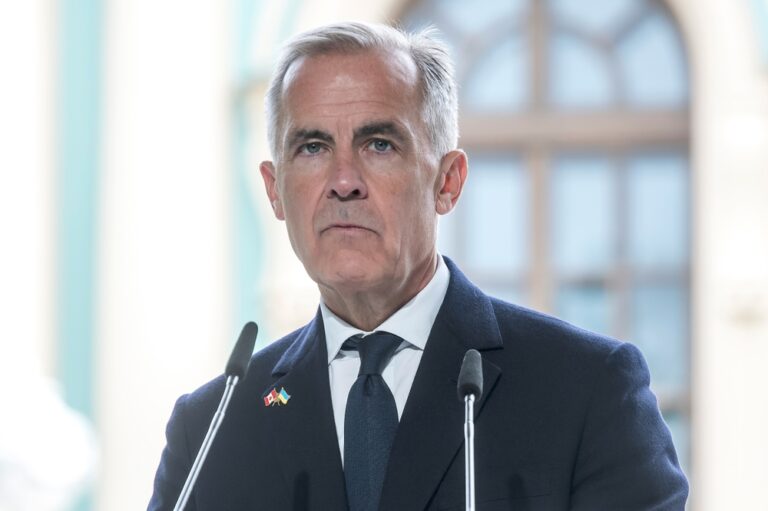
Alberta’s unity debate has suddenly moved from political background noise to a national flashpoint. Prime Minister Mark Carney is warning that Premier Danielle Smith’s referendum plan could become a risky wager: a vote meant to channel frustration, but one that may instead harden divisions, unsettle investors, and force legal questions Ottawa cannot ignore.
Smith says the vote is about letting Albertans be heard, not immediately taking the province out of Canada. Carney argues that separation politics can quickly escape the control of leaders who treat them as bargaining tools. With an October vote now looming, Alberta’s grievance politics are colliding with constitutional law, economic uncertainty, Indigenous rights, and the wider question of how Canada holds itself together.
Carney’s Warning Is About More Than One Vote
Carney Warns Smith’s Alberta Referendum Gamble Could Backfire
- Carney’s Warning Is About More Than One Vote
- Smith’s Question Leaves Plenty Of Room For Confusion
- The Numbers Suggest Separation Is Still A Minority Position
- The Legal Path Is Much Harder Than The Politics Suggests
- Business Leaders Are Already Worried About Uncertainty
- Alberta’s Energy Frustration Is Real
- Indigenous Rights Could Become A Central Obstacle
- The Referendum Could Divide Smith’s Own Coalition
- Ottawa May Have To Judge The Question
- The Backfire Risk Is A Long Campaign With No Clean Ending
Carney’s message is aimed at the idea that a referendum can be used as leverage without consequences. His warning is that once voters are asked a nation-defining question, the result may take on a life of its own. That is why he compared Alberta’s situation to Brexit, where a vote framed by some as a pressure tactic became a historic rupture.
The political risk is obvious. Even a non-binding result could inflame regional resentment, empower separatist organizers, and force Ottawa into a defensive national-unity campaign. Carney has said he will make the case for a strong Alberta inside a united Canada. For households in Calgary, Edmonton, Grande Prairie, or Medicine Hat, the debate may sound abstract, but it could quickly touch jobs, investment, pensions, trade, and confidence in the province’s future.
Smith’s Question Leaves Plenty Of Room For Confusion
Smith’s proposed question does not ask Albertans to separate immediately. It asks whether Alberta should remain in Canada or whether the provincial government should start the legal process required under the Constitution to hold a future binding referendum on separation. That wording gives the government political room, but it also creates a complicated ballot choice.
That complexity may be part of the gamble. Voters who are angry at Ottawa but not ready to leave Canada may see the question as a pressure valve. Separatists may see it as a stepping stone. Federalists may see it as an unnecessary risk. The result is a vote that could mean different things to different people. When a question is emotionally loaded and legally layered, the campaign can become less about what the ballot says and more about what each side claims it means.
The Numbers Suggest Separation Is Still A Minority Position
Recent public opinion suggests most Albertans still prefer Canada, even if many want a stronger provincial voice. Angus Reid found that 60 per cent would vote against proceeding with the October separation process, while 35 per cent would vote yes. When the question is simplified to staying or leaving, the pro-Canada side becomes stronger, with 67 per cent choosing to stay and 30 per cent choosing to leave.
Those numbers explain why Carney sees danger in treating the vote casually. A referendum can elevate a minority position into the centre of political life. Even if separation loses, the campaign could deepen distrust between neighbours, parties, and governments. A “no” vote may not end the issue if separatist groups argue the question was flawed, while a surprisingly strong “yes” vote could shake markets and force Ottawa to respond.
The Legal Path Is Much Harder Than The Politics Suggests
Canada does not allow a province to simply vote itself out of Confederation. The Supreme Court’s Quebec Secession Reference established that a clear majority on a clear question would create a duty to negotiate, not an automatic right to leave. The federal Clarity Act then gave Parliament a role in judging whether a question and result are clear enough.
That legal reality matters because Alberta’s proposed vote is not the final constitutional step. It would only ask whether the province should begin the process toward a later binding referendum. In practical terms, that means any winning separation-side result could still run into federal review, constitutional negotiations, questions over borders and debt, and the rights of Indigenous peoples. Carney’s warning is built on that gap between political rhetoric and constitutional reality.
Business Leaders Are Already Worried About Uncertainty
For Alberta’s business community, the biggest concern may not be immediate separation. It is uncertainty. The Calgary Chamber of Commerce reported that 51 per cent of surveyed Calgary respondents said separation discourse was affecting the provincial economy, and 93 per cent of that group described the impact as negative. Another 28 per cent said the debate was affecting their own operations.
Those numbers turn the referendum from a political drama into an economic story. Energy companies, builders, lenders, and small businesses all make decisions based on confidence. If executives begin to wonder about trade rules, labour mobility, tax systems, or the future of federal programs, some may delay hiring or investment. Alberta’s economy depends on long-term bets. A province-wide unity fight makes those bets harder to price.
Alberta’s Energy Frustration Is Real
The referendum push did not emerge from nowhere. Alberta’s economy has long been shaped by oil and gas, and the province has often clashed with Ottawa over environmental rules, pipelines, emissions policy, and market access. The Government of Alberta’s economic dashboard shows mining, quarrying, and oil and gas extraction as the largest share of provincial GDP, making energy politics inseparable from Alberta politics.
Carney has tried to reduce that pressure by working with Smith on energy infrastructure, including plans tied to greater export access to Asian markets. That makes the referendum even more politically delicate. If Ottawa is already moving on some Alberta priorities, Carney can argue that cooperation is producing results. Smith, however, must still manage voters and party activists who believe only hardball pressure will force deeper federal concessions.
Indigenous Rights Could Become A Central Obstacle
Any Alberta separation push would immediately run into treaty and Indigenous rights questions. A recent Alberta Court of King’s Bench decision quashed approval of an independence-related initiative petition after First Nations challenged the process. The ruling highlighted the duty to consult when government action may affect treaty rights.
That creates a serious complication for Smith’s strategy. Alberta did not exist before the treaties; Canada did. First Nations leaders have argued that any attempt to change Alberta’s constitutional status cannot be treated as a simple provincial preference vote. For Carney, this strengthens the argument that separation politics cannot be reduced to a bargaining chip. It involves constitutional obligations, Indigenous nations, and rights that cannot be waved away by a campaign slogan.
The Referendum Could Divide Smith’s Own Coalition
Smith has said she intends to vote for Alberta to remain in Canada, even as her government moves ahead with the October question. That balancing act may satisfy some voters who want a say without endorsing separation. But it also risks frustrating both sides. Federalists may accuse her of legitimizing a dangerous movement, while separatists may accuse her of offering a watered-down question.
That is where the gamble could backfire inside Alberta politics. A referendum campaign can force every MLA, cabinet minister, mayor, business group, and civic leader to take a side. It can also pull attention away from affordability, health care, schools, housing, and jobs. A premier who wants to control the debate may instead find the debate controlling her government.
Ottawa May Have To Judge The Question
Carney has suggested the federal government may review whether the question fits the Clarity Act’s expectations for a clear question and clear majority. That does not mean Ottawa can stop Alberta from holding a provincial vote, but it does mean Parliament could later decide whether the result creates any obligation to negotiate.
That possibility raises the stakes. If Alberta votes heavily to start the process and Ottawa says the question was unclear, separatists may claim democratic insult. If Ottawa accepts the result as politically meaningful, the country could enter a prolonged constitutional crisis. Either way, Carney’s concern is that the referendum may not settle the issue. It may instead create a new argument over who gets to define what Albertans actually decided.
The Backfire Risk Is A Long Campaign With No Clean Ending
The central danger for Smith is that the referendum may produce the worst of both worlds: enough support for separation to keep the movement alive, but not enough clarity to resolve anything. A close or confusing result could leave Alberta more divided, Ottawa more involved, Indigenous leaders more determined to challenge the process, and investors more cautious.
For Carney, the political opening is to argue that Alberta can win more inside Canada than outside it. For Smith, the challenge is proving the vote is a democratic release valve rather than a national-unity crisis in slow motion. The coming campaign will test whether Albertans see the referendum as leverage, liberation, or an unnecessary roll of the dice.
This Options Discord Chat is The Real Deal
While the internet is scoured with trading chat rooms, many of which even charge upwards of thousands of dollars to join, this smaller options trading discord chatroom is the real deal and actually providing valuable trade setups, education, and community without the noise and spam of the larger more expensive rooms. With a incredibly low-cost monthly fee, Options Trading Club (click here to see their reviews) requires an application to join ensuring that every member is dedicated and serious about taking their trading to the next level. If you are looking for a change in your trading strategies, then click here to apply for a membership.