35,000+ smart investors are already getting financial news, market signals, and macro shifts in the economy that could impact their money next with our FREE weekly newsletter. Get ahead of what the crowd finds out too late. Click Here to Subscribe for FREE.
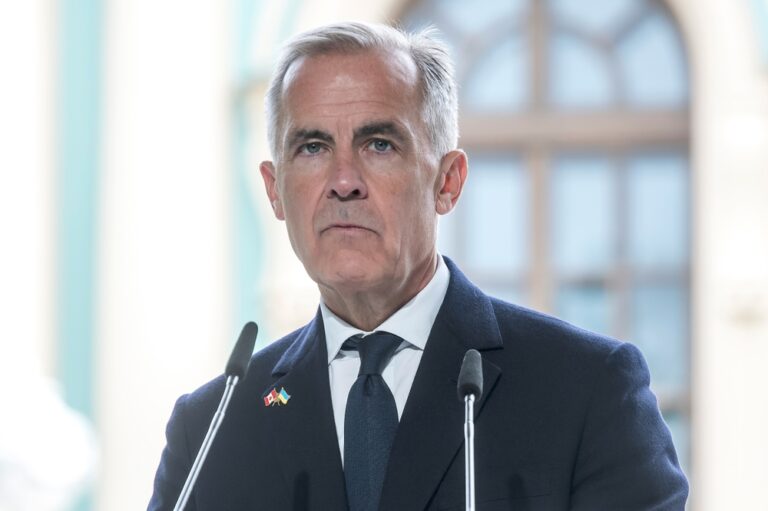
Prime Minister Mark Carney’s walk through the Calgary Stampede turned into more than a prairie photo-op. In a province where energy policy, national unity, and resentment toward Ottawa often collide, his brief exchange with pipeline supporters carried unusual weight. Alberta is heading toward an October referendum question tied to whether the province should remain in Canada or begin the legal process for a future binding vote on separation.
Carney’s message to the crowd was deliberately upbeat: the pipeline push was “looking good.” But behind the friendly handshakes and white-hat symbolism sits a larger test. Ottawa is trying to convince Albertans that Confederation can still deliver market access, resource development, and respect for the province’s economic role — before separatist frustration hardens into something more difficult to unwind.
A Stampede Exchange Becomes a National Unity Moment
Carney Tells Alberta Pipeline Backers ‘It’s Looking Good’ as Separation Vote Looms
- A Stampede Exchange Becomes a National Unity Moment
- The Pipeline Plan Is Bigger Than One Route
- Why Alberta Sees This as a Fairness Test
- Trans Mountain Changed the Math — and the Expectations
- British Columbia’s Position Has Shifted, But Not Disappeared
- Indigenous Consultation Could Decide the Timeline
- The Separation Vote Raises the Stakes
- Carney Is Trying to Replace Alienation With Deliverables
- The Risk Is That Everyone Hears a Different Promise
Carney arrived at the Calgary Stampede after a Middle East trip and moved through one of Alberta’s most politically charged public stages: the fairgrounds where energy workers, business owners, ranching families, and federal politicians all cross paths. Wearing western attire and mingling with visitors, he was pressed directly by people who wanted assurance that a new oil pipeline would actually move ahead. One attendee urged him to get it built, while another framed the project as good for the entire country.
His response was cautious but confident. Carney said he felt good about the project’s prospects and pointed to polling that he said showed majority national support for a pipeline. The setting mattered as much as the words. The Stampede is not Parliament Hill; it is Alberta’s cultural front porch. For a prime minister trying to repair trust, a short exchange near chuckwagon races may have carried more emotional force than a formal Ottawa statement.
The Pipeline Plan Is Bigger Than One Route
The proposal at the centre of Carney’s optimism is a new westbound oil pipeline from Alberta to British Columbia’s south coast. Alberta has submitted a proposed route to Ottawa’s Major Projects Office, with the line expected to follow much of the existing Trans Mountain corridor. The plan would run from the Bruderheim area northeast of Edmonton to a terminal in Delta, British Columbia, south of Vancouver, and could move more than one million barrels of oil per day to tidewater.
The project is being described as a public-private partnership involving Alberta, the federally owned Trans Mountain Corporation, and Pembina Pipeline. Trans Mountain would act as developer, project manager, and eventual operator, while Pembina has been reported as holding an initial minority stake that could rise once the pipeline is operating. Alberta’s submission placed the estimated cost in the tens of billions of dollars, making it one of the largest infrastructure bets in modern Canadian energy politics.
Why Alberta Sees This as a Fairness Test
For many Albertans, the pipeline debate is not only about barrels, tankers, or construction jobs. It is about whether the province’s main export industry can reach global markets without being blocked by federal policy, provincial opposition, or regulatory delay. Alberta remains the dominant force in Canadian oil production, and national energy data show the province accounted for more than four-fifths of Canada’s crude oil and equivalent production in 2025.
That economic weight helps explain why pipeline symbolism runs so deep. Canada produced a record average of 5.35 million barrels per day of crude oil and equivalents in 2025, and Alberta added the largest year-over-year volume increase among provinces. In practical terms, that means every debate over export capacity touches workers far beyond boardrooms: welders, truckers, small-town hotel owners, Indigenous contractors, and municipal governments that depend on energy activity for local revenue.
Trans Mountain Changed the Math — and the Expectations
The existing Trans Mountain expansion is the proof point both sides now use. The expanded system began operating in May 2024, nearly tripling capacity from about 300,000 barrels per day to roughly 890,000 barrels per day. The Canada Energy Regulator says that expansion increased western Canadian crude export pipeline capacity and dramatically expanded tidewater access, helping Canadian crude reach the U.S. West Coast and Asian markets.
That history cuts both ways. Supporters argue Trans Mountain shows that new capacity can improve pricing, reduce bottlenecks, and diversify markets. Critics point to the project’s long delays, heavy cost escalation, and years of legal and political conflict as warnings about what a new megaproject could become. Carney’s challenge is to persuade Albertans that Ottawa learned from the Trans Mountain experience, while also persuading taxpayers elsewhere that another enormous pipeline will not become an open-ended public liability.
British Columbia’s Position Has Shifted, But Not Disappeared
The path through British Columbia remains politically sensitive. Premier David Eby has not become a pipeline booster, but his government has agreed not to fight the proposal in court under a wider agreement with Ottawa. That deal includes a commitment to preserve the northern B.C. tanker ban, financial compensation for B.C. if the project proceeds, and federal responsibility around environmental risk and spill response.
Those concessions are meant to make the route more viable, but they do not erase the underlying tension. British Columbia still has coastal communities, fisheries, environmental groups, and First Nations with strong concerns about tanker traffic and spill risks. The compromise also steers the project toward the southern coast rather than a northern export route, reflecting how geography, law, and local consent shape energy politics. For Alberta, the shift may look like progress. For B.C., it is closer to conditional cooperation.
Indigenous Consultation Could Decide the Timeline
One of the most important unresolved questions is Indigenous participation. Alberta’s submission says the proposed route crosses the traditional territories of as many as 125 Indigenous communities. Carney and Smith have both spoken about opportunities for Indigenous ownership, and consultations on the new route have been described as beginning immediately. That language is important, but it is only the start of a long legal, financial, and community process.
Canada’s pipeline history shows why this cannot be treated as a box-checking exercise. The original Trans Mountain expansion approval was quashed by the Federal Court of Appeal in 2018 in part over consultation and environmental assessment issues, before later approvals allowed the project to proceed. A new pipeline will have to show not only that meetings happened, but that affected communities had meaningful opportunities to shape outcomes. Ownership can create wealth, but consent, safety, and treaty rights remain central.
The Separation Vote Raises the Stakes
Alberta’s October 19 referendum is not a direct vote to leave Canada immediately. Elections Alberta lists Question 10 as a choice between remaining a province of Canada or having the Government of Alberta begin the legal process required under the Canadian Constitution to hold a binding provincial referendum on separation. That distinction matters because even a pro-separation-process result would not equal instant independence.
Still, the political signal would be powerful. The Supreme Court of Canada’s Quebec secession reference established that a clear vote on a clear question would create an obligation to negotiate, but unilateral secession is not available under Canadian law. The federal Clarity Act also gives the House of Commons a role in assessing whether a referendum question and majority are clear enough to justify negotiations. In that context, Carney’s pipeline diplomacy is not just economic policy; it is a unity strategy.
Carney Is Trying to Replace Alienation With Deliverables
Carney’s political pitch to Alberta has been built around a simple idea: the province should not need separation threats to get serious attention from Ottawa. His recent messaging has acknowledged older grievances, including the long shadow of the National Energy Program and the sense among many Albertans that their resource contributions were treated as obstacles rather than assets. That acknowledgement is meant to soften a hard audience without fully adopting Alberta’s view of every dispute.
Whether it works depends on timelines. Voters who have watched Energy East, Northern Gateway, Keystone XL, and years of Trans Mountain battles may not be moved by another announcement. They will look for permits, signed commercial agreements, Indigenous partnerships, financing clarity, and evidence that construction can begin. “It’s looking good” may be a useful Stampede line, but in Alberta’s current mood, optimism has a short shelf life unless it turns into visible progress.
The Risk Is That Everyone Hears a Different Promise
The most difficult part of Carney’s approach is that each audience hears a different promise. Alberta hears market access and respect for oil. British Columbia hears risk protection and no northern tanker route. Indigenous communities hear possible ownership, but also a demand for consultation on a route that may affect lands, waters, and rights. Environmental groups hear another long-life fossil fuel asset at a time when Canada still faces climate commitments.
That is why the coming months matter. If Ottawa, Alberta, B.C., industry, and Indigenous partners can move from framework to specifics, Carney may be able to present the pipeline as proof that Canada can still make hard national projects happen. If the process bogs down, separatist voices will argue that the Stampede optimism was only another performance. In a province preparing to vote on its place in Canada, a pipeline has become more than infrastructure. It has become a test of whether Confederation can still close the deal.
This Options Discord Chat is The Real Deal
While the internet is scoured with trading chat rooms, many of which even charge upwards of thousands of dollars to join, this smaller options trading discord chatroom is the real deal and actually providing valuable trade setups, education, and community without the noise and spam of the larger more expensive rooms. With a incredibly low-cost monthly fee, Options Trading Club (click here to see their reviews) requires an application to join ensuring that every member is dedicated and serious about taking their trading to the next level. If you are looking for a change in your trading strategies, then click here to apply for a membership.