35,000+ smart investors are already getting financial news, market signals, and macro shifts in the economy that could impact their money next with our FREE weekly newsletter. Get ahead of what the crowd finds out too late. Click Here to Subscribe for FREE.
A dispute over tariffs and political pressure has escalated into something far more sensitive: accusations of election interference between two of the world’s closest allies.
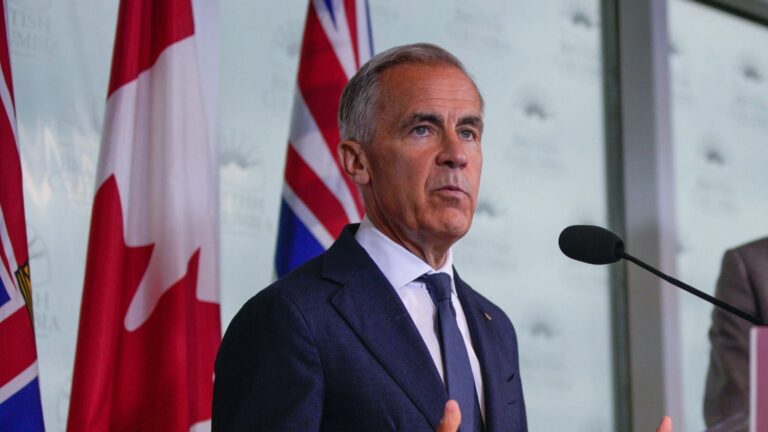
Prime Minister Mark Carney rejected the Trump administration’s allegations on October 23, saying there was “no merit” to claims that Canadian politicians were improperly attempting to influence the November 3 U.S. midterm elections. His response came after the U.S. Embassy in Ottawa circulated a fact sheet highlighting comments, meetings and political activity involving Canadian officials, including Industry Minister Mélanie Joly and Ontario Premier Doug Ford. The confrontation is unfolding as trade relations remain deeply strained by tariffs, stalled negotiations and increasingly personal political rhetoric on both sides of the border.
Carney Draws a Bright Line Between Diplomacy and Election Meddling
Carney Says U.S. Election Interference Accusations Have ‘No Merit’ as Trump Administration Targets Canadian Politicians
- Carney Draws a Bright Line Between Diplomacy and Election Meddling
- What the U.S. Embassy Is Actually Alleging
- Why Mélanie Joly’s Tariff Strategy Became the Centrepiece
- Doug Ford’s Reagan Ad Still Casts a Long Shadow
- Housefather, Jordan and the Illegal-Voting Cases Are Different Questions
- Influence and Interference Are Not the Same Legal Concept
- Hoekstra’s Warning Lands in an Already Fractured Relationship
- The Midterms Now Sit Inside a Much Bigger Trade Fight
Speaking in Istanbul during a visit to Turkey, Carney said he was disappointed by the allegations coming from U.S. Ambassador Pete Hoekstra and argued there was no basis for portraying Canadian government activity as election interference. His government’s position is that advocating for Canadian businesses, challenging American tariffs and speaking with elected officials from both U.S. parties are routine parts of diplomacy between economies that conduct hundreds of billions of dollars in cross-border trade. That defence is particularly important because much of the conduct highlighted by Washington occurred publicly rather than through secret political organizations, anonymous funding or covert communications.
Ottawa is nevertheless behaving cautiously. Canadian diplomats in the United States were instructed this week not to meet with candidates running in the midterm elections or attend their campaign events. Officials were also advised to avoid photographs and public communications that could create the appearance of involvement when candidates happen to be present. The risk-averse policy suggests that, even while rejecting Washington’s accusations, Canada recognizes how easily normal diplomatic contact could become politically explosive in the current environment.
What the U.S. Embassy Is Actually Alleging
The American case does not revolve around a single alleged operation. Instead, the U.S. Embassy assembled a collection of incidents involving Canadian politicians, diplomats and private individuals. Among the examples were Joly’s comments about using retaliatory tariffs to create pressure in politically important states, Ford’s proposal to target certain Republican-leaning states with Canadian countermeasures, Ontario’s U.S. advertising campaign criticizing tariffs, Liberal MP Anthony Housefather’s political volunteering in Florida and a Vermont trade event attended by former Nova Scotia premier and Canadian diplomat Bernadette Jordan.
The embassy also pointed to criminal cases involving Canadians accused of voting illegally in U.S. elections. Those cases add a serious element to the debate because non-citizen voting in federal elections is unlawful, but they are fundamentally different from allegations against Ottawa. Public reporting has not established that the accused voters were acting for the Canadian government or were part of a coordinated Canadian political operation. The fact sheet therefore combines government policy, diplomatic activity, partisan volunteering and individual criminal allegations under a broad concern about Canadian involvement in American politics.
Why Mélanie Joly’s Tariff Strategy Became the Centrepiece
Joly became a central figure in the American allegations largely because she has openly described Canada’s retaliatory trade strategy in political terms. After Washington imposed a 50% tariff affecting approximately C$27.6 billion worth of Canadian products in August, Ottawa announced matching counter-tariffs on the same value of American goods. The measures, which took effect in September at rates of 15%, 25% and 50% depending on the product, covered sectors including steel, agricultural equipment, appliances, electronics and pulp and paper.
While explaining the strategy, Joly acknowledged that Canada was considering where U.S. products originated and how tariffs could generate political pressure on Washington. That language gave the Trump administration an obvious talking point. Joly, however, has maintained that her U.S. outreach is economic diplomacy rather than election campaigning. She has stressed that she meets Republicans as well as Democrats and has used American visits to discuss investment, jobs and trade. Governments routinely design trade retaliation for maximum political impact; the unresolved dispute is whether openly doing so during an election season should be characterized as interference.
Doug Ford’s Reagan Ad Still Casts a Long Shadow
Ontario Premier Doug Ford had already tested Washington’s tolerance for Canadian political messaging long before the latest embassy statement. In August, Ford urged the federal government to consider retaliatory tariffs on products from politically significant states, naming Alabama, Arkansas, Florida, Iowa, Missouri, Montana, Texas and Wisconsin. His argument was strategic: if American tariffs were hurting Ontario workers, Canadian countermeasures should create pressure where U.S. politicians would feel it most strongly.
The more dramatic confrontation came from Ontario’s approximately C$75-million U.S. advertising campaign in 2025. One commercial used excerpts from a 1987 speech by former president Ronald Reagan warning about the economic costs of tariffs. It aired in American markets and during World Series broadcasts, placing a Canadian provincial government’s message directly in front of U.S. voters. Trump reacted furiously and terminated trade negotiations with Canada over the campaign. Ford later agreed to pause the ads. The episode demonstrates why Ontario remains central to Washington’s accusations: unlike quiet lobbying, the campaign was intentionally public and designed to shape American opinion about a defining Trump policy.
Housefather, Jordan and the Illegal-Voting Cases Are Different Questions
Some of the incidents highlighted by the United States require more nuance than the tariff fight. Liberal MP Anthony Housefather travelled to Florida and volunteered during Democratic Rep. Debbie Wasserman Schultz’s 2026 primary campaign. That creates different optics from meeting government officials about trade, but foreign nationality does not automatically make campaign volunteering illegal. Federal Election Commission guidance allows foreign nationals to provide uncompensated personal volunteer services, provided they do not make prohibited contributions or participate in campaign-management or decision-making processes. No publicly established finding cited in the current dispute shows that Housefather crossed those legal boundaries.
Jordan’s appearance at an October trade roundtable in Vermont also occurred publicly alongside U.S. politicians and business representatives and focused on tariffs and cross-border economic consequences. Separately, the embassy highlighted 11 Canadians who had been charged or sentenced in cases involving illegal voting. Recent Justice Department announcements confirm multiple prosecutions involving Canadian nationals. Those allegations should be treated seriously, but charges are not the same as convictions, and public reporting has not connected the individual cases to Carney’s government. Treating all three categories as one phenomenon risks obscuring major factual and legal differences.
Influence and Interference Are Not the Same Legal Concept
The terminology at the heart of the dispute matters. Canada’s own security agencies distinguish ordinary foreign influence from foreign interference. Governments legitimately attempt to influence one another every day through diplomacy, lobbying, public advocacy and trade negotiations. Canadian security guidance generally reserves “foreign interference” for activity that is clandestine, deceptive, threatening or otherwise conducted in a way that harms Canadian interests. Similar language appears in U.S. government descriptions of foreign election interference, which emphasize covert, fraudulent, deceptive or unlawful conduct intended to affect elections or undermine confidence in them.
That distinction does not mean foreign governments have unlimited freedom to participate in another country’s politics. Election-finance rules, contribution restrictions, campaign laws and diplomatic conventions still apply. But it does mean that an openly funded Ontario advertisement, a minister publicly threatening retaliatory tariffs and an ambassador attending a public trade meeting are not automatically equivalent to a covert influence operation. Based on the evidence made public so far, Washington has identified conduct it considers politically inappropriate without publicly demonstrating a secret Canadian government operation designed to manipulate American voting.
Hoekstra’s Warning Lands in an Already Fractured Relationship
The embassy statement did not emerge in isolation. Hoekstra had already warned Canadian politicians that Washington was closely monitoring their behaviour ahead of the midterms and told them, in unusually sharp language for an ambassador, to keep their “nose out” of American elections. Trump trade adviser Peter Navarro has also warned Canada against attempting to affect political outcomes in states such as Michigan and Maine. The rhetoric has generated a strong backlash in Canada, with more than 280,000 people signing a parliamentary petition seeking action against Hoekstra.
The accusations are particularly combustible because Canadians have spent the past two years hearing political commentary flowing in the opposite direction. Trump repeatedly raised the prospect of Canada becoming the “51st state,” while Treasury Secretary Scott Bessent publicly described Alberta as a “natural partner” for the United States amid renewed separatist discussion. U.S. State Department officials also reportedly met representatives of an Alberta separatist organization. Carney has pointed to such episodes when arguing that Washington should apply the same non-interference standard to its own officials that it now demands from Canadians.
The Midterms Now Sit Inside a Much Bigger Trade Fight
The November 3 midterms will determine control of the entire 435-seat U.S. House of Representatives and roughly one-third of the Senate, making almost any foreign political activity unusually sensitive. For Canada, however, the election is intertwined with a much larger economic confrontation. Washington’s latest 50% tariffs affect roughly C$27.6 billion in Canadian exports, while Ottawa has answered with equivalent retaliatory measures. Trade negotiations were suspended in August after Canada said the United States changed its terms shortly before another tariff increase took effect.
Carney has said Canada is prepared to restart negotiations immediately if Washington is willing to bargain in good faith, but he has resisted the idea that an agreement must be completed before Americans vote. Canada, he has argued, cannot simply stop protecting its economic interests whenever the United States enters an election period. That may become the defining issue behind the interference dispute. What began as a fight over steel, tariffs and market access is increasingly becoming a disagreement over how far one neighbour can go in publicly applying political pressure to another—and who gets to decide when that pressure becomes election interference.
This Options Discord Chat is The Real Deal
While the internet is scoured with trading chat rooms, many of which even charge upwards of thousands of dollars to join, this smaller options trading discord chatroom is the real deal and actually providing valuable trade setups, education, and community without the noise and spam of the larger more expensive rooms. With a incredibly low-cost monthly fee, Options Trading Club (click here to see their reviews) requires an application to join ensuring that every member is dedicated and serious about taking their trading to the next level. If you are looking for a change in your trading strategies, then click here to apply for a membership.