35,000+ smart investors are already getting financial news, market signals, and macro shifts in the economy that could impact their money next with our FREE weekly newsletter. Get ahead of what the crowd finds out too late. Click Here to Subscribe for FREE.
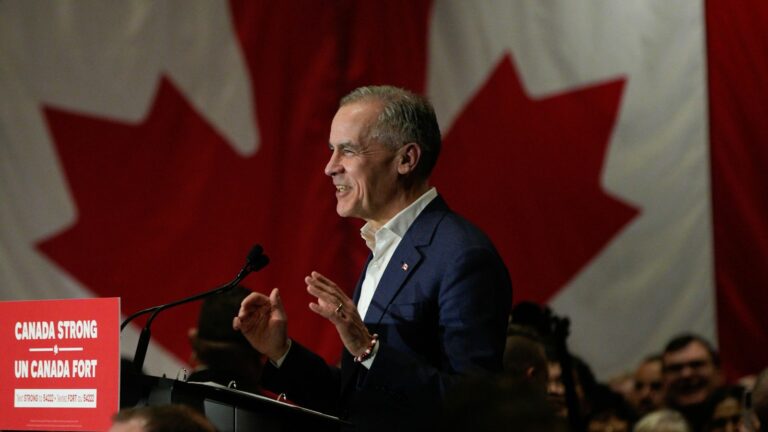
Canada’s federal political landscape remains tilted toward Mark Carney’s Liberals, but the latest Abacus Data numbers are less straightforward than a seven-point lead suggests. The party stands at 42% among committed voters, compared with 35% for Pierre Poilievre’s Conservatives, while government approval remains above 50%. At the same time, Quebec has shifted sharply toward the Bloc Québécois, affordability still dominates household concerns, and Poilievre’s personal negatives have worsened.
The most striking international finding is even more lopsided: 80% of Canadians say the United States is on the wrong track, compared with only 12% who believe it is heading in the right direction. With Canada-U.S. trade negotiations approaching another tariff deadline, those views are not an abstract foreign-policy judgment. They are increasingly intertwined with domestic politics, economic anxiety and perceptions of which leader can protect Canadian interests.
The Seven-Point Lead Is Not a Liberal Surge
Carney Liberals Lead Poilievre 42–35 as 80% of Canadians Say U.S. Is on Wrong Track: Abacus
- The Seven-Point Lead Is Not a Liberal Surge
- Quebec Is Where the Political Ground Moved
- Carney’s Personal Ratings Give Liberals a Buffer
- Poilievre Has a Conversion Problem
- Canada’s Electoral Map Is Still Deeply Divided
- Affordability Still Comes Before Almost Everything Else
- The 80% U.S. Number Needs an Important Distinction
- The Trade Fight Gives the U.S. Mood Immediate Stakes
- These Numbers Are a Snapshot, Not an Election Forecast
Strictly speaking, Abacus’s 42–35 result is a comparison of Liberal and Conservative vote intention, not a direct personal contest between Carney and Poilievre. Among committed voters, the Liberals are at 42%, Conservatives 35%, NDP 10%, Bloc Québécois 8%, Greens 4% and People’s Party 2%. The Liberal lead has widened from six points to seven since the previous Abacus wave completed July 29.
That widening did not come from a Liberal surge. Liberal support fell two points, while Conservative support fell three, with smaller parties absorbing the difference. That distinction matters because it suggests relative advantage rather than accelerating momentum. The current numbers also differ notably from the April 2025 federal election, when Elections Canada recorded 43.8% of valid votes for the Liberals and 41.3% for the Conservatives. The governing party is therefore polling below its election vote share, but the Conservatives are further below theirs. That is a meaningful gap.
Quebec Is Where the Political Ground Moved
The biggest movement is in Quebec, where the national topline hides a dramatic two-week change. Abacus has the Liberals at 37% in the province, down from 48% on July 29, while the Bloc Québécois has climbed from 28% to 35%. The Conservatives sit at 18%. What had been a 20-point Liberal advantage over the Bloc has narrowed to only two points.
Outside Quebec, the Liberal position is unchanged at 43%, while Conservative support has slipped from 43% to 40%. That concentration makes Quebec the key source of the Liberals’ national decline. Abacus cautions that regional samples are more volatile, so one wave should not automatically be treated as a durable realignment. Still, the timing is politically sensitive. Canada-U.S. talks have included disputes over dairy access and quota administration, while a federal by-election in Chicoutimi–Le Fjord is scheduled for August 31, keeping trade and Quebec economic interests unusually visible for voters.
Carney’s Personal Ratings Give Liberals a Buffer
Carney’s strongest buffer is his standing. Abacus finds 51% of Canadians have a positive impression of the prime minister and 31% a negative one, giving him a net score of +20. Two weeks earlier, his net score was +17. Federal government approval is holding at 52%, with 31% disapproving and 17% neither approving nor disapproving.
Those numbers help explain why the Liberal drop in Quebec does not yet look like a wholesale rejection of Carney. In Quebec, his net personal rating is +32, essentially unchanged from the previous wave even as Liberal vote intention fell. That gap between leader image and immediate vote choice suggests some voters may be movable rather than permanently lost. It also gives the Liberals room to recover if the issue environment improves. A party can lose soft supporters quickly during a volatile trade fight, but a leader who remains personally well regarded retains an asset.
Poilievre Has a Conversion Problem
Poilievre faces the reverse problem: the Conservatives are close enough to remain competitive, but his personal ratings may limit the party’s ability to capitalize on government vulnerabilities. Abacus reports that 35% of Canadians view the Conservative leader positively and 46% negatively, producing a net impression of -11. Two weeks earlier, he stood at 37% positive and 43% negative, or -6 net.
The regional pattern adds to the challenge. Poilievre is net positive in Alberta and Saskatchewan-Manitoba, but negative in British Columbia, Ontario, Quebec and Atlantic Canada. Among Canadians aged 60 and older, his net rating is -22. That matters because older voters are also one of the Liberals’ strongest groups in current vote intention. None of this means Conservative support cannot rise; opinion can change quickly when economic conditions or events shift. But at this moment, dissatisfaction with Ottawa is not automatically translating into greater enthusiasm for the opposition leader.
Canada’s Electoral Map Is Still Deeply Divided
The national map remains sharply divided. In Ontario, Abacus places the Liberals at 48% and Conservatives at 37%. British Columbia is closer, with Liberals at 42% and Conservatives at 36%, while Atlantic Canada shows a 48–33 Liberal advantage. Alberta moves heavily the other way: Conservatives are at 58%, compared with 30% for the Liberals. Saskatchewan and Manitoba combined also favour the Conservatives, 46–36.
Age produces another important split. Voters 60 and older back the Liberals 51–34, a 17-point advantage. Among those aged 18 to 29, the two major parties are tied at 35%, while the NDP reaches 19%. The Conservatives narrowly lead 35–34 among voters aged 30 to 44. These differences show why a single national number can conceal very different political realities. Winning more votes in regions already dominated by one party does not have the same electoral value as moving persuadable voters in competitive provinces and age groups.
Affordability Still Comes Before Almost Everything Else
Despite the attention on Washington, costs remain the dominant concern. Abacus finds 61% of Canadians select the rising cost of living as one of their three most important issues. That figure is down four points from the previous wave, but it remains ahead of every other concern. The broader economy and Donald Trump’s administration are tied at 38%, followed by healthcare at 34%.
Housing affordability is selected by 30%, while immigration stands at 21% and climate change and the environment at 19%. The mix creates competing pressures for both parties. Conservatives have an opening whenever voters are focused on household finances, wages and economic weakness, while Liberals have benefited politically when Canada-U.S. relations and external instability dominate attention. The key point is that neither agenda has displaced the other. Many Canadians are simultaneously worried about what groceries and housing cost at home and about economic decisions being made in Washington.
The 80% U.S. Number Needs an Important Distinction
The 80% “wrong track” figure is the clearest measure of how negatively Canadians currently view the direction of the United States. Only 12% tell Abacus the U.S. is heading in the right direction, while 8% are unsure or do not state a view. By comparison, Canadians are almost evenly divided on their own country: 43% say Canada is heading in the right direction and 42% say it is on the wrong track.
That result should not be read as proof that four in five Canadians dislike Americans. Other recent research distinguishes between the U.S. government and its people. Angus Reid found 79% of Canadians held an unfavourable view of Trump, while views of Americans themselves were more evenly divided: 45% favourable and 48% unfavourable. Pew Research Center separately found 33% of Canadian adults had a favourable view of the United States in spring 2026, down from 57% in 2023 overall.
The Trade Fight Gives the U.S. Mood Immediate Stakes
The timing gives those U.S. numbers political weight. During and just after the Abacus field period, Canadian and American officials were negotiating over a new U.S. tariff threat scheduled for August 19. Reuters reported that the proposed 50% duties would cover nearly US$20 billion in Canadian goods, including products that would otherwise receive preferential treatment under the Canada-U.S.-Mexico trade agreement.
The dispute includes American complaints about Canadian autos, dairy quota administration and restrictions on U.S. alcohol, while Canada has sought relief from U.S. tariffs on steel and aluminum. By August 14, Reuters reported that Canadian officials still saw distance between the two sides, with Trade Minister Dominic LeBlanc remaining in Washington as talks continued. For Carney, that turns public frustration with the United States into both an opportunity and a risk: Canadians may reward perceived steadiness, but an unpopular concession or damaging tariff outcome could quickly reshape the political mood.
These Numbers Are a Snapshot, Not an Election Forecast
The Abacus release is a snapshot, not a prediction of the next federal election. The poll was conducted from August 7 to 12 with 1,499 Canadian adults recruited through partner online panels using the PureSpectrum platform. Abacus says the data were weighted to census benchmarks and reports that a comparable probability-based random sample of the same size would have a margin of error of plus or minus 2.5 percentage points, 19 times out of 20.
That wording matters. Canadian research standards note that sampling-error margins apply to probability samples, not opt-in non-probability panels. Regional and demographic subsamples are smaller, making movements more uncertain. The strongest conclusions therefore come from patterns appearing across several measures: a Liberal national advantage, strong Carney personal ratings, weaker Poilievre impressions, an unsettled Quebec electorate and deep pessimism about the United States. The next Abacus wave will show whether those patterns hold after the trade deadline.
This Options Discord Chat is The Real Deal
While the internet is scoured with trading chat rooms, many of which even charge upwards of thousands of dollars to join, this smaller options trading discord chatroom is the real deal and actually providing valuable trade setups, education, and community without the noise and spam of the larger more expensive rooms. With a incredibly low-cost monthly fee, Options Trading Club (click here to see their reviews) requires an application to join ensuring that every member is dedicated and serious about taking their trading to the next level. If you are looking for a change in your trading strategies, then click here to apply for a membership.