35,000+ smart investors are already getting financial news, market signals, and macro shifts in the economy that could impact their money next with our FREE weekly newsletter. Get ahead of what the crowd finds out too late. Click Here to Subscribe for FREE.
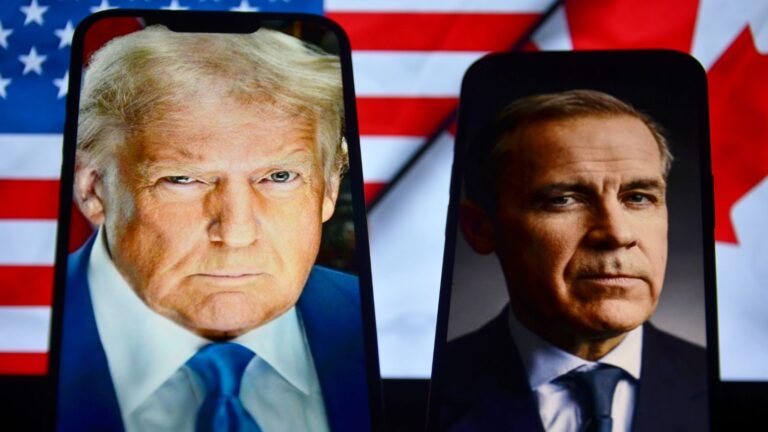
Prime Minister Mark Carney left New York on September 23 without a bilateral meeting with U.S. President Donald Trump, even though both leaders spent time at the United Nations General Assembly. Instead, one of Carney’s final major appearances placed him beside European Commission President Ursula von der Leyen, where Canada committed $82 million over five years to global ocean observation.
The contrast was striking, but it was not as simple as Canada choosing Europe over Washington. Carney attended Trump’s UN address and remained engaged with the United States even as trade relations have deteriorated. At the same time, his New York schedule illustrated a broader Canadian strategy: strengthen relationships with Europe and other partners while reducing the risks created by dependence on a single economic and diplomatic relationship.
Carney and Trump Were in the Same City but Never Sat Down
Carney Leaves New York Without a Trump Meeting, Pledges $82 Million Alongside EU Chief Instead
- Carney and Trump Were in the Same City but Never Sat Down
- His Final New York Event Put Canada Beside the European Union
- The $82 Million Is Going Toward Infrastructure Most People Rarely See
- The Event Continued a Canada-EU Push That Began Before New York
- Carney’s UN Schedule Extended Far Beyond the U.S.-Canada Dispute
- The Missing Trump Meeting Came Against a Much Tougher Trade Backdrop
- Canada Is Trying to Build More Options, Not Simply Change Partners
- The New York Trip Showed the Direction of Travel — With Important Limits
Carney travelled to New York from September 21 to 23 for the 81st United Nations General Assembly, his first U.S. visit since Canada-U.S. trade negotiations broke down in August. Trump was there as well, delivering his address to the General Assembly and holding meetings with several international leaders. Carney attended Trump’s speech, yet the two leaders did not hold a bilateral meeting. Canadian officials had already indicated before the trip that no meeting with the U.S. administration was scheduled, and the crowded UN calendar ultimately did not produce one.
When journalists asked Carney about the absence of direct contact, he emphasized a different purpose for the gathering: meeting leaders he does not normally have opportunities to see. That distinction matters. A missed bilateral at a major international summit does not, by itself, prove a diplomatic rupture. Still, the optics were difficult to ignore because of the economic dispute unfolding between the neighbours and the attention surrounding Carney’s efforts to develop partnerships beyond the United States.
His Final New York Event Put Canada Beside the European Union
Carney’s last major engagement before departing New York was a leader-level event with European Commission President Ursula von der Leyen launching the OceanEye International Alliance. Canada announced an $82 million commitment over five years to expand ocean-observation capabilities and support the Global Ocean Observing System. The European Union had committed €50 million for global ocean-monitoring activities, putting the two co-chairs behind roughly equivalent headline commitments when converted between currencies.
The gathering generated considerably more than the Canadian and European pledges alone. Canada said the event secured more than $339 million, or €211 million, through a combination of money, equipment and other contributions. Research vessels, sensors, drones and data-processing infrastructure can all count toward the international effort. Thirty-one members had joined the alliance by launch day, including Canada, the EU and countries stretching from Brazil and South Korea to Norway, the United Kingdom and several European states. For Carney, that gave the event a tangible deliverable rather than simply another diplomatic declaration.
The $82 Million Is Going Toward Infrastructure Most People Rarely See
Ocean observation can sound remote from everyday life, but the information collected at sea feeds systems used for weather forecasting, storm warnings, maritime navigation, climate modelling and coastal planning. The Global Ocean Observing System coordinates thousands of platforms spread across the world’s oceans. These can include floats, buoys, research vessels, gliders and fixed monitoring stations measuring variables such as temperature, salinity, sea level, oxygen levels and changes in marine ecosystems.
The new money is intended to help maintain observation platforms, fill important geographical data gaps and strengthen the international institutions that organize and distribute ocean information. Arctic waters, the deep ocean and parts of the Southern Hemisphere remain particularly difficult to monitor consistently. UNESCO has warned that global observing capacity remains vulnerable because coverage is uneven and funding relies heavily on a relatively small group of contributors. That makes the initiative relevant to Canada beyond climate diplomacy. A country bordered by three oceans has practical interests in better forecasting, safer shipping, Arctic awareness and improved information about rapidly changing marine conditions.
The Event Continued a Canada-EU Push That Began Before New York
The appearance beside von der Leyen did not emerge suddenly at the UN. Only a week earlier, Carney had travelled to Strasbourg, where he attended von der Leyen’s State of the European Union address and spoke to the European Parliament. The two sides discussed a relationship extending beyond the existing Comprehensive Economic and Trade Agreement, with potential cooperation involving critical minerals, defence production, artificial intelligence, computing capacity, energy, space, financial services and digital trade.
Von der Leyen also opened the door to Canada potentially becoming what she called the European Union’s first “associate member.” That term currently has no established legal form within the EU, and European governments would have to determine what such an arrangement actually means. Carney has stressed that Canada is not seeking conventional EU membership and has focused instead on the substance of a new alliance. Trump reacted critically to the associate-membership idea and raised the possibility of additional tariffs. European officials, meanwhile, have said closer cooperation with Canada is not intended to create an anti-American bloc.
Carney’s UN Schedule Extended Far Beyond the U.S.-Canada Dispute
The absence of a Trump meeting attracted attention, but Carney’s New York visit contained several other commitments. Canada joined Australia, Barbados, Brazil, the European Union, India and Kenya as an initial sponsor of the new Partners for Multilateralism coalition. The initiative is intended to bring governments together around international law, UN reform, resilient supply chains and cooperation on issues ranging from artificial intelligence to climate change and global health.
Carney also co-hosted a high-level meeting related to the Israeli-Palestinian conflict and announced an additional $100 million in Canadian assistance for Palestinians. The government said $80 million would support humanitarian assistance in Gaza and the West Bank, while $20 million would go toward peace and stabilization initiatives. Canada announced another $16.5 million for global biosecurity projects and more than $24 million connected with implementation of the High Seas Treaty. Carney separately met leaders from Chile, Angola and Jordan, with his meeting with Jordan’s King Abdullah II covering regional security and expanded defence cooperation.
The Missing Trump Meeting Came Against a Much Tougher Trade Backdrop
The political significance of the New York schedule cannot be separated from the deterioration in Canada-U.S. trade relations. Negotiations that appeared to be making progress in August ultimately broke down. The United States then imposed 50 per cent tariffs on a range of Canadian products representing C$27.6 billion in trade, according to the Canadian government. Ottawa responded with counter-tariffs on the same value of U.S. imports, applying rates of 15, 25 and 50 per cent depending on the product.
The dispute has since expanded. The Trump administration announced restrictions that would exclude certain Canadian products from the U.S. market beginning September 29, while Ottawa has continued developing support programs for industries affected by tariffs. Both governments have presented sharply different accounts of why negotiations failed: Canadian officials said the concessions requested by Washington were unacceptable, while U.S. officials accused Canada of retreating from a near-final agreement. Against that backdrop, Carney’s first U.S. trip since the talks collapsed was always likely to be scrutinized for signs of renewed engagement.
Canada Is Trying to Build More Options, Not Simply Change Partners
Carney’s approach increasingly revolves around what his government describes as diversification and collective resilience. The Partners for Multilateralism initiative reflects that idea particularly clearly. Its original sponsors span several regions rather than forming a traditional military or trading bloc, and more countries joined after the September 21 launch. The declaration behind the group focuses on international law, supply-chain resilience, institutional reform and cooperation among countries facing pressure from a more competitive global environment.
The economic logic is significant because diversification remains difficult for Canada. Statistics Canada found that 71.7 per cent of Canadian merchandise exports still went to the United States in 2025, despite that share declining from 75.9 per cent a year earlier. Global Affairs Canada similarly reports that roughly 72 per cent of Canadian goods exports go south of the border, while services are more diversified. Europe, Asia and other markets can therefore provide additional customers and investment, but replacing the scale, geography and deeply integrated supply chains of the U.S. market would be an entirely different proposition.
The New York Trip Showed the Direction of Travel — With Important Limits
The most defensible conclusion from Carney’s three days in New York is not that Canada has abandoned Washington for Brussels. Canada and the United States remain connected through enormous trade flows, continental defence structures, energy networks and supply chains that cannot be quickly replicated elsewhere. The lack of a Carney-Trump bilateral also needs to be kept in perspective: UN gatherings involve complicated schedules, and Carney himself framed the event as an opportunity to prioritize leaders he encounters less frequently.
What did change the symbolism was what happened alongside that absence. Carney left after committing Canadian money to a project co-led by the European Union, following a European trip where both sides had already begun discussing a deeper strategic relationship. He also spent much of the UN gathering building coalitions that deliberately stretch beyond traditional North American diplomacy. The $82 million ocean commitment is modest compared with the scale of Canada-U.S. commerce, but the setting around it captured something larger: Ottawa is actively trying to ensure that Washington is no longer the only relationship capable of defining Canada’s room to manoeuvre.
This Options Discord Chat is The Real Deal
While the internet is scoured with trading chat rooms, many of which even charge upwards of thousands of dollars to join, this smaller options trading discord chatroom is the real deal and actually providing valuable trade setups, education, and community without the noise and spam of the larger more expensive rooms. With a incredibly low-cost monthly fee, Options Trading Club (click here to see their reviews) requires an application to join ensuring that every member is dedicated and serious about taking their trading to the next level. If you are looking for a change in your trading strategies, then click here to apply for a membership.