35,000+ smart investors are already getting financial news, market signals, and macro shifts in the economy that could impact their money next with our FREE weekly newsletter. Get ahead of what the crowd finds out too late. Click Here to Subscribe for FREE.
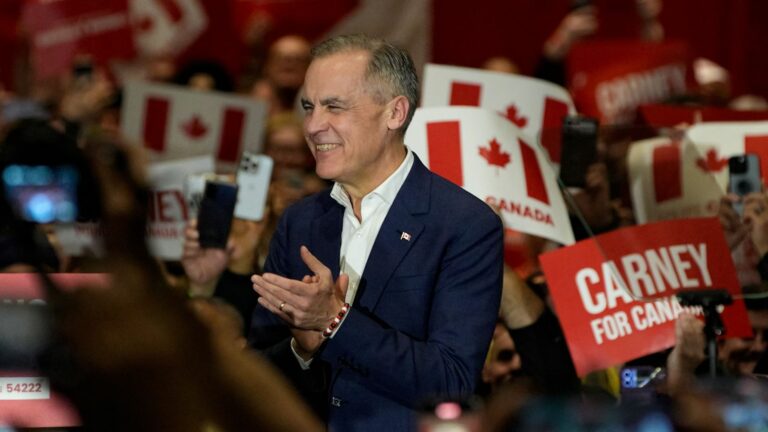
Prime Minister Mark Carney is embarking on a major diplomatic mission that will place Canada at the centre of high-stakes international discussions involving China, the United States and Russia. His November 11–19, 2026, trip includes stops in Ireland, the Philippines, Cambodia and China, where trade negotiations and global security concerns are expected to dominate.
The timing is particularly significant. U.S. President Donald Trump has indicated that he expects to meet Chinese President Xi Jinping and Russian President Vladimir Putin during the upcoming Asia-Pacific Economic Cooperation summit. For Canada, the gathering represents an opportunity to strengthen economic relationships, reduce dependence on the American market and navigate increasingly complicated international alliances.
A Four-Country Diplomatic Mission With China at the Centre
Carney Heads to China for Trade Talks as Trump Prepares Meetings With Xi and Putin
- A Four-Country Diplomatic Mission With China at the Centre
- Carney and Xi Seek to Strengthen a Complicated Relationship
- Trump’s Possible Meeting With Xi and Putin Raises the Stakes
- Canadian Farmers and Seafood Exporters Gain New Trade Certainty
- Chinese Electric Vehicles and Steel Add Complexity to Trade Talks
- Foreign Interference Remains a Major Diplomatic Obstacle
- Canada Looks Beyond the United States to Reduce Economic Dependence
- Ukraine and Iran Could Overshadow the Economic Agenda
- Europe and Southeast Asia Offer Additional Opportunities for Canada
- The Real Test Will Be Whether Diplomacy Produces Results
Carney’s eight-day international itinerary is designed to strengthen Canada’s economic and security relationships beyond North America. His journey includes the European Political Community summit in Ireland, the Association of Southeast Asian Nations summit in the Philippines, the Francophonie summit in Cambodia and the Asia-Pacific Economic Cooperation gathering in Shenzhen, China. The federal government has emphasized that expanding international trade and attracting foreign investment are central objectives. These efforts come as Canada faces pressure to diversify its economic relationships while maintaining access to its largest trading partner, the United States.
The Chinese portion of the trip carries particular significance because of the country’s economic influence and its complicated relationship with Ottawa. According to the Canadian government, APEC’s 21 member economies represented more than 60% of global gross domestic product in 2025. The Shenzhen summit, scheduled for November 18–19, will bring together leaders from some of the world’s largest economies. For Canadian businesses, discussions that take place during these gatherings can eventually influence export opportunities, investment decisions and the reliability of international supply chains.
Carney and Xi Seek to Strengthen a Complicated Relationship
Carney’s planned meeting with Chinese President Xi Jinping represents another step in efforts to rebuild diplomatic and commercial ties between Ottawa and Beijing. The two leaders previously met in January 2026, following discussions at the 2025 APEC summit that marked their first formal engagement. On November 10, Carney confirmed that the upcoming talks would address the global security environment, economic cooperation and foreign interference. He emphasized that Canada’s relationship with China is expanding while maintaining boundaries around sensitive areas. The government has also selected a new ambassador to Beijing, although the appointment had not yet been publicly announced.
Trade is expected to feature prominently because China remains Canada’s second-largest single-country merchandise trading partner. Government figures show that bilateral merchandise trade reached approximately $125.7 billion in 2025. That relationship involves everything from agricultural exports and natural resources to manufactured products and consumer goods. However, expanding trade requires more than political goodwill. Businesses need predictable regulations, dependable market access and confidence that commercial disputes will not suddenly disrupt shipments. Carney’s discussions with Xi could help establish clearer expectations, but their practical value will depend on decisions made after the leaders leave Shenzhen.
Trump’s Possible Meeting With Xi and Putin Raises the Stakes
The diplomatic environment surrounding the Shenzhen summit has become more complicated following Trump’s comments about meeting with Xi and Putin. Speaking to reporters on November 8, the American president said he expected discussions involving both leaders during the November 18–19 gathering. Trump identified nuclear arms control and efforts to end the war in Iran as potential subjects. Russia has also expressed interest in using a three-way meeting to discuss the conflict in Ukraine. The proposed gathering would bring together three nuclear-armed powers whose strategic interests frequently collide, despite occasional areas of cooperation.
However, the proposed trilateral meeting should not be treated as a confirmed diplomatic agreement. Chinese officials have acknowledged discussions about such a gathering, while the Kremlin has indicated that preparations are underway. Final arrangements and a detailed agenda have not been publicly established. For Canada, the possibility introduces another layer of uncertainty. Decisions involving Washington, Beijing and Moscow could influence international security, commodity markets and future trade relationships. Carney will be seeking economic progress with China while potentially sharing the diplomatic stage with negotiations that carry consequences far beyond Canadian trade policy.
Canadian Farmers and Seafood Exporters Gain New Trade Certainty
One of the most concrete developments ahead of Carney’s visit is an agreement extending favourable Chinese market access for several important Canadian agricultural and seafood products. On November 4, International Trade Minister Maninder Sidhu announced that China would maintain preferential arrangements for Canadian canola meal, peas, lobster and crab until the end of 2028. The agreement extends measures negotiated during Carney’s January visit to Beijing and implemented in March. It provides additional stability for agricultural producers who have faced uncertainty over Chinese tariffs and market restrictions. For farmers and seafood businesses, predictable access is particularly valuable when planning production, processing and international shipments.
The benefits are especially significant for Canada’s canola industry. According to the Canola Council of Canada, exports of Canadian canola and canola products to China reached approximately $2.4 billion during the first eight months of 2026, an increase of 28% from the corresponding period in 2025. The latest agreement maintains the suspension of China’s previous 100% tariff on Canadian canola meal. However, other trade barriers remain, including tariffs affecting canola oil. For producers in Saskatchewan and Alberta, and seafood harvesters in Atlantic Canada, the extension offers welcome certainty without eliminating every difficulty associated with selling into the Chinese market.
Chinese Electric Vehicles and Steel Add Complexity to Trade Talks
Canada’s renewed relationship with China also involves policy decisions affecting domestic manufacturing. During Carney’s January 2026 visit, Ottawa agreed to establish an initial annual quota of 49,000 Chinese electric vehicles entering Canada at a tariff rate of 6.1%. The arrangement took effect on March 1, replacing the previous 100% surtax for vehicles admitted under the quota. The government expects the agreement to encourage investment involving Chinese automakers and Canadian manufacturing partners. It also anticipates that the share reserved for lower-priced vehicles, defined by an import price of $35,000 or less, will reach 50% by 2030.
The latest trade extension contains another important provision involving industrial products. Canada has agreed to maintain tariff-remission measures until the end of 2028 for certain Chinese steel and aluminum products that are not manufactured domestically. These limited exemptions are different from unrestricted access for all Chinese metal imports. Nevertheless, the measures illustrate how Ottawa is attempting to balance lower trade barriers with Canadian industrial interests. Increased Chinese investment could support new manufacturing activity, but the ultimate consequences will depend on actual projects, employment commitments and competitive conditions. Any expansion in Chinese vehicle imports also carries implications for Canada’s sensitive automotive trade relationship with the United States.
Foreign Interference Remains a Major Diplomatic Obstacle
Despite improving commercial relations, foreign interference remains one of the most sensitive issues between Ottawa and Beijing. Carney has confirmed that he intends to raise the matter directly with Xi during their upcoming meeting. His position reflects longstanding Canadian concerns involving alleged attempts by foreign governments to influence political institutions and democratic processes. A federal public inquiry led by Justice Marie-Josée Hogue concluded in January 2025 that China was the most active foreign interference actor targeting Canadian democratic institutions. However, the inquiry also found that Canada’s democratic institutions remained resilient and that foreign interference did not change the outcomes of the 2019 and 2021 federal elections.
Beijing has consistently denied allegations that it interferes in Canadian domestic affairs. Nevertheless, the issue presents a difficult balancing act for Carney’s government. Expanding trade could create meaningful opportunities for Canadian companies, but economic cooperation cannot substitute for safeguards protecting democratic institutions and national security. At a November 10 news conference, Carney stressed that direct meetings allow leaders to raise difficult subjects openly. His approach suggests Ottawa wants to maintain commercial engagement with China while preserving the ability to challenge Beijing over activities considered contrary to Canadian interests.
Canada Looks Beyond the United States to Reduce Economic Dependence
Canada’s renewed engagement with China reflects a larger economic strategy aimed at reducing its reliance on the American market. Statistics Canada reported that 71.7% of Canadian merchandise exports went to the United States in 2025, down from 75.9% in 2024. Although the United States remains Canada’s dominant export destination, the figures demonstrate a gradual shift toward other markets. The federal government’s 2026 budget also reiterates its ambition to double exports to non-American destinations over the next decade. Achieving that objective would require stronger relationships with major economies across Europe, Asia and other regions.
The urgency surrounding diversification has increased because of ongoing trade tensions with Washington. Trump’s tariffs and demands in Canada–U.S. negotiations have created uncertainty for manufacturers, exporters and investment planners. Carney has emphasized that the American administration remains central to resolving those disputes, regardless of political developments in Congress. At the same time, pursuing new opportunities with China provides another route for Canadian businesses seeking customers beyond North America. Diversification cannot happen overnight, particularly when companies have spent decades building supply chains around the American market. However, expanding alternative export destinations could gradually reduce Canada’s exposure to sudden changes in U.S. trade policy.
Ukraine and Iran Could Overshadow the Economic Agenda
Although APEC primarily focuses on trade and regional economic cooperation, the ongoing conflicts in Ukraine and Iran could become major subjects of discussion. Trump’s interest in meeting Putin and Xi has attracted attention because of the possibility that the leaders could discuss international security arrangements without the direct participation of other affected governments. Russia’s war against Ukraine remains particularly sensitive. On November 10, American, Ukrainian and Russian representatives participated in renewed negotiations in Abu Dhabi, demonstrating that diplomatic efforts were already underway before the Shenzhen gathering. Ukrainian President Volodymyr Zelenskyy has emphasized the importance of ending the fighting and establishing security guarantees before addressing broader European security arrangements.
Iran represents another potentially significant issue. Trump has explicitly identified ending the war in Iran as a possible subject of discussions with Xi and Putin, alongside nuclear arms control. However, a proposed meeting does not guarantee agreement, particularly when the three governments have differing strategic objectives. For Canada, developments involving these conflicts could influence energy markets, international investment sentiment and relations with European allies. Ottawa also has an interest in ensuring that any diplomatic discussions concerning Ukraine respect the country’s sovereignty. These considerations mean Carney’s visit could involve balancing commercial opportunities with difficult questions about international security and the future direction of global diplomacy.
Europe and Southeast Asia Offer Additional Opportunities for Canada
While attention is concentrated on China, Carney’s meetings in Europe and Southeast Asia form another important part of Canada’s diversification strategy. In Ireland, the prime minister is participating in discussions with European leaders about economic cooperation, security and closer institutional relationships. Canada and the European Union have already launched an Alliance for the Future and are exploring a framework that could make Canada the EU’s first associate member. According to the federal government, two-way trade in goods and services with the European Union reached approximately $178 billion in 2025. Strengthening that relationship could provide Canadian businesses with additional opportunities in advanced technology, energy, manufacturing and investment.
Southeast Asia presents a different but equally important opportunity. Canadian merchandise trade with ASEAN countries reached $52.5 billion in 2025, increasing 23.7% from the previous year. Ottawa hopes to finalize a Canada-ASEAN free trade agreement that it estimates could unlock more than $3.5 billion in exports. Carney also intends to advance a separate agreement with the Philippines, which the government expects could triple bilateral trade by 2035. His stop in Cambodia for the Francophonie summit provides another platform for strengthening relationships with French-speaking countries. Together, these diplomatic engagements demonstrate that Canada’s strategy extends beyond China and aims to build commercial relationships across multiple regions.
The Real Test Will Be Whether Diplomacy Produces Results
Carney’s international meetings come shortly after Canada and China completed another round of high-level economic discussions. On November 8 and 9, Finance Minister François-Philippe Champagne and International Trade Minister Maninder Sidhu met Chinese Vice Premier He Lifeng in Vancouver. The discussions produced agreements to strengthen financial cooperation, including arrangements involving finance ministries and financial regulators. Both governments also reaffirmed their commitment to a more predictable environment for trade and investment. These developments demonstrate that the diplomatic relationship is already producing formal mechanisms for cooperation, even before Carney’s latest meeting with Xi.
Nevertheless, the effectiveness of Canada’s renewed international strategy will ultimately depend on measurable economic results. Ottawa has established a target of increasing Canadian exports to China by 50% by 2030, but achieving that goal will require sustained demand, improved market access and competitive Canadian businesses. Any promised Chinese investment in Canada’s automotive or energy industries will also need to materialize before its economic benefits can be assessed. Meanwhile, negotiations with Washington remain unresolved, and the proposed Trump-Xi-Putin meeting has not been finalized. As Carney approaches the Shenzhen summit, his challenge is to convert diplomatic engagement into opportunities for Canadian workers and businesses while protecting the country’s economic independence and security interests.
This Options Discord Chat is The Real Deal
While the internet is scoured with trading chat rooms, many of which even charge upwards of thousands of dollars to join, this smaller options trading discord chatroom is the real deal and actually providing valuable trade setups, education, and community without the noise and spam of the larger more expensive rooms. With a incredibly low-cost monthly fee, Options Trading Club (click here to see their reviews) requires an application to join ensuring that every member is dedicated and serious about taking their trading to the next level. If you are looking for a change in your trading strategies, then click here to apply for a membership.