35,000+ smart investors are already getting financial news, market signals, and macro shifts in the economy that could impact their money next with our FREE weekly newsletter. Get ahead of what the crowd finds out too late. Click Here to Subscribe for FREE.
Prime Minister Mark Carney has begun a high-stakes diplomatic tour spanning Ireland, the Philippines, Cambodia, and China, as Canada works to strengthen international trade relationships amid continuing uncertainty with the United States.
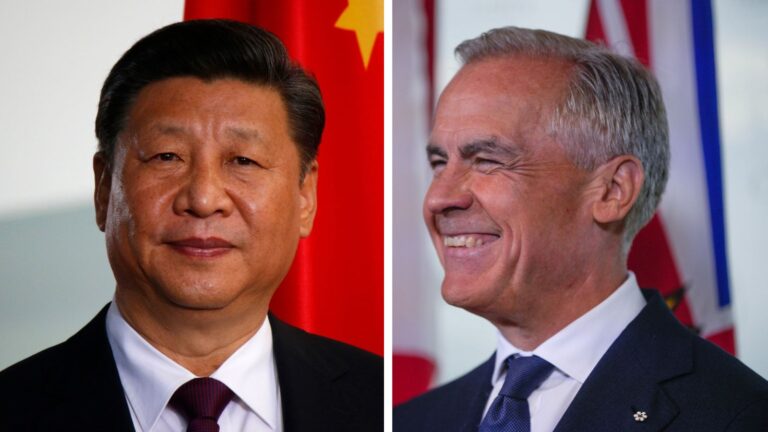
The November 11–19 trip comes at a particularly sensitive moment. U.S. President Donald Trump is preparing for discussions with Chinese President Xi Jinping, while Carney is expected to hold his own meeting with Xi during a major economic summit in China.
Across four international gatherings, Carney will pursue new trade opportunities, strengthen diplomatic partnerships, and reinforce Canada’s position in an increasingly unpredictable global economy. With tariff disputes, security concerns, and shifting international alliances affecting Canadian businesses, the government’s challenge is turning diplomatic agreements into meaningful economic results.
Ireland: Carney Opens His Tour by Strengthening Canada’s European Economic Partnerships
Carney Begins Four-Country Trade Tour as Trump and Xi Prepare for Separate China Talks
- Ireland: Carney Opens His Tour by Strengthening Canada’s European Economic Partnerships
- Philippines: Two Major Trade Agreements Could Open New Markets for Canadian Businesses
- Cambodia: Carney Uses Francophonie Summit to Build Economic and Diplomatic Relationships
- China: Carney Prepares for Xi Meeting as Trump Pursues His Own High-Stakes Negotiations
Carney’s first destination is Dublin, Ireland, where he arrived after departing Ottawa on November 11. He is attending the European Political Community Summit on November 12, joining leaders from across Europe to discuss economic competitiveness, security, infrastructure, and international cooperation. Canada has been invited as a guest to the gathering, reflecting its increasingly close relationship with European governments. The summit brings together representatives from European Union countries and other participating nations, creating opportunities for discussions that extend beyond traditional trade negotiations. The meeting also follows Carney’s participation in the European Political Community gathering in Armenia earlier this year. For Canada, closer European cooperation carries considerable economic importance. The European Union was Canada’s second-largest trading partner for goods and services in 2025, with bilateral trade valued at approximately $178 billion. These commercial relationships provide Canadian exporters with important alternatives as uncertainty continues to surround trade with Washington.
The Dublin discussions also build on a major diplomatic development announced in Montreal on October 30, when Canada and the European Union launched their Alliance for the Future. The initiative seeks deeper cooperation in energy, critical minerals, digital technologies, investment, and security. Both sides have also agreed to explore an unprecedented association arrangement that would bring Canada closer to the EU without making it a full member. The concept is expected to be defined by their 2027 summit, meaning no new membership rights have yet been established. Negotiations have also advanced on a digital trade agreement and an arrangement designed to facilitate European investment in Canadian critical resources. For Canadian manufacturers, technology companies, and resource producers, these initiatives could eventually create additional opportunities to participate in European supply chains. However, achieving meaningful results will depend on businesses securing contracts and governments implementing their commitments, rather than diplomatic announcements alone.
Philippines: Two Major Trade Agreements Could Open New Markets for Canadian Businesses
The Philippines represents one of the most commercially significant stops on Carney’s itinerary. In Manila, the prime minister will attend the Association of Southeast Asian Nations summit as a guest of Philippine President Ferdinand Marcos Jr., who chairs ASEAN in 2026. Ottawa is attempting to finalize negotiations on two separate agreements: a free trade agreement with ASEAN and another specifically with the Philippines. Together, these arrangements could improve access to a rapidly expanding economic region. Canada’s merchandise trade with ASEAN’s 11 member countries reached approximately $52.5 billion in 2025, representing an increase of 23.7% from the previous year. The Canadian government estimates that the broader free trade agreement could unlock more than $3.5 billion in additional export opportunities. However, those potential gains should not be confused with completed contracts or guaranteed economic growth. Businesses would still need to establish customers, distribution networks, and competitive pricing to capitalize on improved market access.
The proposed bilateral agreement with the Philippines offers another opportunity. Canada and the Philippines recorded approximately $3.4 billion in merchandise trade during 2025, and Ottawa projects that a successful agreement could help triple bilateral trade by 2035. The countries already strengthened their relationship in July 2026 when President Marcos visited Canada and announced a strategic partnership involving trade, energy, defence, and tourism. For Canadian farmers, aerospace suppliers, and clean-technology companies, expanding Southeast Asian markets could help reduce reliance on existing customers. Yet trade negotiations are only one part of the diplomatic picture. Trump is also expected to attend ASEAN meetings in Manila on November 17, raising the possibility that he and Carney could speak during the gathering. No formal bilateral meeting between the two leaders had been confirmed when the tour began. That uncertainty underscores how Canada’s commercial ambitions in Southeast Asia are unfolding alongside its difficult relationship with Washington.
Cambodia: Carney Uses Francophonie Summit to Build Economic and Diplomatic Relationships
Carney’s visit to Phnom Penh, Cambodia, will focus on strengthening Canada’s influence within the international French-speaking community while advancing broader economic and diplomatic relationships. The Cambodian capital is hosting the 20th Sommet de la Francophonie on November 15 and 16, bringing together leaders and representatives from an organization comprising 90 member states and governments. The summit addresses issues extending well beyond language preservation, including political cooperation, education, economic development, and international stability. Canada holds a prominent position within the organization as a founding member and one of its largest financial contributors, providing more than $43 million annually to Francophonie institutions. Canadian participation also reflects the country’s distinctive linguistic structure. Quebec and New Brunswick participate as member governments, while Ontario and Nova Scotia hold observer status. For Ottawa, these connections provide access to international networks that span Europe, Africa, Asia, and the Americas, creating opportunities to strengthen partnerships outside traditional North American markets.
The economic dimension will be especially visible through FrancoTech 2026, an innovation gathering running alongside the summit that connects entrepreneurs, investors, technology companies, and government representatives. Canadian business organizations and Quebec trade representatives are participating in related networking and commercial activities. Such gatherings can help smaller businesses explore unfamiliar markets without needing to establish a permanent overseas presence immediately. Canada also has an established economic relationship with Cambodia, with bilateral merchandise trade reaching approximately $2.4 billion in 2024, although most of that trade consisted of Cambodian exports to Canada. Another major priority involves the next Francophonie Summit, scheduled for Canada’s National Capital Region in 2028. Canada is expected to receive formal designation as the next host during the Cambodia gathering. That would mark its first time hosting the summit since Quebec City welcomed delegates in 2008. The upcoming event will give Canada another opportunity to promote French-language technology, cultural industries, and international economic cooperation.
China: Carney Prepares for Xi Meeting as Trump Pursues His Own High-Stakes Negotiations
The final and potentially most consequential destination is Shenzhen, China, where Carney will attend the Asia-Pacific Economic Cooperation Economic Leaders’ Meeting on November 18 and 19. The summit brings together representatives from 21 economies that accounted for more than 60% of global GDP and approximately 80.6% of Canada’s merchandise trade in 2025. Carney is expected to meet separately with Chinese President Xi Jinping as Ottawa attempts to build on the strategic partnership established earlier this year. China remains Canada’s second-largest single-country merchandise trading partner, with bilateral trade reaching $125.7 billion in 2025. Recent progress includes a November agreement extending favourable Chinese market access for Canadian canola meal, peas, lobster, and crab through the end of 2028. Canada will maintain corresponding tariff relief for certain Chinese steel and aluminum products unavailable from domestic production. These measures offer greater predictability for Canadian exporters, although disputes remain. Canadian canola oil, for example, continues to face a 100% Chinese tariff.
The discussions will unfold alongside major diplomatic manoeuvring involving Trump, Xi, and potentially Russian President Vladimir Putin. Trump has indicated that he expects meetings with the Chinese and Russian leaders during the summit, with nuclear arms control, international conflicts, and economic relations among the potential subjects. American and Chinese officials have been discussing arrangements, but a proposed three-way meeting involving all three leaders has not been finalized. Carney’s own discussions with Xi will involve a different set of priorities. The prime minister has confirmed that he intends to raise concerns about foreign interference in Canadian affairs while discussing global security and opportunities for deeper economic cooperation. Beijing has repeatedly rejected allegations of interference. Meanwhile, Canada must carefully manage its relationship with Washington, where significant tariff disagreements remain unresolved. The challenge extends beyond securing new export opportunities. Ottawa must demonstrate that closer commercial cooperation with China can benefit Canadian workers and businesses without creating new economic dependencies or compromising national security.
This Options Discord Chat is The Real Deal
While the internet is scoured with trading chat rooms, many of which even charge upwards of thousands of dollars to join, this smaller options trading discord chatroom is the real deal and actually providing valuable trade setups, education, and community without the noise and spam of the larger more expensive rooms. With a incredibly low-cost monthly fee, Options Trading Club (click here to see their reviews) requires an application to join ensuring that every member is dedicated and serious about taking their trading to the next level. If you are looking for a change in your trading strategies, then click here to apply for a membership.