35,000+ smart investors are already getting financial news, market signals, and macro shifts in the economy that could impact their money next with our FREE weekly newsletter. Get ahead of what the crowd finds out too late. Click Here to Subscribe for FREE.
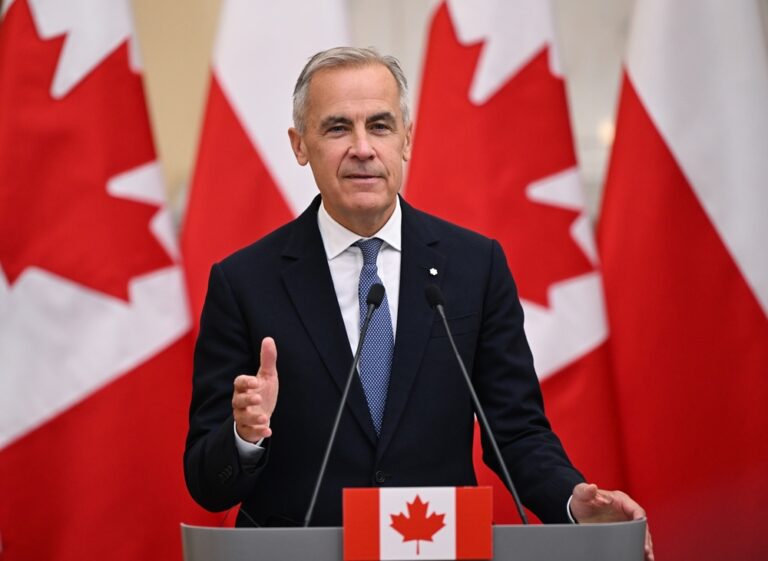
A C$39-million deal to modernize Portuguese military aircraft has given Ottawa something it badly wanted: a concrete Canadian defence win in Europe soon after Prime Minister Mark Carney tied the country more closely to the European Union’s security architecture. General Dynamics Mission Systems–Canada will upgrade five additional P-3C Orion aircraft under a government-to-government contract arranged by the Canadian Commercial Corporation.
The timing makes the agreement politically significant, but the fine print matters. Canada formally joined the EU’s Security Action for Europe procurement framework weeks before the contract was announced. Yet neither Ottawa nor Brussels has identified the Portuguese project as SAFE-financed, and it expands a program that began in 2022. The deal is therefore best understood as an early test of Carney’s European strategy—not definitive proof that the new EU fund has already produced its first Canadian award.
The Deal Behind the Headline
Canadian Defence Firm Wins First EU Arms Contract Under Carney’s New Security Pact
- The Deal Behind the Headline
- Why Portugal Is Upgrading an Older Patrol Fleet
- The Pact That Changed Canada’s Position in Europe
- Why SAFE Could Be Worth Far More Than One Contract
- How Government Backing Helped Close the Deal
- Europe’s Rearmament Push Creates a Much Bigger Market
- Carney Is Betting Defence Exports Can Become an Economic Engine
- What This Deal Proves—and What It Does Not
The contract was announced on March 9, 2026, with the Canadian Commercial Corporation serving as the government-to-government contracting partner and General Dynamics Mission Systems–Canada carrying out the technical work. Its value is C$39 million, and the project covers modernization work on five additional P-3C Orion aircraft operated by the Portuguese Air Force. Ottawa says the work is expected to support as many as 50 jobs in Canada.
This is not a brand-new relationship created from scratch by the Carney government. The latest award builds on a 2022 agreement covering Portugal’s initial P-3C modernization program. That history is important because it shows how defence exports often grow: a supplier proves itself during an earlier phase, earns the customer’s confidence and then receives follow-on work. For the Canadian engineers involved, the headline may be geopolitical, but the daily reality is more familiar—meeting schedules, integrating complex systems and keeping an established customer satisfied.
Why Portugal Is Upgrading an Older Patrol Fleet
The P-3C Orion is an older airframe, but Portugal still relies on it for missions that remain central to Atlantic security. Official descriptions list anti-submarine warfare, intelligence, surveillance and reconnaissance, maritime patrol and search-and-rescue among its roles. Modernizing mission systems can extend the usefulness of the aircraft without forcing an immediate, full-fleet replacement, an approach governments often take when new platforms are expensive or take years to deliver.
Portugal’s geography explains why that capability matters. The country faces the Atlantic and carries responsibilities across an extensive maritime area while also contributing to NATO operations. A patrol crew may spend hours monitoring shipping routes, gathering information or assisting a search mission far from land. The Canadian work is intended to improve the aircraft’s operational relevance and compatibility with allied forces. That makes the contract more than an electronics upgrade: it supports a platform used to watch a strategically important stretch of ocean connecting North America, Europe and the approaches to the Arctic.
The Pact That Changed Canada’s Position in Europe
Canada and the European Union signed their Security and Defence Partnership at the June 2025 Canada-EU summit. The framework created an annual high-level dialogue and established cooperation in areas including support for Ukraine, military mobility, maritime security, cyber threats, space security, crisis management and emerging technologies. It did not automatically hand contracts to Canadian companies, but it created the political and institutional route for deeper industrial cooperation.
The more commercially important step came when Canada secured participation in the EU’s Security Action for Europe, or SAFE, instrument. The agreement gives eligible Canadian firms preferential treatment in procurements financed through the program. Ottawa described Canada as the only country outside Europe receiving that level of access. The Portugal contract arrived shortly after Canada’s formal entry, which makes it a symbol of the new relationship. Still, chronology is not causation: the official contract announcement connects the project to broader European diversification, not specifically to SAFE financing.
Why SAFE Could Be Worth Far More Than One Contract
SAFE is a €150-billion loan facility designed to accelerate European defence procurement, while the wider Readiness 2030 plan aims to mobilize more than €800 billion. The loans are offered to EU member states for urgent, large-scale capability purchases, with an emphasis on common procurement and strengthening Europe’s industrial base. Nineteen countries submitted national investment plans during the program’s first round, creating a potentially large pipeline of contracts.
Canada negotiated unusually favourable access. Canadian content may account for as much as 80% of a SAFE-supported procurement, compared with the normal 35% ceiling applied to many outside countries. Ottawa committed an initial €10 million contribution, including a €7.5 million down payment against future fees. A further participation charge can apply when European content represents less than 65% of a contract’s value. Those rules give Canadian suppliers room to compete, but they also reward partnerships. A company may have strong technology and still need European production, integration or supply-chain partners to assemble an eligible bid.
How Government Backing Helped Close the Deal
The Portuguese agreement uses Canada’s government-to-government contracting model. Instead of Portugal signing only with a private supplier, the Canadian Commercial Corporation acts as the contractual counterparty and prime contractor, while General Dynamics Mission Systems–Canada delivers the work. This structure is commonly used for complex or strategically sensitive purchases because the buying government receives Canadian state-backed oversight and performance assurance.
That support can be especially valuable for a customer extending the life of military aircraft. The buyer is not simply purchasing a stand-alone product; it is relying on engineering, integration, testing and long-term accountability. The economic relationship is broader than defence. Two-way merchandise trade between Canada and Portugal reached C$3.24 billion in 2024, and aircraft and parts were among Canada’s leading exports to the country. The new contract is modest beside that total, but up to 50 supported jobs make its benefits tangible in Canadian workplaces rather than leaving the security pact as an abstract diplomatic announcement.
Europe’s Rearmament Push Creates a Much Bigger Market
The Portuguese project arrives during one of Europe’s largest defence-industrial expansions in decades. SAFE was created to help countries place major orders more quickly, borrow on favourable terms and reduce fragmented national purchasing. Poland became the first member state to sign a SAFE loan agreement, securing €43.7 billion, and later prepared roughly 40 agreements covering equipment worth about 100 billion Polish zlotys. Other governments are developing plans involving air defence, surveillance, vehicles, military infrastructure and industrial production.
Competition will be intense. European governments want faster delivery, but they also want more production, intellectual property and skilled employment located inside Europe. Major European contractors already have established relationships with defence ministries and extensive local supply chains. Canadian businesses will therefore need more than political goodwill. They will need competitive pricing, proven systems, dependable production capacity and partners that can meet local-content requirements. The Portugal award demonstrates that Canadian expertise can win repeat business. It does not guarantee that Canadian firms will capture a large portion of the wider European spending wave.
Carney Is Betting Defence Exports Can Become an Economic Engine
Carney’s Defence Industrial Strategy treats national security and industrial policy as parts of the same project. The federal government says Canada’s defence sector includes nearly 600 companies, supports more than 81,000 jobs and contributes almost C$10 billion to gross domestic product. Its stated goals include increasing defence exports by 50%, raising the share of Canadian defence acquisitions awarded to domestic firms to 70% and creating as many as 125,000 additional high-paying careers by 2035.
Those figures are government targets, not guaranteed outcomes. A C$39-million follow-on contract supporting up to 50 jobs is encouraging, but it is tiny beside Ottawa’s projected C$180 billion in domestic procurement opportunities and C$290 billion in related capital investment over the next decade. The value of the Portugal deal lies partly in its repeatability. If Canadian companies can convert existing relationships into follow-on orders and then use SAFE access to enter joint European projects, individual wins could accumulate into a durable export base. Without that pipeline, the strategy risks producing impressive targets with too few contracts beneath them.
What This Deal Proves—and What It Does Not
The strongest conclusion is also the most measured one. General Dynamics Mission Systems–Canada has secured a real European defence contract, backed by the Canadian government, that expands an existing program and supports skilled work at home. It shows that Canadian mission-system expertise has value to a European NATO ally and that Ottawa has tools capable of helping domestic firms complete sensitive international projects.
What it does not yet prove is that SAFE has delivered its first Canadian procurement victory. Official sources do not identify the Portuguese contract as financed through the EU facility, and the project’s roots predate the new pact. The more accurate milestone is that Canada now has both a fresh European contract and unprecedented access to a much larger procurement market. The next test will be whether Canadian companies appear inside clearly identified SAFE projects involving multiple European buyers. When that happens, Carney’s security pact will have moved from diplomatic architecture to a measurable new stream of orders, jobs and industrial partnerships.
This Options Discord Chat is The Real Deal
While the internet is scoured with trading chat rooms, many of which even charge upwards of thousands of dollars to join, this smaller options trading discord chatroom is the real deal and actually providing valuable trade setups, education, and community without the noise and spam of the larger more expensive rooms. With a incredibly low-cost monthly fee, Options Trading Club (click here to see their reviews) requires an application to join ensuring that every member is dedicated and serious about taking their trading to the next level. If you are looking for a change in your trading strategies, then click here to apply for a membership.