35,000+ smart investors are already getting financial news, market signals, and macro shifts in the economy that could impact their money next with our FREE weekly newsletter. Get ahead of what the crowd finds out too late. Click Here to Subscribe for FREE.
At the Iowa State Fair, the Canada-U.S. trade dispute is being translated from tariff percentages and negotiating tables into something far easier to picture: millions of young pigs moving south across the border every year. A Manitoba-led Canadian delegation has descended on Des Moines to remind American farmers, industry groups and political leaders that cross-border commerce is woven directly into Iowa’s agricultural economy.
The timing is deliberate. Canada and the United States are racing toward an August 19 tariff deadline while uncertainty hangs over the future of CUSMA. Manitoba’s message is that disrupting Canadian trade would not stop at the border. In Iowa, where Canada is the state’s largest export customer and pork is a multibillion-dollar industry, the consequences could quickly become local.
A State Fair Becomes a Trade Mission
Canada Takes Trade Fight to Iowa as Manitoba Tells Americans 2 Million Pigs a Year Cross Into the State
- A State Fair Becomes a Trade Mission
- Two Million Pigs Make the Supply Chain Visible
- Why Iowa Pulls Young Pigs North to South
- Canada Is Not a Side Market for Iowa
- The August 19 Tariff Deadline Changes the Stakes
- CUSMA’s Uncertain Renewal Is the Bigger Problem
- Canada Is Trying to Build Pressure Outside Washington
The Iowa State Fair usually revolves around livestock competitions, food stands, farm equipment and the kind of retail politics that has made the event famous far beyond the Midwest. This year, Canadians are using that familiar setting for something more urgent. Manitoba Pork chair Rick Préjet and general manager Cam Dahl joined a broader Canadian delegation that met American politicians, regulators and agricultural organizations, including the Iowa Pork Producers Association. Manitoba’s senior U.S. representative, Richard Madan, described the approach as taking Canada’s message directly to stakeholders rather than relying entirely on negotiations in Washington.
The diplomatic effort was intentionally visible. Canada’s ambassador to the United States, Mark Wiseman, participated in the fair’s traditional pork-chop flip and posed with the Iowa Pork Queen. Federal Agriculture Minister Heath MacDonald, Minneapolis Consul General Beth Richardson and representatives from Alberta and Quebec were also present. Behind those lighthearted fair traditions were meetings with the U.S. Department of Agriculture, Iowa officials, legislators and farm organizations. Canada was effectively making the argument that the trade relationship is not an abstract agreement between capitals; it reaches barns, processing plants and rural communities across the Midwest.
Two Million Pigs Make the Supply Chain Visible
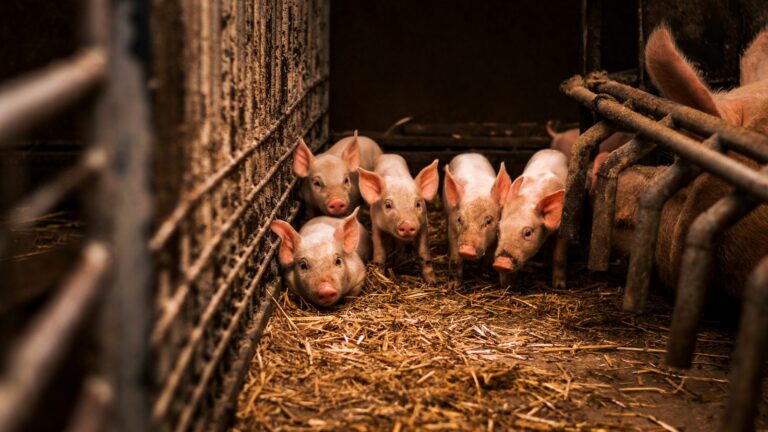
The most memorable number in Manitoba’s pitch is also one of the strongest examples of how intertwined Canadian and American agriculture has become. Manitoba ships more than three million young pigs to the United States each year, according to Manitoba Pork officials speaking at the fair. Roughly two million of them go directly to Iowa. Préjet summarized the commercial relationship bluntly: “They’re pulling them from us.” In other words, the animals are moving south because American producers have built operations around that supply, not because Manitoba is simply trying to unload surplus livestock.
That flow reflects a specialized North American production system developed over decades. Young pigs can be born and raised through their earliest stages in Canada before moving to American farms for finishing. USDA research describes finishing operations as farms that take feeder pigs and raise them to slaughter weight, typically using feed dominated by corn and soybean meal. Iowa has both the livestock infrastructure and enormous supplies of those crops. A pig crossing the border, therefore, can connect a Manitoba breeding operation with an Iowa feed supplier, trucking company, finishing barn and ultimately a processor. The border is one step in the production process rather than its beginning or end.
Why Iowa Pulls Young Pigs North to South
Iowa’s appetite for pigs becomes easier to understand when the scale of its livestock sector is considered. The U.S. Department of Agriculture reported that Iowa farms held about 24.7 million hogs and pigs on June 1, 2026, the largest inventory of any state. Minnesota was a distant second at 9.3 million. Iowa is not simply one participant in America’s pork business; it sits at the centre of it. U.S. trade data also put Iowa’s pork exports at approximately US$2.9 billion in 2024, ranking the state first nationally in that category.
Those numbers help explain why Canadian feeder pigs fit so naturally into Iowa’s economy. The state has abundant corn, soybean meal, specialized barns, veterinary services, transport networks and processing capacity. USDA data show Iowa is also a leading exporter of corn and soybeans, commodities that form the economic foundation of large-scale hog finishing. Manitoba, meanwhile, has developed substantial sow and young-pig production. The resulting relationship resembles a regional production network more than conventional imports and exports. When Manitoba officials emphasize the pigs Iowa buys, they are pointing to capacity that American farmers have already incorporated into their business models.
Canada Is Not a Side Market for Iowa
The argument becomes broader than pork once Iowa’s trade numbers are examined. Canada was Iowa’s largest foreign goods market in 2025, purchasing approximately US$4.9 billion in products. That represented about 30 per cent of all Iowa goods exports, according to the Office of the U.S. Trade Representative. Mexico ranked second at roughly US$3.2 billion. Iowa exported US$16.2 billion in goods worldwide that year, meaning nearly one dollar out of every three in state exports went to Canada.
Agriculture magnifies those ties. Iowa was the second-largest U.S. agricultural exporting state based on the latest USDA figures cited by USTR, with an estimated US$13.7 billion in agricultural exports during 2024. Pork, soybeans, corn and feed grains all ranked among its biggest categories. The relationship also runs northward: Canadian reporting from the fair put Iowa’s imports from Canada at about US$3.2 billion, including agricultural products and machinery used by local businesses. Nationally, the United States purchased more than 60 per cent of Canada’s agricultural exports in 2025. That level of integration means a trade dispute can create winners and losers on both sides at the same time.
The August 19 Tariff Deadline Changes the Stakes
The Canadian delegation arrived in Iowa with a deadline hanging over the broader relationship. President Donald Trump has ordered additional 50 per cent duties on a selection of Canadian products beginning at 12:01 a.m. Eastern time on August 19. The White House says the measures respond to Canadian policies involving areas such as automobiles, alcohol and dairy. The covered trade is worth nearly US$20 billion, or roughly 5.2 per cent of the goods the United States imported from Canada in 2025. Unlike several earlier measures, these duties can hit covered products even when they qualify for preferential treatment under CUSMA.
That does not mean the two million Manitoba pigs themselves are necessarily subject to the new 50 per cent tariff. The importance of the pork example is broader. Producers are demonstrating what happens when businesses spend years organizing production around relatively predictable cross-border access and suddenly have to plan around escalating tariffs and political deadlines. Canadian agriculture has escaped some of the harshest measures imposed on other sectors, but farmers have already confronted uncertainty over contracts, prices and future market access during the prolonged trade dispute. For businesses operating on thin agricultural margins, uncertainty itself carries a cost.
CUSMA’s Uncertain Renewal Is the Bigger Problem
Beyond the immediate tariff deadline lies a longer-term question: whether businesses can continue treating the North American market as a predictable production zone. CUSMA entered into force on July 1, 2020, with an initial term running to 2036 and a mandatory joint review six years later. Canada pushed for the agreement to be extended for another 16 years during the 2026 review. The Trump administration did not agree to that extension, triggering the mechanism under which the three countries can return for annual reviews until they reach consensus or the agreement ultimately expires in 2036.
Importantly, CUSMA has not disappeared. The Canadian government stresses that it remains fully in force. What has changed is the level of certainty surrounding its long-term future. That distinction matters for industries planning investments that last decades rather than months. A hog barn, processing facility, machinery plant or transportation network cannot be moved every time negotiating positions change. Manitoba Pork officials said agricultural groups they encountered in Iowa strongly supported continuation of the trade framework. Their concern is straightforward: integrated production becomes harder to finance and manage when companies cannot confidently predict the rules governing the next shipment, expansion or investment.
Canada Is Trying to Build Pressure Outside Washington
Canada’s Iowa strategy reflects a recognition that influence over U.S. trade policy does not exist only inside the White House or the Office of the U.S. Trade Representative. Manitoba’s delegation met state legislators, regulators, the Iowa agriculture establishment and representatives of organizations whose members directly feel changes in commodity prices and export demand. U.S. Trade Representative Jamieson Greer was also at the fair defending the administration’s tariff strategy, placing competing trade messages in front of some of the same politically important agricultural audiences.
The setting carries particular weight because Iowa farmers have already experienced the disruptive side of tariff retaliation. Fairgoers discussing trade with Canadian Press reporters pointed to the damage Chinese retaliation had done to soybean exports during earlier disputes. Yet some also admitted they knew surprisingly little about Iowa’s economic relationship with Canada. That knowledge gap is precisely what Manitoba is trying to close. A statistic such as US$4.9 billion in exports may be forgotten quickly. Two million pigs arriving each year is easier to visualize. It turns Canada from a foreign-policy subject into a customer and supplier tied to everyday farm operations.
What Farmers and Consumers Have at Risk
For producers, the immediate concern is not that trucks carrying pigs suddenly vanish. It is that tariffs, countermeasures and uncertainty gradually change the economics supporting those trucks. If additional costs are placed somewhere in a tightly connected supply chain, farmers, processors, transporters and retailers have to decide who absorbs them. Contracts may be rewritten, sourcing patterns can change and investment can be postponed. USDA research on hog production shows how specialized each stage has become, which means replacing an established supplier or production partner is not always as simple as buying the same product somewhere else.
The next test comes quickly. Canadian Trade Minister Dominic LeBlanc has been in Washington with chief negotiator Janice Charette as officials attempt to find an agreement before August 19. Reuters reported on August 14 that the two governments remained far apart on a draft arrangement, even after repeated high-level meetings. That leaves the Iowa outreach serving two purposes at once: defending an existing agricultural relationship and building American constituencies that may argue against further disruption. For Manitoba and Iowa, the two million pigs crossing south each year have become evidence of a larger reality—the border divides two countries, but many of their farms already operate inside the same economy.
This Options Discord Chat is The Real Deal
While the internet is scoured with trading chat rooms, many of which even charge upwards of thousands of dollars to join, this smaller options trading discord chatroom is the real deal and actually providing valuable trade setups, education, and community without the noise and spam of the larger more expensive rooms. With a incredibly low-cost monthly fee, Options Trading Club (click here to see their reviews) requires an application to join ensuring that every member is dedicated and serious about taking their trading to the next level. If you are looking for a change in your trading strategies, then click here to apply for a membership.